India commits to increased US imports in energy and technology
Source:Indian Express ↗
Why It Matters
The article is highly relevant for GS2 (International Relations) and GS3 (Economy), as it demonstrates how India employs economic diplomacy to navigate global trade protectionism. Understanding the trade deficit friction between India and the US, and how strategic imports (energy, defense, tech) are used to solidify bilateral ties, is crucial for analyzing India's foreign policy maneuvering in a multipolar world.
Summary
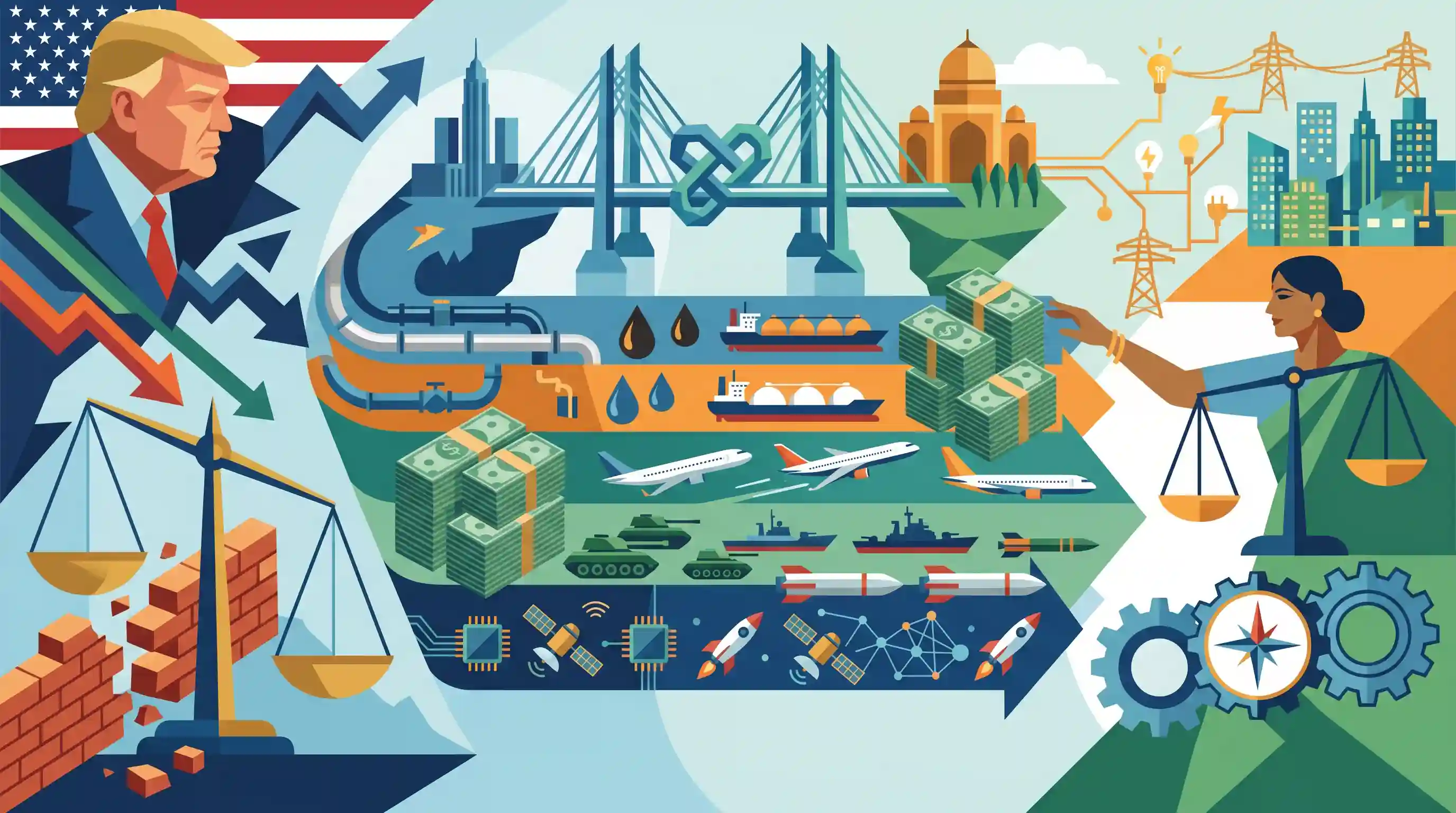
Under pressure from the incoming Trump administration's threats of reciprocal tariffs and a renewed focus on addressing trade deficits, India has reportedly committed to purchasing $100 billion per year in US imports over the next five years. This preemptive 'Buy American' pact aims to rebalance bilateral trade and secure massive tariff cuts or exemptions from the US. The planned surge in imports will be predominantly fueled by energy commodities (such as crude oil and LNG), commercial aircraft, defense equipment, and advanced technology. This arrangement reflects India's proactive economic diplomacy to navigate rising global protectionism, secure its energy supply lines, and deepen its strategic partnership with Washington.
Key Points
- India has reportedly committed to purchasing $100 billion per year in US imports over the next five years to address the bilateral trade deficit.
- The import surge will be strategically dominated by energy resources (crude oil, natural gas), commercial aircraft parts, and advanced technology.
- This preemptive 'Buy American' pact is designed to shield India from the punitive reciprocal tariffs threatened by the incoming Trump administration.
- The strategy underscores India's proactive economic diplomacy, aiming to secure massive tariff cuts and potentially lay the groundwork for restoring GSP status or negotiating an FTA.
Important Terms
Generalized System of Preferences (GSP)

A US trade program providing non-reciprocal duty-free entry for thousands of products from designated developing countries to support their economic growth.
UPSC context
GS-II/GS-III; tests knowledge of international trade instruments and major friction points in Indo-US economic relations.
Reciprocal Tariffs
A trade policy where a country imposes import duties on another nation at rates matching those that the other nation levies on its own exports.
UPSC context
GS-II (International Relations); relevant for questions on global protectionism, trade wars, and US-India bilateral trade negotiations.
Trade Deficit
An economic condition where the value of a country's imports exceeds its exports; a key driver of US pressure on India to rebalance trade.
UPSC context
GS-III (Economy); fundamental concept for understanding bilateral trade friction and balance of payments.
Economic Diplomacy
The use of a country's economic resources and trade commitments as a tool to achieve strategic foreign policy objectives and national interests.
UPSC context
GS-II (IR); tests India's proactive strategy in navigating global geoeconomic shifts and strategic partnerships.
Liquefied Natural Gas (LNG)
Natural gas cooled to a liquid state for easier transport; a primary commodity in India's strategy to increase US imports and ensure energy security.
UPSC context
GS-III (Energy Security); tests knowledge of India's energy mix diversification and import-dependency management.
Buy American Pact
The 2026 Indo-US arrangement where India committed to purchase $500 billion in US goods over five years to secure tariff exemptions.
UPSC context
GS-II; specific term for the 2026 trade framework used to navigate the 'Trump 2.0' trade agenda.
Prelims Trap
The Generalized System of Preferences (GSP) is a bilateral, reciprocal trade agreement ensuring mutual tariff exemptions.
GSP is fundamentally non-reciprocal. Instituted under UNCTAD, it allows developed nations to grant unilateral tariff concessions to developing countries without demanding mutual market access in return.
Static Concepts Connected
What is the Generalized System of Preferences (GSP) under the WTO framework?
- Non-reciprocal basis: It is a unilateral, non-reciprocal preferential tariff system granted by developed countries to developing countries.
- Enabling Clause: It operates as a legal exception to the WTO's Most-Favored-Nation (MFN) principle, authorized under the 1979 Enabling Clause.
- UNCTAD origin: It was established under the auspices of UNCTAD in 1971 to promote export-led industrialization in developing nations.
How does India's global trade balance contrast with its US bilateral trade?
- Global deficit: India maintains a massive overall global merchandise trade deficit, heavily driven by oil and electronics imports.
- US surplus: The US is one of the few major economies where India consistently enjoys a large trade surplus, creating friction with protectionist US administrations.
Cross-Topic Patterns
Energy imports as diplomatic leverage
India's shift towards importing US crude and LNG offsets its heavy reliance on Middle Eastern and Russian oil, doubling as a geopolitical buffer against potential future US sanctions risks.
High-tech trade and iCET alignment
Sourcing advanced technology and defense equipment from the US directly complements the Initiative on Critical and Emerging Technology (iCET), intertwining trade concessions with strategic defense modernization.

Bilateral trade surplus mechanics with the US + GSP restoration conditions are prime targets for a multi-statement Economy question.
Linked PYQs · 5
Linked PYQs · 5
- 2019MainsGS2
‘What introduces friction into the ties between India and the United States is that Washington is still unable to find for India a position in its global strategy, which would satisfy India's national self-esteem and ambitions.’ Explain with suitable examples.
- 2018MainsGS2
What are the key areas of reform if the WTO has to survive in the present context of "Trade War', especially keeping in mind the interest of India?
- 2018MainsGS3
How would the recent phenomena of protectionism and currency manipulations in world trade affect macroeconomic stability of India?
- 2012MainsGS2
Discuss the likely negative impact of the protectionist measures proposed by the US on India's software industry.
- 2024PrelimsGS1
Consider the following statements : Statement-I : India does not import apples from the United States of America. Statement-II : In India, the law prohibits the import of Genetically Modified food without the approval of the competent authority. Which one of the following is correct in respect of the above statements ?
