India-US Bilateral Trade Agreement Terms Finalised by USTR
Source:The Hindu ↗
Why It Matters
Understanding the evolving India-US trade dynamics is crucial for GS2 International Relations and GS3 Economy. The article provides vital statistics on tariff disparities and trade deficits, illustrating the shift from multilateralism to bilateralism and protectionism in global trade policy.
Summary
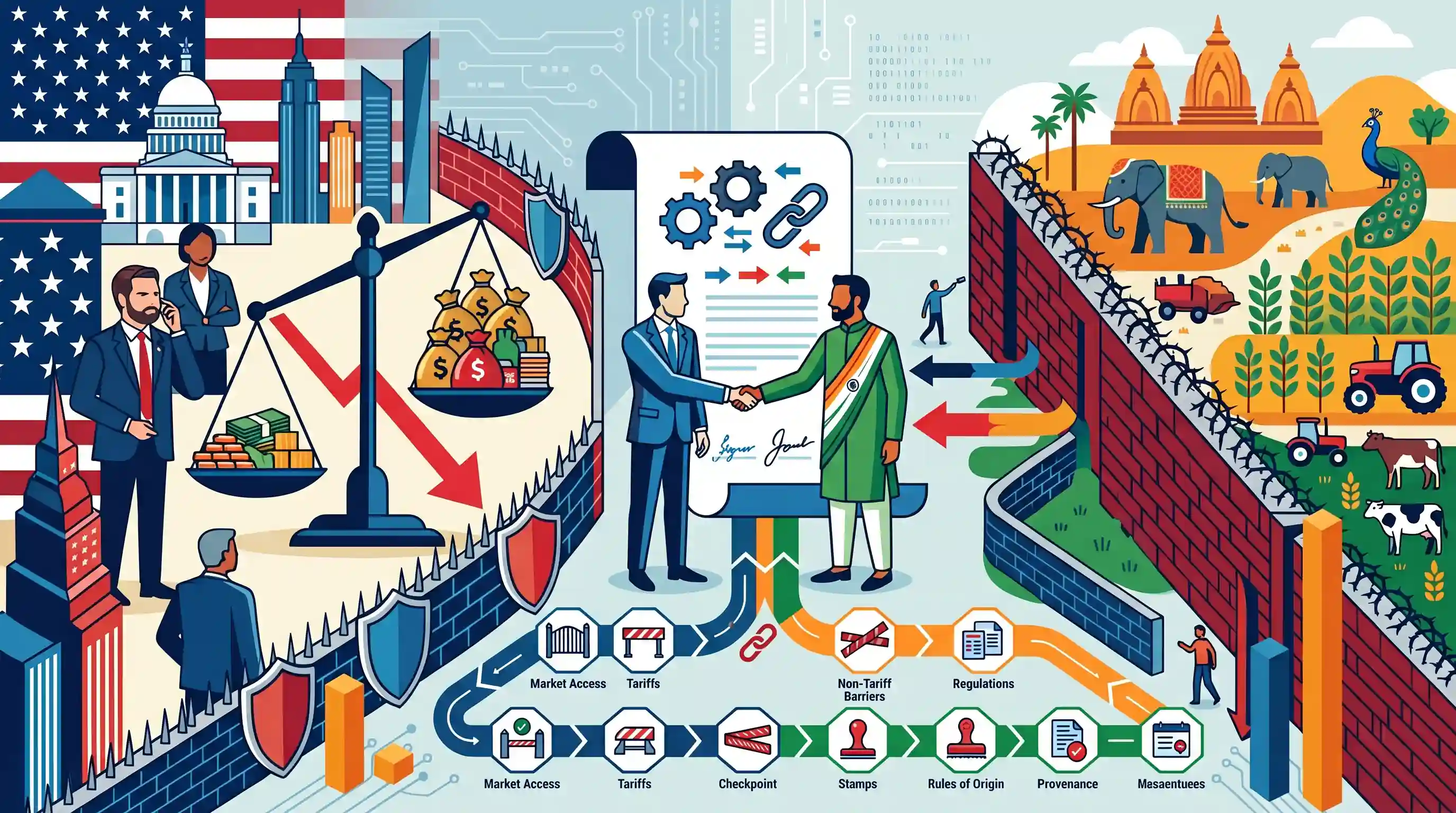
India and the United States have finalised the Terms of Reference (ToR) for a proposed Bilateral Trade Agreement (BTA), marking a significant step in bilateral economic relations. Announced during US Vice President J.D. Vance's visit to New Delhi, the agreement aims to address what the US Trade Representative terms a "serious lack of reciprocity." The US is particularly concerned about its $45.7 billion trade deficit with India in 2024 and India's significantly higher average applied tariffs (17% overall, 39% in agriculture) compared to the US (3.3% overall). The upcoming negotiations will cover 19 chapters, focusing on market access, tariffs, non-tariff barriers, and rules of origin, occurring against a backdrop of increasing US trade protectionism.
Key Points
- India and the US have finalised the Terms of Reference (ToR) for a proposed Bilateral Trade Agreement (BTA) during US Vice President J.D. Vance\'s visit to New Delhi.
- The US Trade Representative (USTR) noted a "serious lack of reciprocity" in the current trade relationship, pointing out India\'s average applied tariff of 17% (39% in agriculture) compared to the US\'s 3.3% (5% in agriculture).
- The US aims to address its $45.7 billion trade deficit with India (2024) by seeking greater market access and reducing non-tariff barriers.
- The proposed agreement will cover approximately 19 chapters, encompassing tariffs, non-tariff barriers, rules of origin, and customs facilitation.
- This development aligns with the US administration\'s recent protectionist measures, including reciprocal tariffs on countries maintaining large trade surpluses with the US.
Important Terms
Bilateral Trade Agreement (BTA)

An economic treaty between two nations intended to reduce trade barriers, eliminate tariffs, and promote economic cooperation by setting specific terms for the exchange of goods and services.
UPSC context
GS Paper 2 & 3: Tests understanding of bilateral economic diplomacy, market access, and compliance with WTO's 'Most Favored Nation' (MFN) principle.
United States Trade Representative (USTR)
The executive agency of the U.S. government responsible for developing trade policy, conducting negotiations, and enforcing trade laws like Section 301 to address foreign trade barriers.
UPSC context
GS Paper 2: Crucial for analyzing India-U.S. trade friction, including intellectual property rights (Special 301) and 'reciprocal' tariff investigations.
Non-Tariff Barriers (NTB)
Regulatory or procedural measures—such as quotas, licensing, and technical standards—other than direct customs tariffs, used by governments to restrict imports or protect domestic industries.
UPSC context
GS Paper 3: Tests knowledge of 'hidden protectionism' and its impact on India’s agricultural and manufacturing exports in developed markets.
Rules of Origin
Criteria used in trade agreements to determine the national source of a product, ensuring that only goods genuinely produced in member countries receive preferential tariff treatment.
UPSC context
GS Paper 3: Essential for understanding Free Trade Agreements (FTAs) and preventing 'trade deflection' where third countries route exports through partner nations.
Trade Deficit
An economic condition where the value of a country's imports exceeds its exports; often a primary point of contention in trade negotiations with surplus nations.
UPSC context
GS Paper 3: Relevant for Balance of Payments (BoP) analysis, currency depreciation, and its role as a driver for protectionist trade policies.
Terms of Reference (ToR)
A formal document that defines the purpose, scope, and procedural framework for a negotiation, ensuring both parties agree on what issues will be addressed.
UPSC context
GS Paper 2: Tests awareness of the procedural stages in international treaty-making and the diplomatic architecture of bilateral negotiations.
Prelims Trap
"India's 'applied tariffs' represent the legally binding maximum ceiling rates committed under the World Trade Organization."
Aspirants often confuse applied tariffs with bound tariffs. 'Bound tariffs' are the WTO maximum ceilings, while 'applied tariffs' are the actual (usually lower) rates levied by customs at the border.
Static Concepts Connected
What is the difference between Bound, Applied, and Reciprocal tariffs?
- Bound Tariffs: The absolute maximum ceiling rate a WTO member has legally committed not to exceed for a specific product category.
- Applied Tariffs: The actual tariff rate currently levied by a country's customs at the border, which must be equal to or lower than the bound rate.
- Reciprocal Tariffs: Retaliatory or balancing tariffs levied by one nation to exactly match the import duty rates imposed by a trading partner.
What are Rules of Origin (RoO) in free trade agreements?
- Definition: Criteria used by customs authorities to determine the true "economic nationality" of a manufactured product.
- Purpose: They prevent "trade deflection," where a third country routes goods through an FTA partner nation merely to claim duty-free access.
- India's Mechanism: India enforces strict RoO scrutiny through CAROTAR 2020 to ensure minimum value addition happens in the partner country.
Cross-Topic Patterns
Rules of Origin + Chinese routing
The US insistence on strict Rules of Origin in the BTA mirrors India's own CAROTAR 2020 rules, which were explicitly designed to stop Chinese goods bypassing tariffs via ASEAN or UAE FTAs.
Strategic convergence vs Economic friction
While India and the US converge strategically via Quad and iCET initiatives, their economic track increasingly diverges due to reciprocal trade protectionism and friction over India's high agricultural tariffs.

Expect a 2026 prelims question testing the difference between Bound vs Applied tariffs, alongside WTO exceptions for bilateral FTAs.
Linked PYQs · 2
Linked PYQs · 2
- 2025MainsGS3
What are the challenges before the Indian economy when the world is moving away from free trade and multilateralism to protectionism and bilateralism? How can these challenges be met?
- 2020MainsGS2
What is the significance of Indo-US defence deals over Indo-Russian defence deals? Discuss with reference to stability in the Indo-Pacific region.
