Bilateral Defense Technology Transfers and Structural Bottlenecks
Source:The Hindu ↗
Why It Matters
This analysis is critical for both GS Paper II (Bilateral Relations/International Relations) and GS Paper III (Internal Security/Defense Indigenization). It helps aspirants look past superficial diplomatic announcements to understand the structural, legislative, and institutional bottlenecks that prevent strategic defense agreements from materializing on the ground.
Summary
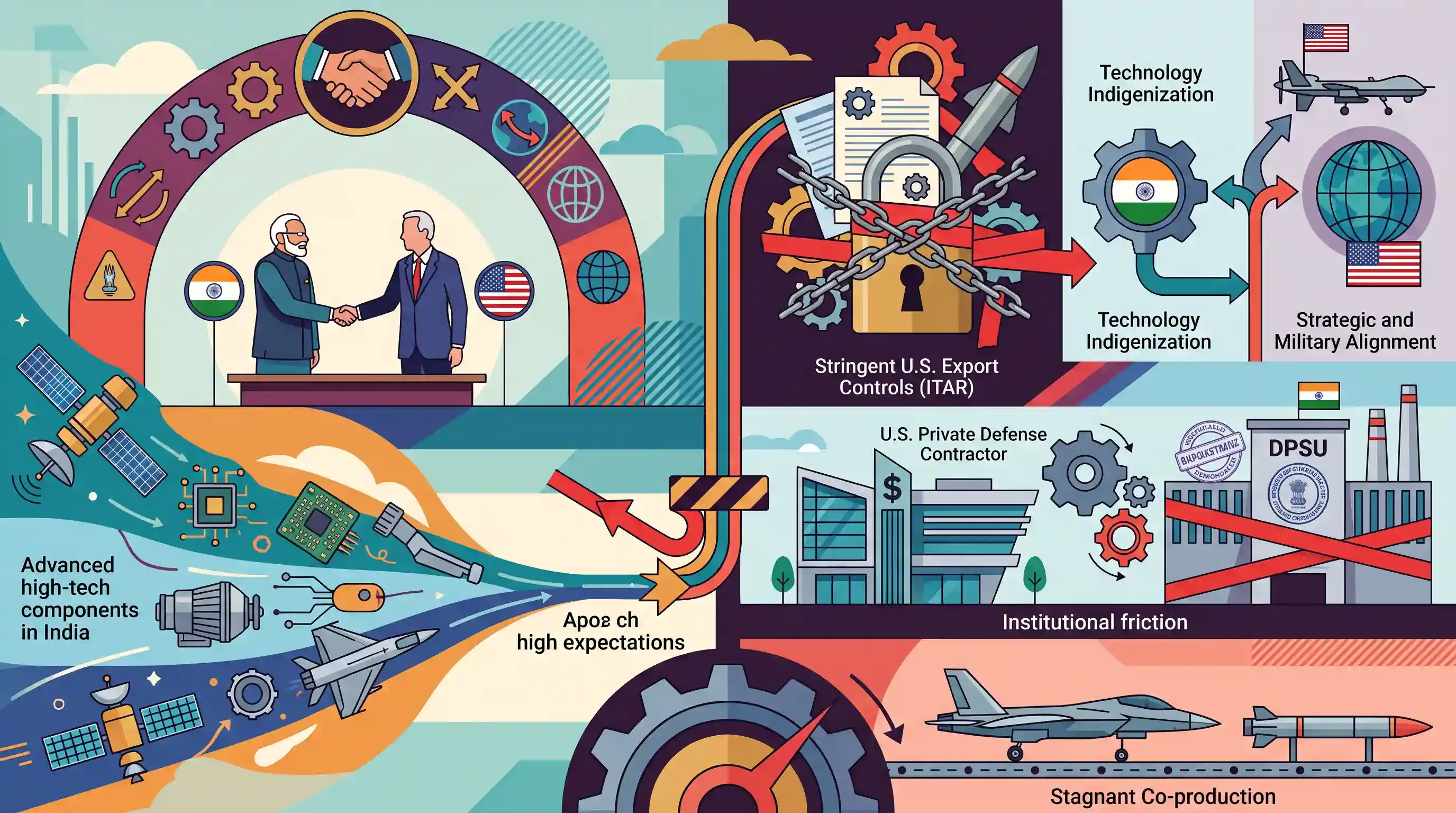
This article critically examines the friction between high-profile bilateral rhetoric and the actual delivery of defense technology under India-U.S. cooperation. Despite landmark frameworks like the Defense Technology and Trade Initiative (DTTI), the Initiative on Critical and Emerging Technology (iCET), and INDUS-X, deep technology-sharing and co-production remain stagnant. The persistent roadblocks include stringent U.S. export control laws (such as ITAR), divergent expectations (India seeks technology indigenization, while the U.S. seeks strategic and military alignment), and institutional friction between private-led U.S. defense contractors and state-led Indian defense public sector undertakings (DPSUs).
Key Points
- The strategic partnership between India and the U.S. features high diplomatic ambitions but has faced significant bottlenecks in actual defense technology transfers, co-development, and co-production.
- Initiatives like the Defense Technology and Trade Initiative (DTTI) launched in 2012, and newer frameworks like iCET and INDUS-X, have struggled to bypass bureaucratic hurdles, often delivering low-tech projects rather than high-end strategic transfers.
- U.S. export controls, primarily the International Traffic in Arms Regulations (ITAR) and Export Administration Regulations (EAR), act as legal and bureaucratic barriers to transferring critical military source codes and proprietary intellectual property.
- A fundamental misalignment of expectations exists: India seeks unrestricted 'know-how' and 'know-why' to foster defense self-reliance ('Atmanirbhar Bharat') and reduce its dependence on Russia; whereas the U.S. views technology transfer as an incentive for closer strategic integration and alignment, which conflicts with India's policy of strategic autonomy.
- The structural divergence between the two nations' defense ecosystems—namely the private-sector-led commercial model of the U.S. versus India's public-sector-dominated defense industry (DPSUs)—creates friction in joint manufacturing and commercial supply chain integration.
- If these technology-sharing hurdles remain unresolved, India is likely to continue looking towards alternative partners like France (which offers technology with fewer regulatory caveats) and maintaining legacy defense ties with Russia.
Important Terms
Initiative on Critical and Emerging Technology (iCET)

A bilateral framework launched in January 2023 by India and the U.S. to expand strategic technology partnership, co-production, and co-development across sectors like AI, semiconductors, space, and defense.
UPSC context
GS Paper II (Bilateral Relations/Agreements). Essential for questions on Indo-U.S. strategic partnerships and technology transfers.
India-U.S. Defense Acceleration Ecosystem (INDUS-X)
A defense innovation bridge launched in June 2023 under iCET, connecting startups, academia, and industry of both nations to foster joint research, development, and co-production of military technologies.
UPSC context
GS Paper II (Bilateral Relations) and Paper III (Security). Relevant for testing defense technology collaborations.
Defense Technology and Trade Initiative (DTTI)
A flexible mechanism launched in 2012 by India and the U.S. to bypass bureaucratic red tape, promote collaborative technology exchange, and enable co-production and co-development of defense systems.
UPSC context
GS Paper II (International Relations). Tests knowledge of historical frameworks trying to shift India-U.S. ties beyond simple buyer-seller dynamics.
International Traffic in Arms Regulations (ITAR)
A set of stringent U.S. export control regulations governing the transfer and export of defense articles, military technologies, and technical data to foreign countries.
UPSC context
GS Paper II (Bilateral Relations/Agreements). Key for explaining regulatory and legal bottlenecks in India-U.S. defense technology sharing.
COMCASA
A foundational defense agreement signed in 2018 allowing the U.S. to transfer proprietary encrypted communication systems to India, enhancing military interoperability and secure networks.
UPSC context
GS Paper II (Bilateral Relations) and Paper III (Security). Tests understanding of the operationalization of India-U.S. defense cooperation.
LEMOA
A foundational defense agreement signed in 2016 enabling the militaries of India and the U.S. to use each other's bases and ports for logistics, replenishment, and repair services.
UPSC context
GS Paper II (Bilateral Relations) and Paper III (Security). Key for analyzing logistics sharing and maritime cooperation in the Indo-Pacific.
BECA
A foundational defense agreement signed in 2020 that facilitates the sharing of classified geospatial intelligence, satellite maps, and real-time navigation/targeting data between India and the U.S.
UPSC context
GS Paper II (Bilateral Agreements) and Paper III (Security). Crucial for questions on satellite intelligence and military strategic alignment.
Atmanirbhar Bharat
A nationwide mission ("Self-reliant India") to boost domestic manufacturing, reduce import dependency, and indigenize strategic areas, particularly defense production, research, and development.
UPSC context
GS Paper III (Defense Indigenization/Economy). Essential for discussing policy reforms targeting domestic manufacturing and technological sovereignty.
Prelims Trap
India’s STA-1 status and Major Defence Partner designation exempt it from ITAR licensing requirements for critical military hardware.
STA-1 relaxes dual-use EAR regulations under the Commerce Department, but has no jurisdiction over the State Department’s strict ITAR restrictions on military source codes.
Static Concepts Connected
What are the four foundational defense agreements signed between India and the United States?
- LEMOA (2016): Governs reciprocal logistics support, permitting refueling and replenishment of military assets during port visits and joint exercises.
- COMCASA (2018): Facilitates secure, encrypted communications and real-time operational data-sharing between the armed forces of both nations.
- BECA (2020): Enables exchange of high-accuracy geospatial intelligence, topographic, and aeronautical data to enhance weapon target coordination.
How do ITAR and EAR differ in the US export control framework?
- ITAR jurisdiction: Administered by the Department of State; strictly regulates military-grade defense articles, services, and technical data.
- EAR jurisdiction: Administered by the Department of Commerce; governs "dual-use" technologies that have both commercial and military applications.
- End-use monitoring: Prevents foreign entities from re-exporting, modifying, or transferring intellectual property without prior US federal authorization.
Cross-Topic Patterns
Interoperability vs. Strategic Autonomy
US defense transfers expect operational alignment, whereas India’s doctrine of strategic autonomy relies on diversified hardware from Russia and France, creating a fundamental friction in bilateral trust.
Defense indigenization and startup ecosystems
Linking INDUS-X and India's iDEX highlights a shift from DPSU-led manufacturing to private-sector defense startups, accelerating domestic R&D under Atmanirbhar Bharat.

2026 Mains will likely contrast India's demand for 'know-why' technology transfer with US ITAR regulatory barriers under iCET.
Linked PYQs · 2
Linked PYQs · 2
- 2020MainsGS2
What is the significance of Indo-US defence deals over Indo-Russian defence deals? Discuss with reference to stability in the Indo-Pacific region.
- 2026PrelimsGS1
Which of the following items of defence hardware is/are manufactured in India ? 1. Su-30 MKI Fighter Jets 2. T-90 MK-III Tanks 3. Akula Class Submarine Select the answer using the code given below :
