United States Approves Defense Sale of Javelin Missiles
Source:Indian Express ↗
Why It Matters
This defense deal is crucial for understanding the evolving India-US strategic partnership, specifically in terms of defense modernization, capability building, and maintaining deterrence in the regional security landscape.
Summary
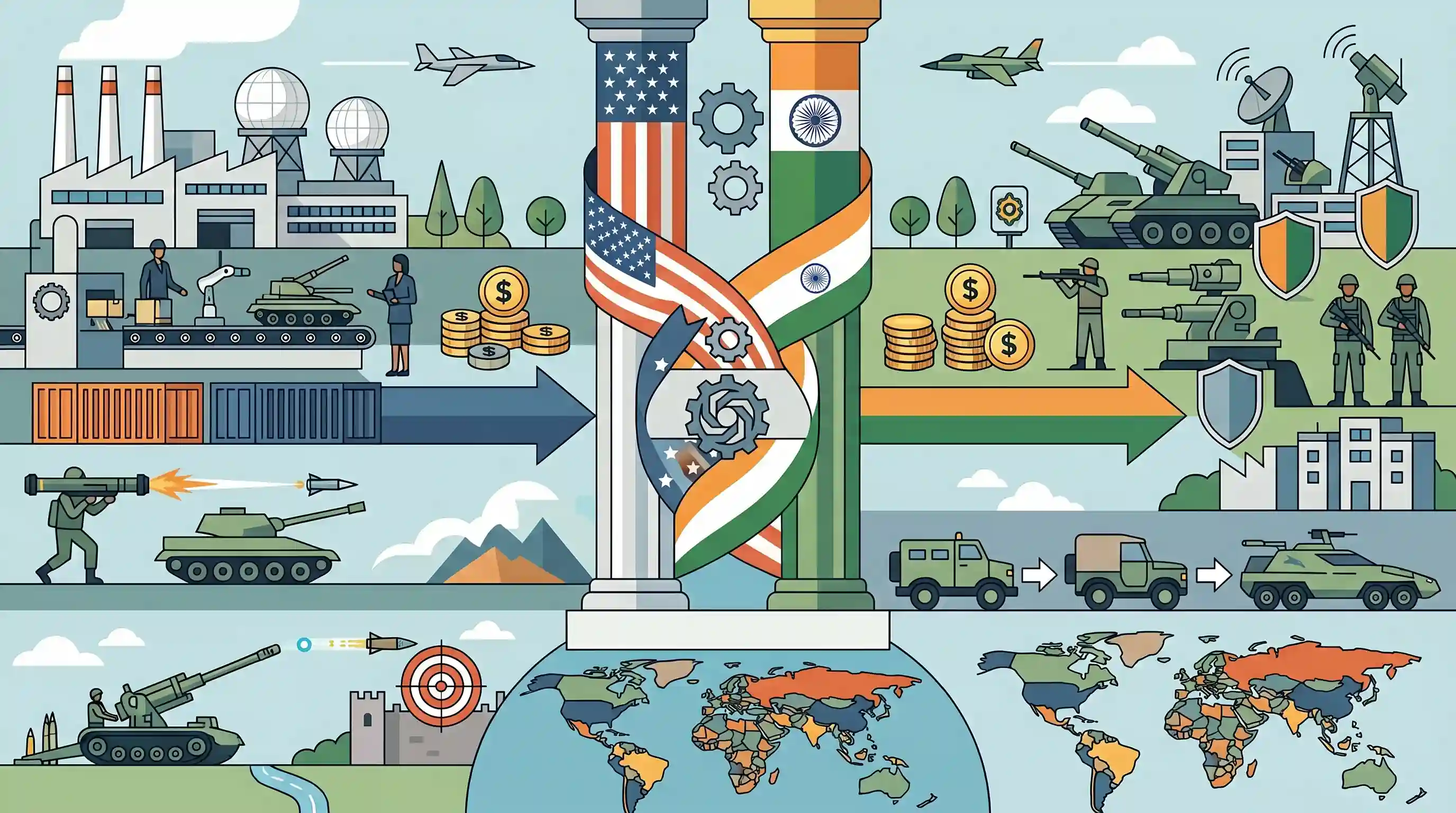
The United States has approved a potential $93 million military sale to India, including the supply of Javelin anti-tank missiles and Excalibur tactical projectiles. The US Defense Security Cooperation Agency (DSCA) notified Congress of the sale, which comprises $45.7 million for the FGM-148 Javelin Missile System and $47.1 million for the M982A1 Excalibur artillery. The acquisition aims to enhance India's capability to counter current and future threats, improve first-strike accuracy, and deepen the US-India strategic relationship while maintaining the regional military balance.
Key Points
- The US approved a potential $93 million sale of military equipment to India, further deepening defense cooperation between the two nations.
- The deal includes the $45.7 million purchase of 100 FGM-148 Javelin rounds, 25 Command Launch Units, and related lifecycle support.
- An additional $47.1 million was approved for 216 M982A1 Excalibur tactical projectiles and ancillary systems.
- The US Defense Security Cooperation Agency (DSCA) noted the deal will enhance India's capability to deter regional threats and improve its first-strike accuracy, without altering the basic military balance.
Important Terms
FGM-148 Javelin Missiles

A US-made man-portable, "fire-and-forget" anti-tank guided missile (ATGM). It uses an infrared seeker to track and strike armored vehicles automatically after launch, allowing operators to immediately take cover.
UPSC context
GS Paper III: Security/Defense. Tests knowledge of infantry modernization and high-altitude warfare capabilities against armored threats on contested borders.
M982A1 Excalibur tactical projectiles
A GPS-guided 155mm extended-range artillery shell capable of precision strikes within two meters of a target. It reduces collateral damage and is compatible with India's M777 and Bofors howitzers.
UPSC context
GS Paper III: Defense Technology. Relevant for precision-strike capabilities and logistic efficiency in stretched conflict zones like Ladakh.
Defense Security Cooperation Agency (DSCA)
A US Department of Defense agency that manages international military transfers. It notifies the US Congress of potential sales and provides technical and financial assistance to foreign partners.
UPSC context
GS Paper II: International Relations. Represents the institutional mechanism governing India-US defense trade and military-to-military cooperation.
Foreign Military Sales (FMS)
A US government program for selling defense equipment, services, and training to foreign governments. Unlike commercial sales, these are government-to-government agreements managed by the Department of Defense.
UPSC context
GS Paper II/III: Bilateral Relations/Procurement. The primary legal channel for India's high-end strategic acquisitions from the United States.
Major Defense Partnership (MDP)
A unique designation granted to India by the US in 2016, allowing for technology sharing and defense cooperation on par with America’s closest allies and NATO partners.
UPSC context
GS Paper II: International Relations. The foundational framework enabling expedited high-tech military deals and deeper strategic convergence in the Indo-Pacific.
Prelims Trap
"India's Major Defense Partner status makes it a formal treaty ally of the US."
India is a 'Major Defense Partner' (a unique legislative designation) with STA-1 status, but it remains strictly non-aligned. It is not a formal treaty ally (like NATO members).
Static Concepts Connected
How do 3rd-generation Anti-Tank Guided Missiles (ATGMs) differ from earlier generations?
- 1st/2nd Gen ATGMs: They require the operator to actively guide the missile to the target via a wire or laser after firing, exposing the operator.
- 3rd Gen ATGMs: They utilize advanced "fire-and-forget" technology (like infrared seekers), allowing the operator to launch and immediately relocate for safety.
- Top-Attack Mode: Modern ATGMs are engineered to strike the thinner, vulnerable upper armor of a tank rather than the heavily fortified front or sides.
What are the four foundational defense agreements signed between India and the US?
- GSOMIA: General Security of Military Information Agreement (2002) allows the sharing of classified military intelligence and safeguards shared information.
- LEMOA: Logistics Exchange Memorandum of Agreement (2016) enables both militaries to access each other's bases for refueling, supplies, and repairs.
- COMCASA: Communications Compatibility and Security Agreement (2018) permits the transfer of highly secure encrypted US communication equipment to India.
- BECA: Basic Exchange and Cooperation Agreement (2020) allows the sharing of high-end geospatial intelligence, military maps, and satellite data.
Cross-Topic Patterns
Defense diversification away from Russia
Acquiring US Javelins alongside Israeli Spikes and indigenous NAG missiles highlights India's multi-alignment procurement strategy to mitigate defense supply chain risks tied to the Russia-Ukraine war.
BECA synergy with precision artillery
The Excalibur artillery's GPS-guided precision relies on accurate geospatial data, demonstrating the operational significance of the 2020 US-India BECA agreement for geospatial intelligence sharing.

Expect a Prelims 'match-the-following' pairing modern defense platforms (Javelin, MQ-9B, S-400, Spike) with their specific tech profiles.
Linked PYQs · 2
Linked PYQs · 2
- 2020MainsGS2
What is the significance of Indo-US defence deals over Indo-Russian defence deals? Discuss with reference to stability in the Indo-Pacific region.
- 2023MainsGS2
‘The expansion and strengthening of NATO and a stronger US-Europe strategic partnership works well for India.’ What is your opinion about this statement ? Give reasons and examples to support your answer.
