Renewal of India-US Ten-Year Defence Framework Agreement
Source:Indian Express ↗
Why It Matters
The renewal of the India-US 10-year defence framework agreement marks a critical milestone in bilateral security architecture, affecting regional stability, technology transfer, and counter-balancing dynamics in the Indo-Pacific.
Summary
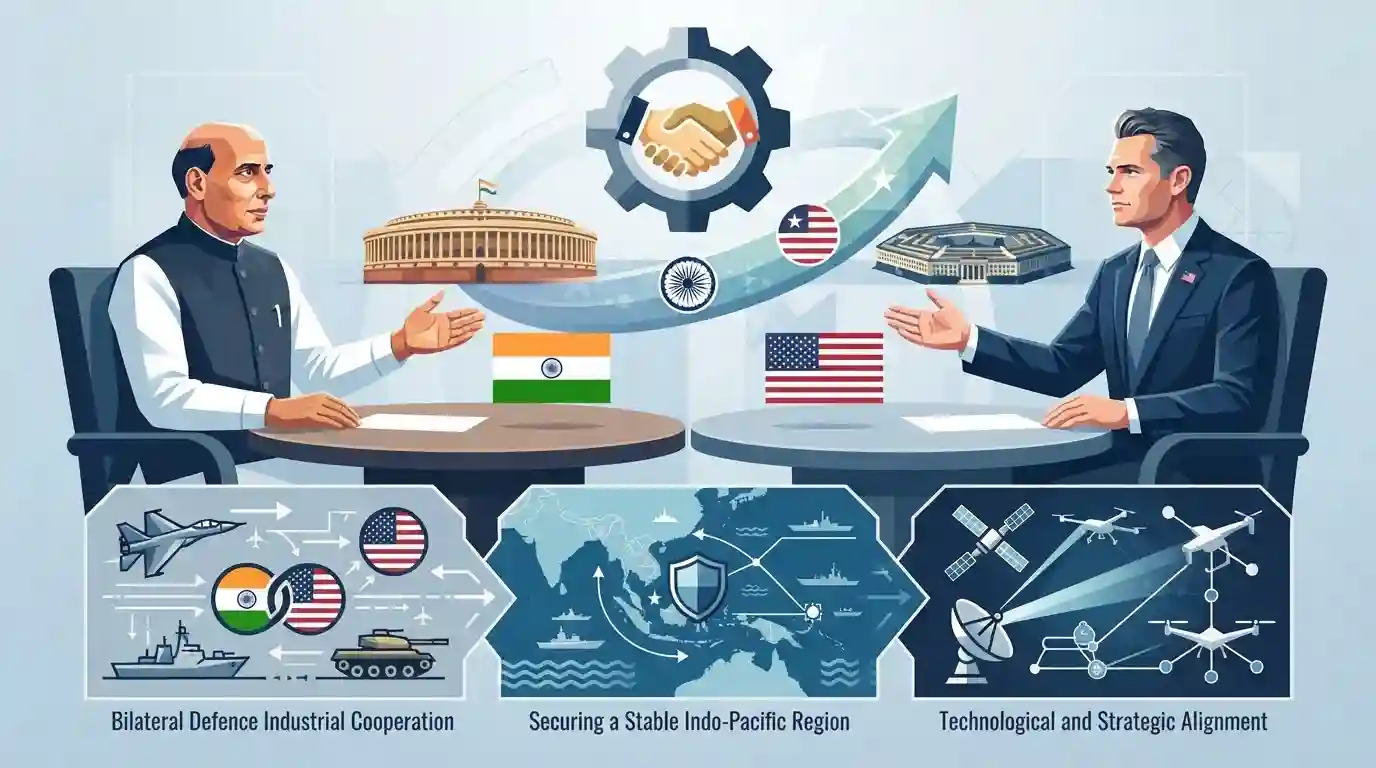
Indian Defence Minister Rajnath Singh and US Defense Secretary Pete Hegseth engaged in high-level talks focusing on the renewal of the 10-year defence framework pact, enhancing bilateral defence industrial cooperation, and securing a stable Indo-Pacific region through technological and strategic alignment.
Key Points
- India and the United States are working on renewing their 10-year defence framework pact to deepen strategic and military cooperation.
- US Defense Secretary Pete Hegseth and Indian Defence Minister Rajnath Singh discussed expanding technological co-development, co-production, and supply chain resiliency.
- The partnership highlights a shared vision for a free, open, and secure Indo-Pacific region amid evolving geopolitical challenges.
- Emphasis is laid on institutionalizing foundational agreements and expanding defense industrial cooperation through initiatives like INDUS-X.
Important Terms
10-Year Defence Framework Pact

A renewable bilateral strategic pact signed between India and the US to guide military coordination, joint technology development, and regional security in the Indo-Pacific for a decade.
UPSC context
UPSC GS Paper II: Bilateral, regional and global groupings and agreements involving India and/or affecting India's interests.
Major Defense Partnership
A unique legal designation granted to India by the US in 2016, placing it on par with America’s closest allies for defense trade, technology transfer, and industrial collaboration.
UPSC context
UPSC GS Paper II: Effect of policies and politics of developed and developing countries on India's interests.
US Department of Defense
The executive department of the US federal government charged with coordinating and supervising all agencies and functions of the government directly related to national security and the US Armed Forces.
UPSC context
UPSC GS Paper II: Important International institutions, agencies and fora - structure and mandate.
Static Concepts Connected
What are the foundational defense agreements signed between India and the United States?
- GSOMIA: GSOMIA signed in 2002 allows sharing of military intelligence and classified information securely.
- LEMOA: LEMOA signed in 2016 permits reciprocal use of logistics, supplies, and services at each other's military bases.
- COMCASA: COMCASA signed in 2018 facilitates transfer of encrypted communication equipment and sensitive tactical data.
- BECA: BECA signed in 2020 enables sharing of geospatial intelligence, maps, and high-end navigation data for precision targeting.
Cross-Topic Patterns
Defense Trade + Make in India + WTO
INDUS-X and foundational pacts link bilateral defense trade directly to the Make in India initiative and WTO government procurement exemption rules.
Indo-Pacific Security + Minilateralism (Quad/AUKUS)
The Indo-Pacific security architecture underpins both bilateral US-India frameworks and minilateral plurilateral groupings like the Quad and AUKUS tech pillar.

Expect a multi-statement match question pairing India-US foundational defense pacts (LEMOA, COMCASA, BECA) with their specific functional domains.
Linked PYQs · 1
Linked PYQs · 1
- 2020MainsGS2
What is the significance of Indo-US defence deals over Indo-Russian defence deals? Discuss with reference to stability in the Indo-Pacific region.
