Rajasthan Assembly Witnesses Protest Over Trade Deal
Source:The Hindu ↗
Why It Matters
The event is a pertinent example of how domestic political dynamics intersect with foreign policy and international trade agreements. It is relevant for understanding the socio-economic concerns (like agriculture) that influence bilateral ties, as well as the practical challenges of maintaining decorum in state legislative bodies.
Summary
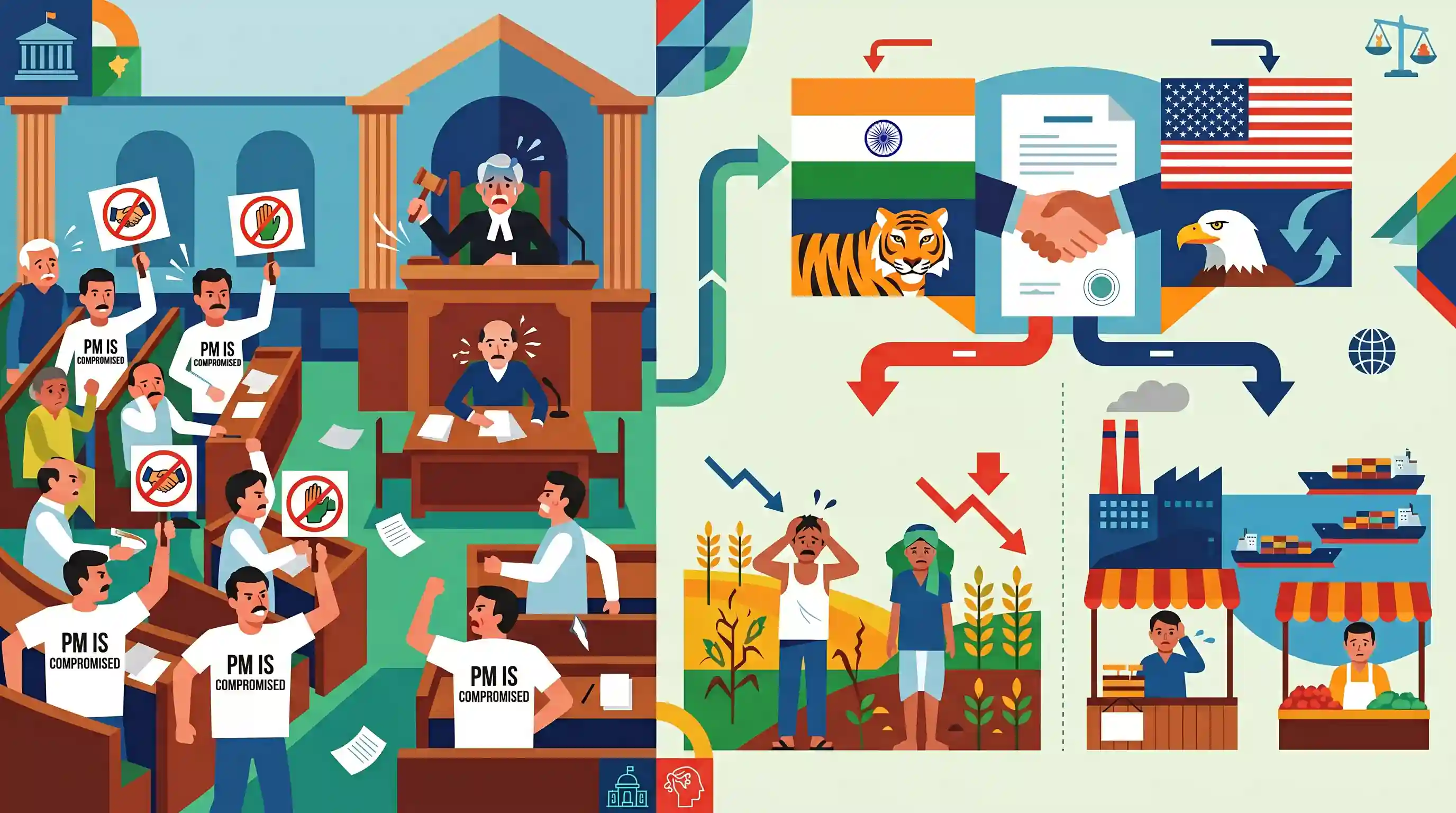
Rajasthan Congress MLAs staged a protest in the State Assembly wearing 'PM is compromised' T-shirts to oppose the India-U.S. trade deal. They alleged the agreement would adversely impact Indian farmers and small traders. The protest not only highlighted domestic political concerns over international trade agreements and their effect on the agriculture sector but also disrupted the functioning of the legislative assembly, raising questions about legislative decorum.
Key Points
- Rajasthan Congress MLAs protested against a recent India-U.S. trade deal during the State Assembly session.
- The MLAs wore T-shirts with the slogan 'PM is compromised', leading to disruptions in the assembly's functioning.
- Opposition leaders alleged that the trade agreement would severely harm Indian farmers and small traders.
- The protest underscores the ongoing debate over the impact of international trade deals and protectionist measures on domestic sectors.
- The incident highlights challenges related to maintaining decorum and order in State Legislative Assemblies during political protests.
Important Terms
India-U.S. Interim Trade Agreement

A 2026 pact where India reduced tariffs on U.S. industrial/agricultural goods (like soybean oil) in exchange for the U.S. lowering tariffs on Indian exports to 18%.
UPSC context
GS Paper II (International Relations); tests understanding of bilateral trade diplomacy, tariff negotiations, and the impact of foreign policy on domestic sectors.
State Legislative Assembly (Vidhan Sabha)
The directly elected lower house of a state legislature (Articles 168–212), functioning as the primary body for regional legislation and holding the state executive accountable.
UPSC context
GS Paper II (Polity); central to topics on the structure and functioning of State Legislatures and federalism.
Legislative Decorum
The code of conduct and procedural rules followed by members during House proceedings to maintain the dignity, order, and effective functioning of the legislature.
UPSC context
GS Paper II (Polity); relevant to the conduct of business and the role of the Speaker in managing House disruptions.
Legislative Privileges (Article 194)
Constitutional immunities under Article 194 that protect MLAs' freedom of speech and actions within the House from legal liability to ensure independent functioning.
UPSC context
GS Paper II (Polity); tests knowledge of the rights and immunities of legislators and their limitations.
U.S. Agricultural Subsidies
Financial assistance provided by the U.S. government to its farmers, which Indian critics argue allows American produce to unfairly undercut local prices in the Indian market.
UPSC context
GS Paper III (Economy/Agriculture); examines issues of global trade fairness, WTO compliance, and domestic food security.
Prelims Trap
International treaties affecting subjects on the State List require ratification by at least half of the State Legislatures.
Article 253 grants Parliament exclusive and overriding power to implement international treaties, even if the subject (like agriculture) falls entirely under the State List. State ratification is not required.
Static Concepts Connected
How does Article 253 govern international treaties affecting State List subjects?
- Absolute Override: Parliament can legislate on any subject, including those strictly on the State List, to implement international agreements, treaties, or conventions.
- No State Veto: States have no constitutional authority to block or ratify international trade deals, even if they heavily impact State List subjects like Agriculture (Entry 14).
- Executive Dominance: The Union Executive negotiates and signs international treaties under Article 73 without needing prior legislative approval from Parliament or State Assemblies.
What are the Speaker's powers against disorderly conduct in State Assemblies?
- Rules of Procedure: Speakers enforce decorum using the assembly's Rules of Procedure, which explicitly prohibit displaying placards, shouting, or wearing disruptive protest apparel in the House.
- Naming and Suspension: A Speaker can direct a member to withdraw immediately or name a member for grossly disorderly conduct, which can trigger a motion for suspension.
Cross-Topic Patterns
Sub-national friction in Foreign Policy
While international trade is a Union subject, local political economies (agriculture, fisheries) often trigger state-level opposition, echoing past federal tensions over the Teesta water pact and Sri Lankan Tamil issues.
FTAs vs. Domestic Food Security
Developed nations frequently demand relaxed agricultural tariffs in FTAs. This clashes with India's defensive trade stance, aimed at protecting marginal farmers and maintaining sovereign food security.

Friction between FTAs (Union list) and agriculture (State list) under Article 253 is prime for a 2026 Mains GS2 or Prelims question.
Linked PYQs · 3
Linked PYQs · 3
- 2023MainsGS2
Discuss the role of Presiding Officers of state legislatures in maintaining order and impartiality in conducting legislative work and in facilitating best democratic practices.
- 2018MainsGS3
How would the recent phenomena of protectionism and currency manipulations in world trade affect macroeconomic stability of India?
- 2012MainsGS2
Discuss the likely negative impact of the protectionist measures proposed by the US on India's software industry.
