Indian Farmer Organizations Raise Concerns Over Bilateral Trade Deal
Source:Indian Express ↗
Why It Matters
Trade agreements are critical to India's economic growth, but they frequently clash with the interests of the domestic agricultural sector, which employs nearly half the workforce. Understanding this dynamic is crucial for answering questions on farm subsidies, WTO negotiations, and the impact of bilateralism on Indian agriculture in GS-3.
Summary
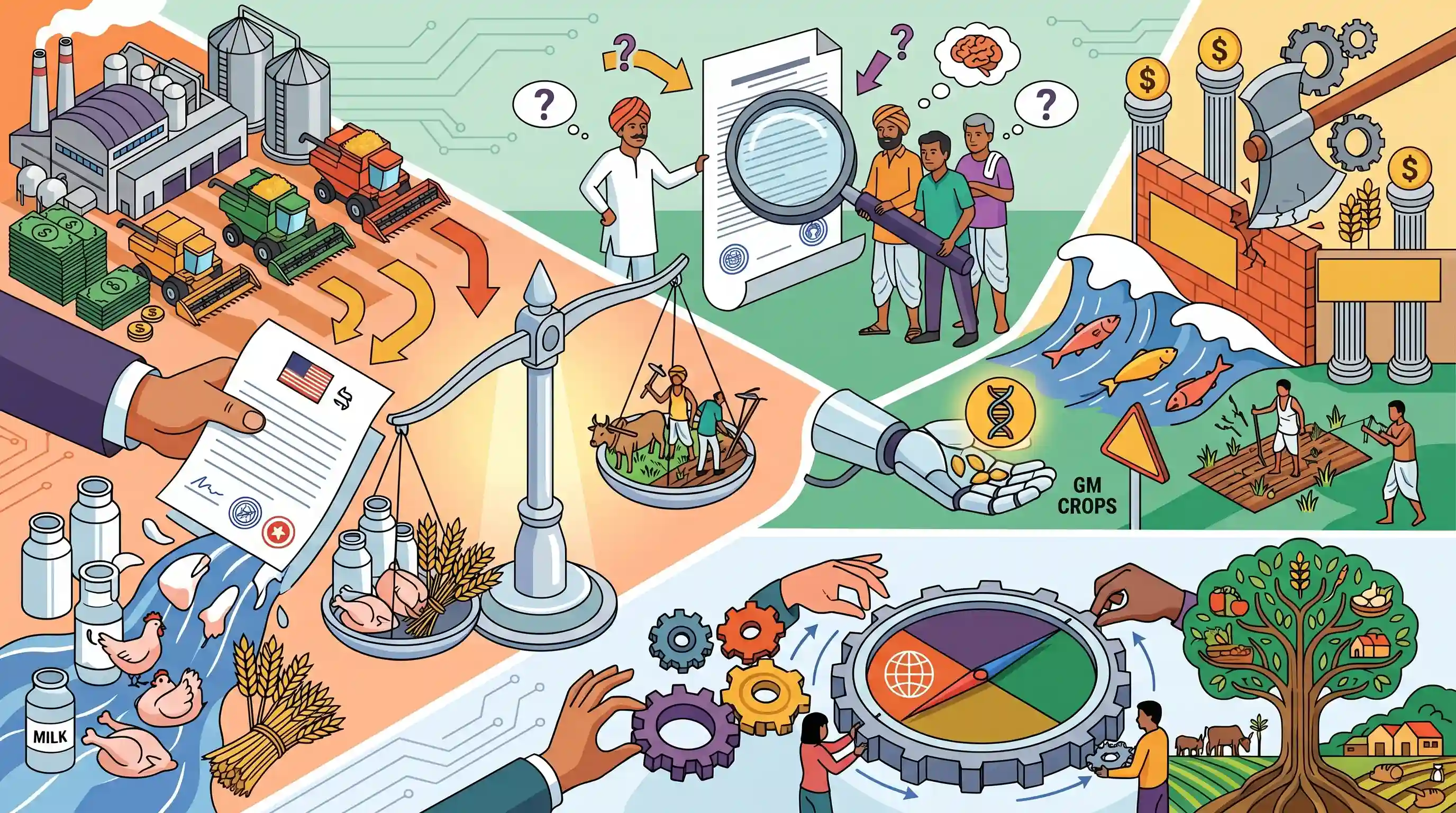
Indian farmer unions are demanding transparency over a prospective India-US bilateral trade deal, warning that potential agricultural concessions could severely impact domestic farmers. Organizations fear that opening Indian markets to heavily subsidized American agribusiness—particularly in sectors like dairy, poultry, and wheat—will create unfair competition for small and marginal Indian farmers. Furthermore, there are anxieties regarding the entry of Genetically Modified (GM) crops and the potential undermining of domestic support frameworks such as the Minimum Support Price (MSP). The situation underscores the complex challenge of balancing international bilateral trade negotiations with domestic food security and rural livelihoods.
Key Points
- Farmer unions in India have expressed serious concerns over potential agricultural concessions in recent India-US trade negotiations, demanding that the government release the "fine print" of the deal.
- Primary fears revolve around the influx of highly subsidized agricultural products from the US, such as dairy, poultry, and fruits, which could undercut prices for domestic smallholder farmers.
- There are also deep-seated apprehensions regarding the potential backdoor entry of Genetically Modified (GM) crops and patented American seeds, compromising agricultural sovereignty.
- The protests highlight the constant friction between international trade commitments (pushing for lower import tariffs and market access) and domestic food security needs (safeguarding MSP and providing farmer subsidies).
Important Terms
WTO Agreement on Agriculture (AoA)

A multilateral treaty governing global trade in agricultural products. It focuses on three pillars: market access, domestic support (subsidies), and export competition to ensure fair trade.
UPSC context
GS Paper II (International Relations) & III (Economy); tests knowledge of global trade rules and food security.
Samyukt Kisan Morcha (SKM)
An umbrella coalition of over 40 Indian farmer unions formed in 2020. It acts as a major pressure group, advocating for farmers' rights, MSP, and agricultural sovereignty.
UPSC context
GS Paper II (Pressure Groups); relevant for questions on civil society's role in policy-making.
Genetically Modified (GM) Crops
Plants whose DNA has been altered using genetic engineering to enhance traits like pest resistance. In India, only GM cotton is approved for commercial cultivation.
UPSC context
GS Paper III (S&T and Agriculture); tests understanding of biosafety, biotechnology, and food security.
Minimum Support Price (MSP)
A floor price set by the Indian government to purchase crops from farmers, ensuring they recover production costs and earn a profit margin (typically 50%).
UPSC context
GS Paper III (Agriculture); essential for questions on domestic farm policy and trade distortions.
Aggregate Measure of Support (AMS)
The total value of trade-distorting domestic support provided by a government to its agricultural producers, calculated under WTO rules to limit unfair competition.
UPSC context
GS Paper III (WTO Issues); a technical concept frequently appearing in Mains questions on subsidies.
Bilateral Trade Agreement
A trade pact between two nations to reduce or eliminate tariffs and trade barriers on specific goods or services, often as a precursor to a Free Trade Agreement.
UPSC context
GS Paper II (Bilateral Relations); tests understanding of economic diplomacy and trade liberalization.
Prelims Trap
"India's Minimum Support Price (MSP) is classified under the Green Box and is exempt from WTO reduction commitments."
MSP falls under the trade-distorting 'Amber Box' and is subject to the 10% de minimis limit. India relies on the temporary 'Peace Clause' to protect its public stockholding programs.
Static Concepts Connected
How are agricultural subsidies classified under the WTO Agreement on Agriculture (AoA)?
- Green Box: Subsidies causing minimal or no trade distortion (e.g., R&D, infrastructure). They are exempt from reduction commitments and heavily utilized by developed nations.
- Amber Box: Trade-distorting subsidies like Minimum Support Price (MSP). Capped at a 10% 'de minimis' limit of the total agricultural production value for developing nations.
- Blue Box: Essentially Amber Box subsidies but tied to programs that require farmers to limit production. They are currently exempt from reduction limits.
Who regulates the commercial release of Genetically Modified (GM) crops in India?
- Statutory Body: The Genetic Engineering Appraisal Committee (GEAC), functioning under the Ministry of Environment, Forest and Climate Change (MoEFCC).
- Legal Backing: Constituted under the Hazardous Microorganisms Rules of 1989, framed under the Environment (Protection) Act, 1986.
- Core Mandate: Responsible for environmental appraisal of activities involving large-scale use of hazardous microorganisms and the approval of GM crops for commercial release.
Cross-Topic Patterns
FTAs and Agricultural Protectionism
The resistance to US agricultural concessions perfectly mirrors India's 2019 RCEP withdrawal, highlighting the recurring clash between trade liberalization and safeguarding India's 85% smallholder farmer base.
SPS Measures as Trade Shields
India strategically utilizes stringent Sanitary and Phytosanitary (SPS) conditions, like the mandatory "vegetarian feed" certification for dairy, acting as non-tariff barriers to block heavily subsidized foreign imports.

Expect a multi-statement Prelims question linking WTO's Amber Box limits, the Peace Clause, and India's SPS barriers on US agricultural imports.
Linked PYQs · 4
Linked PYQs · 4
- 2023MainsGS3
What are the direct and indirect subsidies provided to farm sector in India? Discuss the issues raised by the World Trade Organization (WTO) in relation to agricultural subsidies.
- 2025MainsGS3
What are the challenges before the Indian economy when the world is moving away from free trade and multilateralism to protectionism and bilateralism? How can these challenges be met?
- 2015PrelimsGS1
The terms 'Agreement on Agriculture', 'Agreement on the Application of Sanitary and Phytosanitary Measures' and 'Peace Clause' appear in the news frequently in the context of the affairs of the
- 2017MainsGS3
How do subsidies affect the cropping pattern, crop diversity and economy of farmers? What is the significance of crop insurance, minimum support price and food processing for small and marginal farmers?
