Indian farmer bodies express concerns over bilateral trade pact
Source:Indian Express ↗
Why It Matters
The topic is crucial for UPSC as it bridges International Relations (bilateral trade pacts) with the core GS3 issue of Agricultural Economy. It tests the aspirant's understanding of how global trade mechanisms (WTO, FTAs) can directly influence domestic policies, Minimum Support Prices (MSP), and the socio-economic security of small and marginal farmers.
Summary
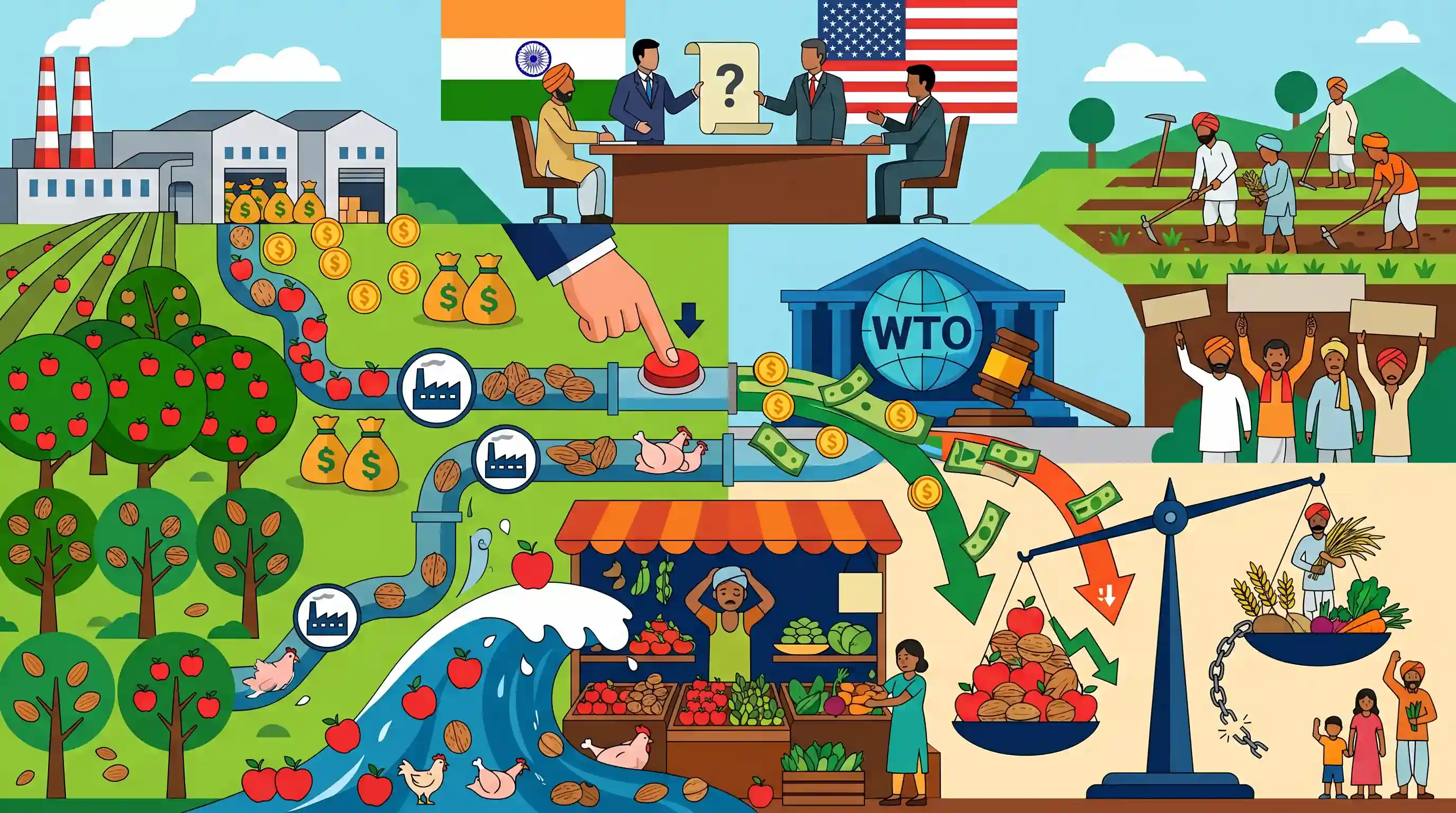
Farmer bodies in India have raised significant concerns over recent India-US trade deals, specifically regarding potential agreements on agricultural imports. They are demanding that the government release the 'fine print' of these negotiations, expressing fears that lowered tariffs on US products—such as apples, walnuts, almonds, and poultry—will result in Indian markets being flooded with cheaper, subsidized foreign goods. This influx threatens to undercut domestic prices, severely impacting the livelihoods of Indian farmers. The issue underscores the ongoing tension between bilateral trade diplomacy and domestic agricultural security.
Key Points
- Farmer unions have demanded transparency regarding the 'fine print' of recent India-US agricultural trade negotiations, fearing negative impacts on domestic agriculture.
- The primary concern centers on the removal or reduction of import tariffs on US agricultural products (such as apples, walnuts, and poultry).
- Farmers fear that exposing domestic markets to heavily subsidized, cheap US agricultural imports will severely undercut local prices and ruin their livelihoods.
- The situation highlights the complex trade-off between securing strategic bilateral relationships/trade dispute resolutions and safeguarding the interests of domestic smallholder farmers.
Important Terms
WTO Agreement on Agriculture (AoA)

A 1995 WTO treaty focusing on reducing trade-distorting subsidies, improving market access, and limiting export competition in the global agricultural sector.
UPSC context
GS Paper 3: Agriculture/Economy. Tests understanding of global trade frameworks and their impact on domestic food security.
Amber Box Subsidies
Trade-distorting domestic supports (such as MSP) that influence production and prices, subject to reduction commitments under WTO rules.
UPSC context
GS Paper 3: Subsidies. Crucial for analyzing international trade disputes and India's agricultural policy space.
Samyukta Kisan Morcha (SKM)
An umbrella body of Indian farmer unions that coordinates collective action and protests against policies perceived as harmful to agricultural livelihoods.
UPSC context
GS Paper 2: Pressure Groups. Relates to the role of civil society and organized interest groups in governance.
Peace Clause (WTO)
A WTO mechanism allowing developing countries to provide domestic support for public food stockholding even if it exceeds agreed-upon subsidy limits.
UPSC context
GS Paper 3: Food Security. Important for discussing the sustainability of India's MSP and PDS systems.
India-US Bilateral Trade Agreement (BTA)
A proposed multi-sector trade pact aiming to resolve bilateral disputes and increase trade volume, often involving sensitive negotiations over agricultural market access.
UPSC context
GS Paper 2: IR. Tests knowledge of bilateral relations and global trade diplomacy.
Minimum Support Price (MSP)
The floor price at which the government ensures a minimum profit for farmers, protecting them from market volatility and price crashes.
UPSC context
GS Paper 3: Agriculture. A fundamental topic for issues of farm distress and government intervention.
Prelims Trap
"Developing countries have a 5% de minimis limit for agricultural subsidies under WTO, while developed countries have a 10% limit."
UPSC often swaps limits. Under the WTO AoA, developed nations (like the US) are capped at 5% for Amber Box subsidies, while developing nations (like India) receive a 10% limit.
Static Concepts Connected
How are agricultural subsidies classified under the WTO Agreement on Agriculture (AoA)?
- Amber Box: Trade-distorting subsidies, like MSP and fertilizer support. They are capped at de minimis limits (5% of production value for developed nations, 10% for developing).
- Blue Box: Amber Box subsidies that are accompanied by conditions requiring farmers to limit production. There are currently no limits on these subsidies.
- Green Box: Non-trade-distorting support, such as agricultural R&D, environmental programs, and disaster relief. These are entirely exempt from reduction commitments.
What trade defense tools are used to protect domestic agriculture during bilateral FTAs?
- Negative List: A specific list of sensitive items (like dairy, poultry, or staple cereals) deliberately excluded from mutual tariff reductions to shield local livelihoods.
- Tariff Rate Quotas: A two-tiered system allowing a fixed volume of imports at a concessional tariff rate, but applying steep safeguard duties on any imports exceeding that quota.
Cross-Topic Patterns
WTO Peace Clause & Domestic MSP
US pressure to open Indian agriculture heavily contrasts with India's reliance on the WTO Peace Clause to shield its MSP-based public stockholding from global trade disputes.
GSP Revocation & Retaliatory Tariffs
The current tariff reduction debate directly traces back to the 2019 US withdrawal of India's Generalized System of Preferences (GSP) status, which triggered retaliatory duties on US apples and walnuts.

Expect a 2026 Prelims question linking bilateral agricultural tariff reductions (TRQs) directly to WTO subsidy boxes and the Peace Clause.
Linked PYQs · 3
Linked PYQs · 3
- 2023MainsGS3
What are the direct and indirect subsidies provided to farm sector in India? Discuss the issues raised by the World Trade Organization (WTO) in relation to agricultural subsidies.
- 2017MainsGS3
How do subsidies affect the cropping pattern, crop diversity and economy of farmers? What is the significance of crop insurance, minimum support price and food processing for small and marginal farmers?
- 2015PrelimsGS1
The terms 'Agreement on Agriculture', 'Agreement on the Application of Sanitary and Phytosanitary Measures' and 'Peace Clause' appear in the news frequently in the context of the affairs of the
