Farmer Bodies Demand Fine Print of India US Trade Deal
Source:Indian Express ↗
Why It Matters
This issue highlights the complex interplay between foreign trade policy and domestic agricultural protection. It is critical for UPSC aspirants to understand how bilateral trade negotiations impact the primary sector, the role of pressure groups (farmer bodies) in shaping policy, and the ongoing disputes over agricultural subsidies at multilateral forums like the WTO.
Summary
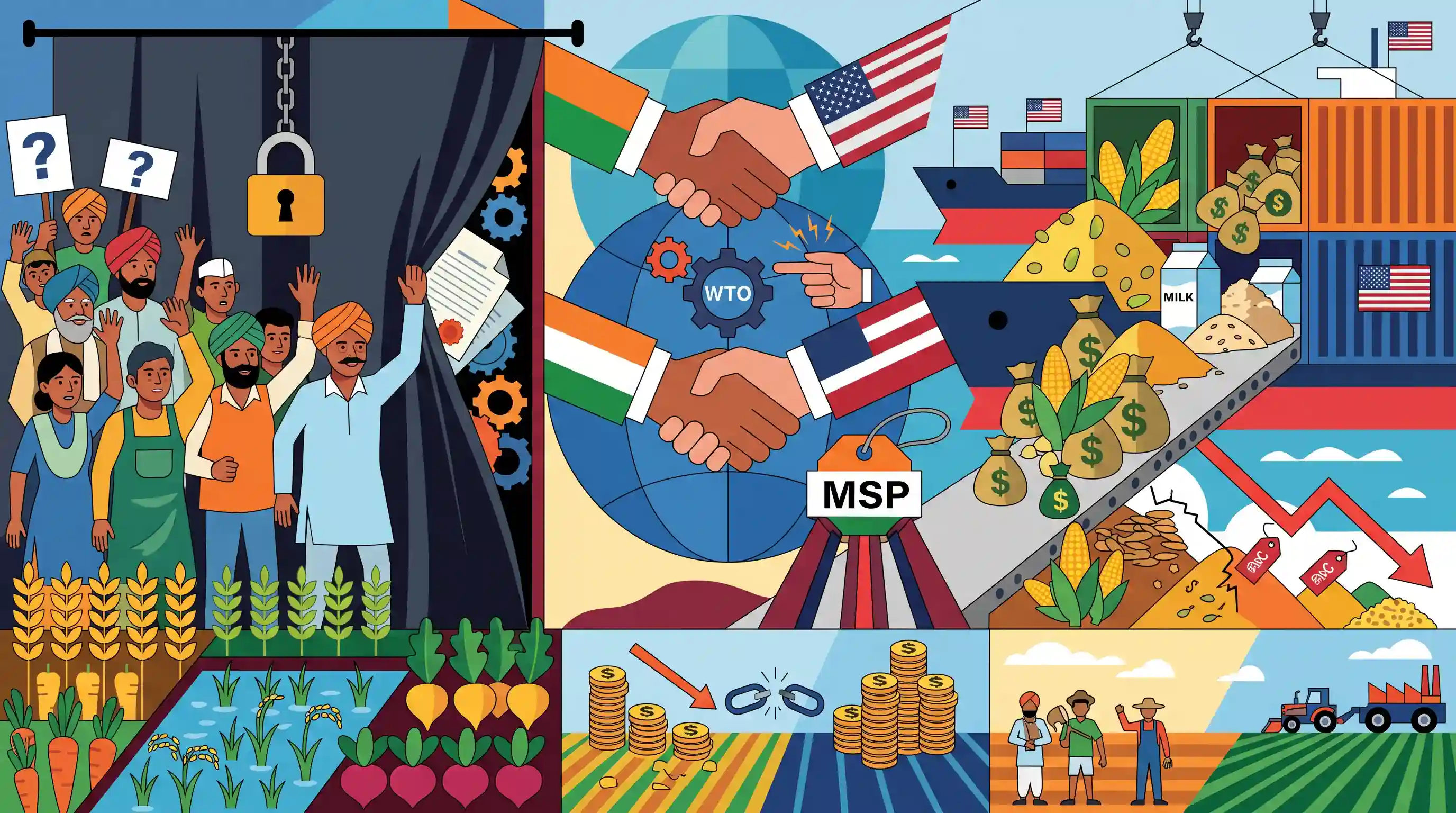
Farmer organizations in India have mobilized against a proposed India-US trade deal, demanding that the government release the agreement's 'fine print' to ensure transparency. The farmer bodies have raised alarms about the deal's potential repercussions on the domestic agricultural sector. Key apprehensions include the prospect of opening Indian markets to highly subsidized and cheaper US agricultural imports, which could severely depress local crop prices and harm smallholder farmers. Furthermore, there is widespread anxiety that the agreement may mandate compromises on India's Minimum Support Price (MSP) and broader agricultural subsidy frameworks—areas where the US has historically pressured India at the World Trade Organization (WTO). The protests reflect the ongoing tension between pursuing deeper bilateral trade partnerships and protecting domestic food security and rural livelihoods.
Key Points
- Farmer organizations are strongly opposing a proposed India-US trade deal, demanding full transparency and the release of the agreement's 'fine print'.
- The primary concern is the potential influx of cheaper American agricultural products (such as dairy, poultry, and specific crops), which could undermine domestic prices and threaten the livelihoods of Indian farmers.
- Farmers also apprehend that the deal may compromise India's agricultural subsidies and Minimum Support Price (MSP) regime, which have been consistent points of friction between the US and India at the WTO.
- There are additional fears regarding potential clauses related to Intellectual Property Rights (IPR) on seeds and the market entry of Genetically Modified (GM) crops.
- The protests underscore the significant challenge policymakers face in balancing strategic global trade integration with the need to protect vulnerable domestic sectors like agriculture.
Important Terms
India-US Interim Trade Agreement

A proposed bilateral pact aimed at reducing tariffs and easing market access. Negotiations often stall over sensitive sectors like dairy and agriculture due to India's protective domestic policies.
UPSC context
GS Paper 2: Bilateral Agreements; GS Paper 3: Effects of Liberalization on Economy and Trade Policy.
Minimum Support Price (MSP)
The floor price at which the Indian government procures crops from farmers to ensure price stability. It is often challenged at the WTO as a trade-distorting subsidy.
UPSC context
GS Paper 3: Issues related to direct/indirect farm subsidies and PDS objectives.
Agreement on Agriculture (AoA)
A WTO treaty regulating domestic subsidies, market access, and export competition. It aims to reduce trade-distorting support while allowing exemptions for food security.
UPSC context
GS Paper 3: WTO agreements and their implications for Indian agriculture and food security.
Amber Box Subsidies
A category of domestic support in the WTO considered trade-distorting (e.g., MSP). Developing countries must limit these to 10% of their total agricultural production value.
UPSC context
GS Paper 3: Subsidies and economic trade regulations under international bodies.
Bali Peace Clause
A WTO provision allowing developing nations to exceed subsidy limits for public stockholding of food grains without legal challenge, provided they meet specific transparency conditions.
UPSC context
GS Paper 3: Food security, buffer stocks, and international trade negotiations.
Samyukt Kisan Morcha (SKM)
An umbrella coalition of over 40 farmers' unions in India. It leads major protests and advocates for legal MSP guarantees and protection from unfavorable trade deals.
UPSC context
GS Paper 2: Pressure groups and formal/informal associations and their role in the Polity.
Prelims Trap
The WTO Peace Clause grants India permanent exemption from the 10% de minimis limit on all agricultural subsidies.
The Peace Clause is strictly an interim arrangement limited to public stockholding for food security purposes. It is not a permanent, blanket exemption for all subsidies.
Static Concepts Connected
What are the three main subsidy boxes under the WTO Agreement on Agriculture?
- Amber Box: Trade-distorting subsidies, like MSP and fertilizer support. Capped at a 10% de minimis limit of total agricultural production value for developing nations.
- Blue Box: Subsidies tied to production-limiting programs. These are considered less trade-distorting and are currently exempt from WTO reduction commitments.
- Green Box: Non-trade distorting support like agricultural R&D, pest control, and direct income transfers decoupled from production levels. These have no spending limits.
How does India balance WTO TRIPS obligations with seed sovereignty?
- Patent Exclusion: Section 3(j) of the Indian Patents Act explicitly prohibits the patenting of plants, seeds, and plant varieties.
- PPV&FR Act: India uses a sui generis system via the Protection of Plant Varieties and Farmers' Rights Act, 2001, complying with WTO TRIPS without adopting strict US-style patents.
- Farmers' Rights: Farmers are legally entitled to save, sow, exchange, and sell seeds of protected varieties, provided they do not sell them as branded, packaged seeds.
Cross-Topic Patterns
Dairy vulnerability in FTAs (RCEP parallel)
India's resistance to US dairy and poultry access mirrors its 2019 withdrawal from RCEP, which was heavily driven by fears of cheap imports from New Zealand devastating domestic smallholder cooperatives.
GEAC vs. Market Access for GM Crops
Bilateral trade negotiations frequently target domestic biosafety barriers. The US push for GM corn/soybean access directly tests the regulatory autonomy of India's Genetic Engineering Appraisal Committee (GEAC).

Expect a 2026 Prelims question linking the PPV&FR Act's 'seed sovereignty' rights with WTO TRIPS compliance and FTA pressures.
Linked PYQs · 4
Linked PYQs · 4
- 2023MainsGS3
What are the direct and indirect subsidies provided to farm sector in India? Discuss the issues raised by the World Trade Organization (WTO) in relation to agricultural subsidies.
- 2018MainsGS2
What are the key areas of reform if the WTO has to survive in the present context of "Trade War', especially keeping in mind the interest of India?
- 2016MainsGS2
The broader aims and objectives of WTO are to manage and promote international trade in the era of globalization. But the Doha round of negotiations seem doomed due to differences between the developed and the developing countries." Discuss in the Indian perspective.
- 2017MainsGS3
How do subsidies affect the cropping pattern, crop diversity and economy of farmers? What is the significance of crop insurance, minimum support price and food processing for small and marginal farmers?
