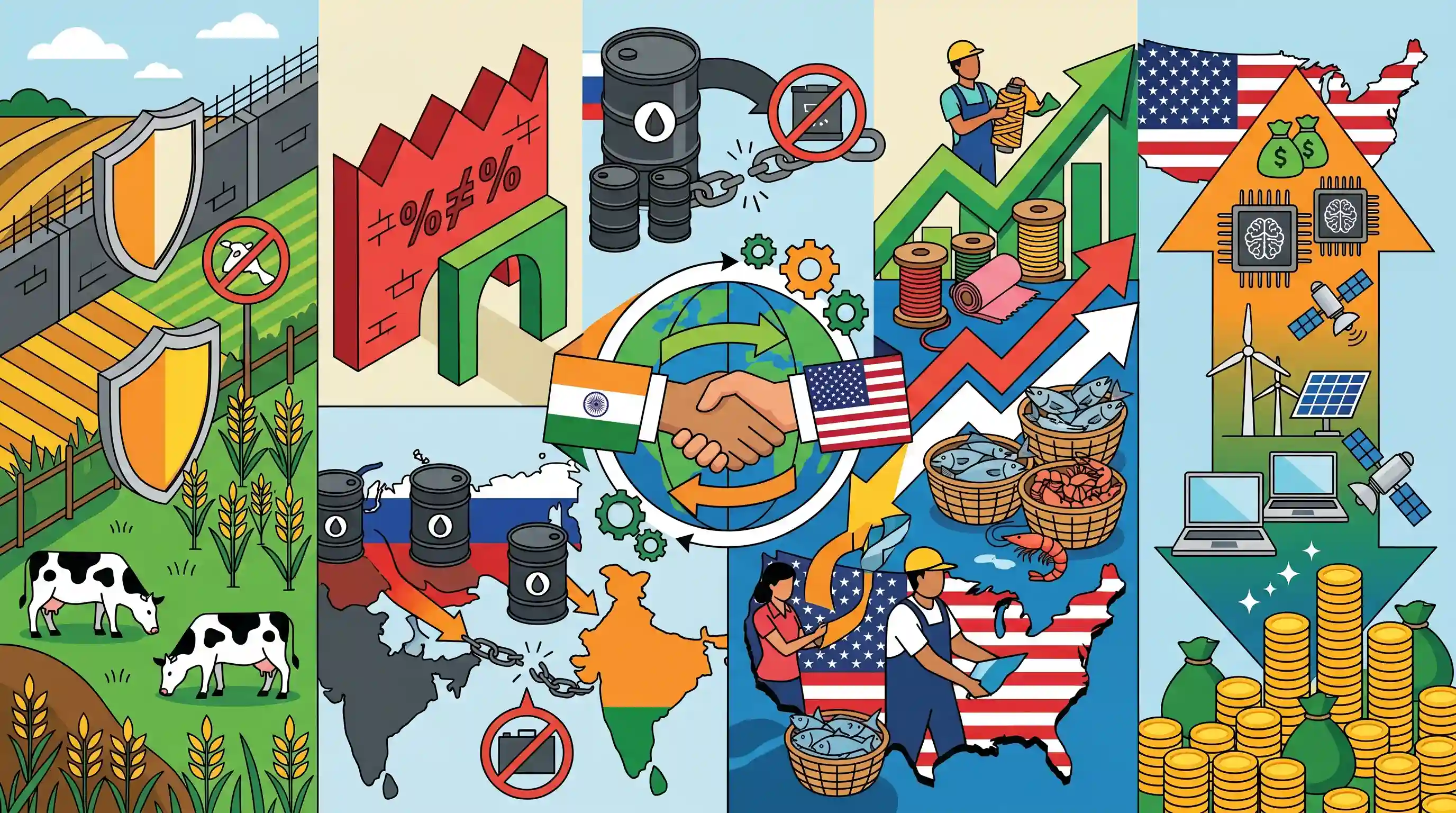
Trade deal safeguards sensitive domestic agriculture and dairy
Source:The Hindu ↗
Why It Matters
This deal underscores India's successful economic diplomacy in balancing strategic autonomy—specifically regarding Russian oil imports—while securing market access for labor-intensive industries in the U.S. It also highlights the continued prioritization of domestic agricultural and dairy interests in international trade negotiations.
Summary
The recently announced India-U.S. trade deal, finalized by Prime Minister Narendra Modi and President Donald Trump, secures crucial tariff reductions while protecting India's sensitive agriculture and dairy sectors. Key elements include the U.S. lowering "reciprocal" tariffs from 25% to 18% and entirely lifting the 25% "penalty" tariff imposed over India's continued imports of Russian oil. Commerce Minister Piyush Goyal noted that these changes will significantly boost labor-intensive export sectors like textiles and marine products. Additionally, India has signaled an intent to purchase $500 billion worth of U.S. energy, AI chips, and technology over the next five years.
Key Points
- The newly finalized India-U.S. trade deal explicitly excludes sensitive Indian agricultural and dairy products from its purview to protect domestic interests.
- The U.S. has agreed to lower its "reciprocal" tariffs on Indian goods from 25% to 18%.
- The U.S. will completely remove the 25% "penalty" tariffs previously imposed on India for importing Russian oil.
- Labor-intensive sectors such as textiles, apparel, marine exports, footwear, and gems are expected to benefit significantly from the reduced tariffs.
- The deal reportedly includes an Indian commitment to purchase $500 billion worth of U.S. energy, technology, and other goods spread over a five-year period.
Important Terms
India-U.S. Trade Deal (2026)

A 2026 bilateral "strategic reset" reducing U.S. tariffs on Indian goods to 18% in exchange for India's commitment to purchase $500 billion in U.S. energy and technology.
UPSC context
GS Paper 2 (International Relations); focuses on bilateral groupings and agreements involving India and their impact on national interest.
Reciprocal Tariffs
Trade duties applied mutually between nations; in this deal, the U.S. lowered its reciprocal rate from 25% to 18% to match negotiated market access.
UPSC context
GS Paper 3 (Economy); relates to trade policy, liberalization, and India's evolving stance on global trade reciprocity.
Sensitive Sectors
Economic areas (e.g., dairy and staple agriculture) exempted from tariff cuts in trade deals to protect local farmers, food security, and rural livelihoods.
UPSC context
GS Paper 3 (Economy); tests knowledge of agricultural protectionism, food security, and the impact of trade on small-scale producers.
Labor-Intensive Export Sectors
Industries requiring high human effort relative to capital—such as textiles, leather, and marine products—that are vital for India’s employment and export-led growth.
UPSC context
GS Paper 3 (Economy); covers industrial growth, employment generation, and the competitiveness of the "Make in India" initiative.
Penalty Tariffs
Punitive duties, such as the 25% surcharge removed in this deal, imposed to discourage specific actions like India's continued imports of Russian crude oil.
UPSC context
GS Paper 2 (International Relations); examines the intersection of global geopolitics, energy security, and trade-based coercive diplomacy.
Strategic Autonomy
A state's ability to pursue its national interests and foreign policy independently, without being forced into alliances or constrained by external powers.
UPSC context
GS Paper 2 (International Relations); a core pillar of Indian foreign policy tested through its balancing of relations with U.S. and Russia.
Prelims Trap
The deal requires India to lower tariffs on US agriculture and cap Russian oil imports.
India explicitly excluded sensitive agriculture/dairy to protect domestic farmers, and the US lifted its Russian oil penalty tariffs without India agreeing to curb imports.
Static Concepts Connected
What is the role of a 'Negative List' in Free Trade Agreements?
- Definition: A list of products/services explicitly excluded from tariff reductions or liberalisation commitments in a trade pact.
- Strategic Purpose: Used to shield vulnerable domestic industries (like agriculture and dairy in India) from sudden surges in cheap, highly subsidized foreign imports.
- WTO Compliance: Permitted under GATT Article XXIV, provided the overall agreement eliminates duties on "substantially all the trade."
How do reciprocal tariffs interact with WTO multilateral rules?
- Reciprocal Tariffs: Retaliatory duties imposed bilaterally to mirror a trade partner's tariff barriers, often bypassing traditional WTO dispute settlement mechanisms.
- Most-Favored-Nation (MFN): The WTO mandates non-discrimination; treating one nation's goods worse than others violates this, unless under specific FTA or safeguard exceptions.
- Managed Trade Shift: Such bilateral tariff adjustments highlight a shift toward 'managed trade' where major economies use duties as direct geopolitical pressure tactics.
Cross-Topic Patterns
Russian Oil + US Tech Diplomacy
Balancing discounted Russian crude against massive US tech/energy commitments highlights India’s multi-alignment strategy, turning geopolitical friction into trade leverage.
Tariff Cuts + Mass Employment
Reviving textile and footwear exports through US tariff reductions is critical for mass job creation, directly linking trade diplomacy to India's demographic dividend.

Bilateral 'reciprocal tariffs' vs WTO MFN rules, alongside agriculture negative lists, likely form a multi-statement Prelims Q in 2026.
Linked PYQs · 4
Linked PYQs · 4
- 2025MainsGS2
"Energy security constitutes the dominant kingpin of India's foreign policy, and is linked with India's overarching influence in Middle Eastern countries.” How would you integrate energy security with India's foreign policy trajectories in the coming years?
- 2023MainsGS3
What are the direct and indirect subsidies provided to farm sector in India? Discuss the issues raised by the World Trade Organization (WTO) in relation to agricultural subsidies.
- 2017MainsGS3
Account for the failure of manufacturing sector in achieving the goal of labour-intensive exports. Suggest measures for more labour-intensive rather than capital-intensive exports.
- 2012MainsGS2
How have the US sanctions against Iran affected India's bilateral relations with Iran?
