India US Trade Pact Aims for Zero Duty Textile Market Access
Source:Indian Express ↗
Why It Matters
The textile industry is one of India's largest employers. Overcoming tariff barriers in major markets like the US is essential to counter fierce competition from nations like Bangladesh and Vietnam, and to revive India's labour-intensive export growth.
Summary
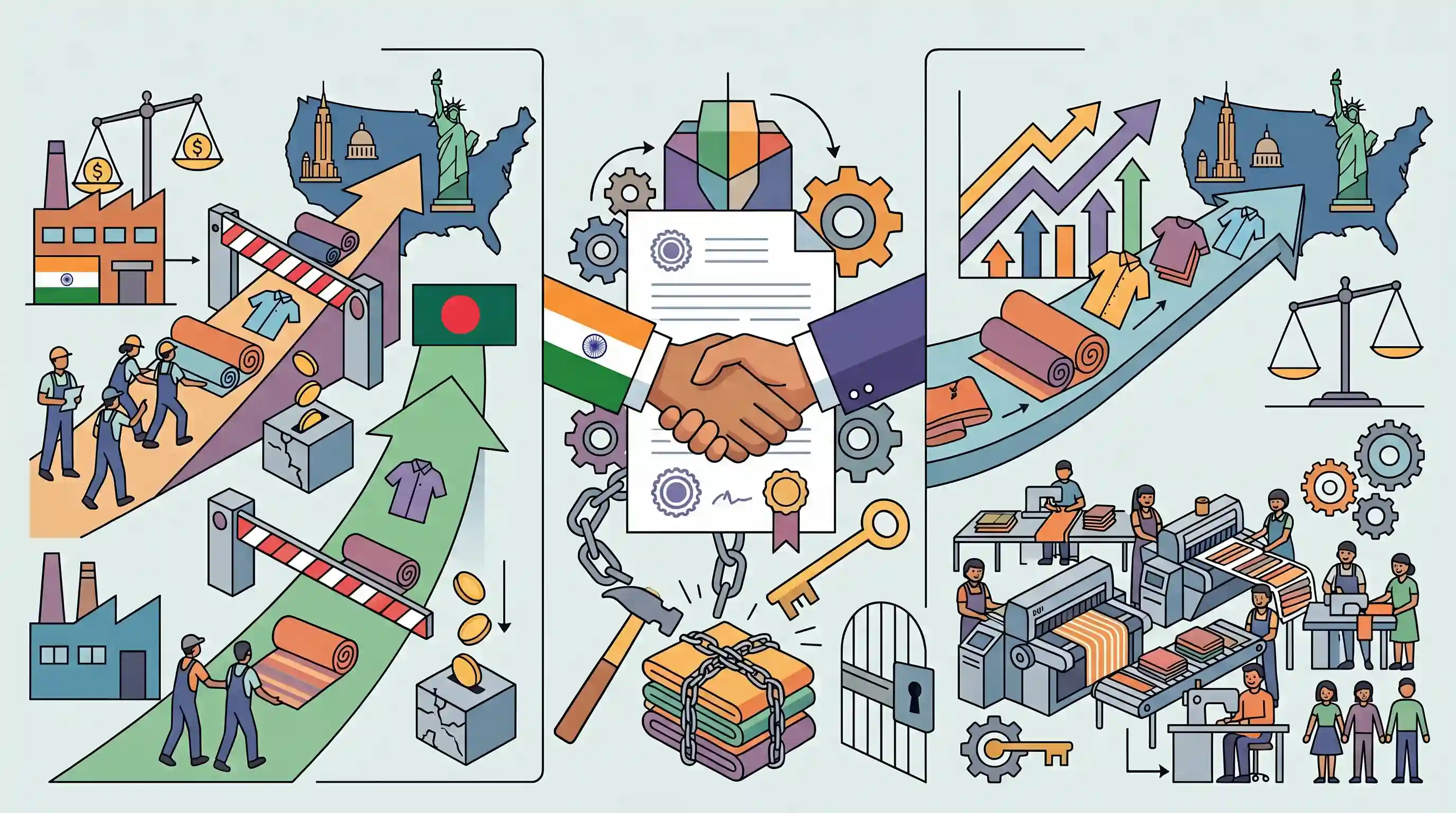
Commerce Minister Piyush Goyal announced that an upcoming India-US trade deal will likely include a provision granting Indian textiles zero-duty access to the US market, similar to the advantages enjoyed by Bangladesh. Currently, competing nations like Bangladesh benefit from specific tariff concessions that have given them a significant edge in the global apparel trade. By securing zero-duty access, India aims to eliminate this tariff disadvantage, enhance the export competitiveness of its textile industry, and spur job creation within this crucial labour-intensive manufacturing sector.
Key Points
- India and the United States are negotiating a trade agreement that aims to secure zero-duty access for Indian textiles in the US market.
- The provision seeks to replicate the "Bangladesh-style" tariff advantages, allowing Indian exporters to compete on a level playing field.
- Currently, Indian textile and apparel exports face tariff disadvantages in major Western markets compared to competitors like Bangladesh, which benefits from special tariff exemptions.
- Achieving zero-duty access would provide a significant boost to India's labour-intensive manufacturing sector, increasing its global market share and generating employment.
Important Terms
Free Trade Agreement (FTA)

A formal treaty between two or more countries to reduce or eliminate tariffs and non-tariff barriers on goods and services, facilitating smoother cross-border commerce.
UPSC context
GS Paper II (International Relations) & GS Paper III (Indian Economy); tests trade policy and economic integration strategies.
Zero-Duty Access
A trade provision allowing goods to enter a foreign market without any import duties or tariffs, significantly lowering prices for consumers and increasing exporter competitiveness.
UPSC context
GS Paper III (Economy); relevant for topics on export competitiveness and tariff structures in international trade.
Textile Sector
A critical economic segment encompassing the production of yarn, fabric, and garments; it is India's second-largest employer after agriculture and a major export earner.
UPSC context
GS Paper III (Economy/Industrial Growth); tests understanding of employment generation and sector-specific manufacturing challenges.
Bilateral Trade
The exchange of goods, services, or capital between two specific nations, usually governed by mutually negotiated agreements to enhance economic cooperation and market access.
UPSC context
GS Paper II (International Relations); focuses on India's diplomatic and economic engagement with key global partners.
Ministry of Commerce and Industry
The nodal Indian ministry responsible for formulating trade policy, promoting exports, and negotiating international trade agreements through its Department of Commerce.
UPSC context
GS Paper II (Governance); identifies the executive body managing India's external trade and industrial development.
Labour-intensive Manufacturing
Industrial sectors, like textiles and leather, that require a large amount of manual labor relative to capital, making them vital for mass employment.
UPSC context
GS Paper III (Economy/Employment); tests strategies for job creation and inclusive economic growth.
Prelims Trap
Bangladesh enjoys unconditional zero-duty access to the US market for all textiles due to its LDC status.
Bangladesh's US zero-duty access for garments is not a blanket LDC waiver; it is conditional upon strict rules of origin like the 'yarn-forward' principle using specific raw materials.
Static Concepts Connected
What are "Rules of Origin" and the "Yarn-Forward" rule in FTAs?
- Rules of Origin (RoO): Criteria used to determine the true national source of a product, which is essential for applying FTA tariff concessions and preventing third-country abuse.
- Yarn-Forward Rule: A strict RoO requiring that yarn spinning, fabric manufacturing, and final garment assembly must all occur within the FTA partner countries to qualify for duty-free access.
- Protection Mechanism: It acts as a shield against transshipment, ensuring that non-partner countries (like China) cannot simply export cheap fabric to a partner country for final stitching to bypass tariffs.
What is the macroeconomic significance of India's textile sector?
- Employment Engine: It is India's second-largest employer after agriculture, providing direct employment to over 45 million people, crucial for absorbing unskilled and semi-skilled labour.
- Economic Weight: The sector contributes roughly 2.3% to the national GDP, 13% to industrial production, and approximately 12% to total export earnings.
- Stagnant Global Share: Despite having the world's second-largest manufacturing capacity and being a top cotton producer, India's share in global textile and apparel trade remains stagnant at around 4%.
Cross-Topic Patterns
Rules of Origin + CAROTAR
Trade concessions like the 'yarn-forward' rule echo India's own CAROTAR 2020 regulations, which are strictly designed to prevent third-party dumping (like Chinese goods) via FTA routing.
LDC Graduation + Trade Shifts
With Bangladesh slated to graduate from LDC status by 2026, its preferential market access will alter, creating a strategic window for Indian labour-intensive exports to capture Western markets.

Rules of Origin mechanisms (like yarn-forward) and South Asian export competitiveness will likely feature in a 2026 Prelims Economy MCQ.
Linked PYQs · 3
Linked PYQs · 3
- 2017MainsGS3
Account for the failure of manufacturing sector in achieving the goal of labour-intensive exports. Suggest measures for more labour-intensive rather than capital-intensive exports.
- 2014MainsGS2
The aim of Information Technology Agreements (ITAs) is to lower all taxes and tariffs on information technology products by signatories to zero. What impact would such agreements have on India's interests?
- 2016MainsGS2
The broader aims and objectives of WTO are to manage and promote international trade in the era of globalization. But the Doha round of negotiations seem doomed due to differences between the developed and the developing countries." Discuss in the Indian perspective.
