India US Bilateral Trade Negotiations and Interim Agreement Progress
Source:The Hindu ↗
Why It Matters
Highlights the evolving complexities in India-US bilateral trade relations amidst shifting global tariff regimes and domestic political variables, directly relevant for GS-2 (International Relations) and GS-3 (Economy/Trade).
Summary
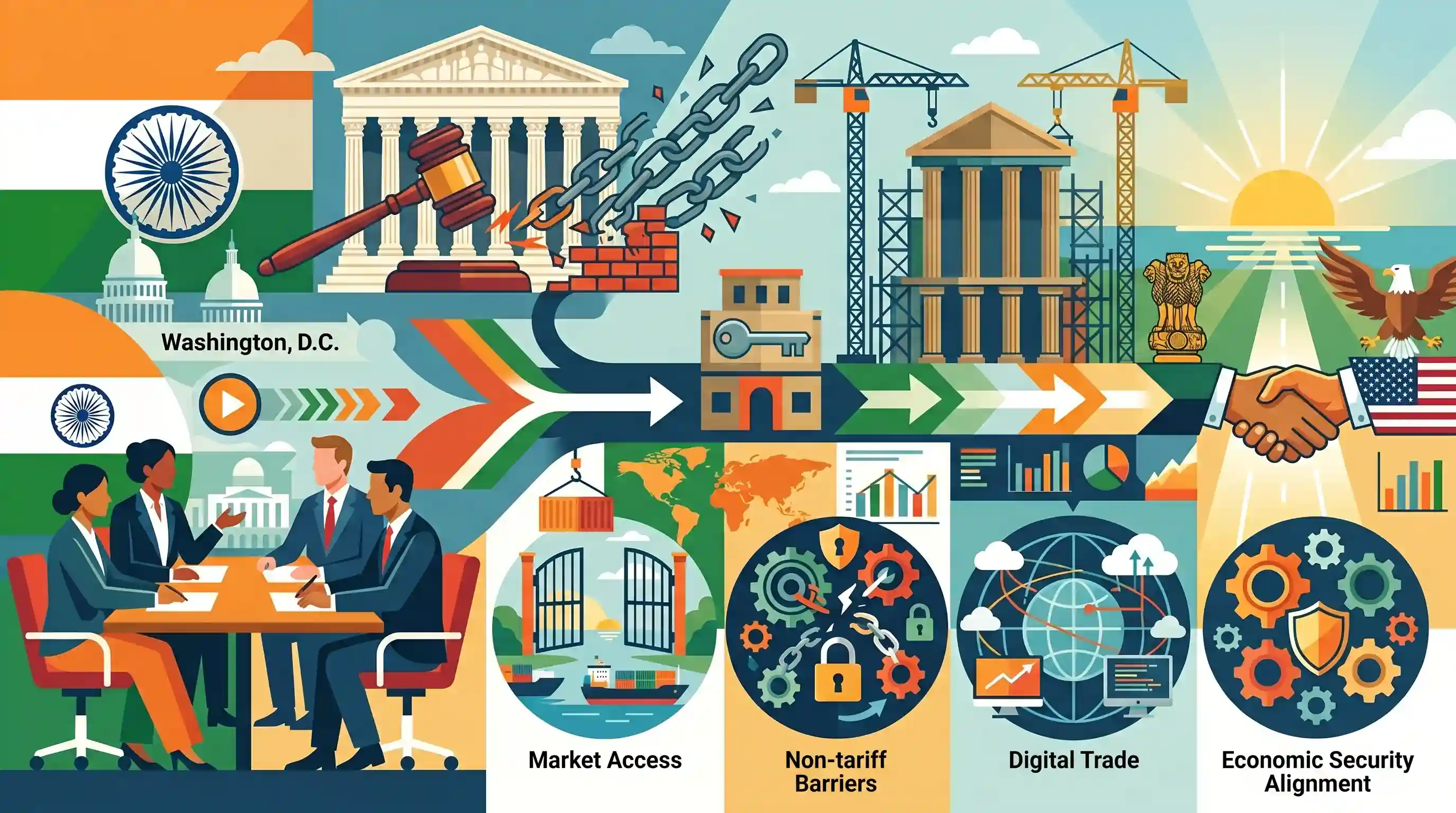
India and the United States recently concluded constructive in-person trade negotiations in Washington, D.C., aiming to finalize an Interim Agreement on reciprocal tariffs and advance towards a broader Bilateral Trade Agreement (BTA). While an initial framework was agreed upon in February 2026, the interim deal faced delays following a U.S. Supreme Court ruling that invalidated reciprocal tariffs previously imposed by Donald Trump. Negotiations spanned crucial areas including market access, non-tariff barriers, digital trade, and economic security alignment. Although no official deadline has been announced, Indian representatives expressed optimism that an agreement might be reached soon, pending final clarity on U.S. tariff impositions.
Key Points
- Indian and U.S. negotiating teams held constructive in-person talks in Washington to advance an Interim Agreement and a broader Bilateral Trade Agreement (BTA).
- The Interim Agreement, initially planned for March 2026, was delayed after the U.S. Supreme Court invalidated reciprocal tariffs levied by former U.S. President Donald Trump.
- Discussions covered market access, non-tariff measures, technical barriers to trade, economic security alignment, and digital trade.
- While no official deadline was stated, senior BJP leader Ram Madhav suggested the deal could be signed within a month, potentially coinciding with U.S. Secretary of State Marco Rubio's visit to India.
- India's Commerce Ministry maintained that the deal will only be signed after the U.S. finalizes its tariff policy regarding India and competing nations.
Important Terms
Bilateral Trade Agreement (BTA)

A formal trade contract between two nations to reduce tariffs and non-tariff barriers, facilitating the reciprocal exchange of goods and services.
UPSC context
GS Paper II (International Relations) & GS Paper III (Economy). Tests India’s shift toward bilateral trade strategies over multilateral forums.
Interim Agreement
A preliminary trade pact, often focusing on an 'Early Harvest' of specific sectors, intended as a precursor to a comprehensive economic partnership.
UPSC context
GS Paper III (Indian Economy). Relevant for understanding the phased nature of trade negotiations and early-stage tariff concessions.
Ministry of Commerce and Industry
The nodal Indian ministry for formulating trade policy and conducting negotiations, primarily through its Department of Commerce.
UPSC context
GS Paper II (Governance) & GS Paper III. Tests knowledge of institutional frameworks for foreign trade and industrial development.
Supreme Court of the U.S.
The highest judicial body in the U.S.; its 2026 ruling (Learning Resources v. Trump) curtailed executive power to unilaterally impose tariffs under emergency laws.
UPSC context
GS Paper II (International Relations). Tests understanding of how foreign legal/constitutional changes disrupt bilateral economic engagements.
Ministry of External Affairs (MEA)
The Indian government ministry responsible for diplomatic relations and providing the strategic framework for international cooperation, including trade diplomacy.
UPSC context
GS Paper II (International Relations). Vital for understanding the diplomatic coordination behind India's global strategic and economic interests.
Prelims Trap
An Interim Trade Agreement automatically covers "substantially all trade" to comply with WTO rules.
Interim deals (Early Harvest) target specific goods. Under WTO GATT Article XXIV, only full FTAs must cover "substantially all trade", making prolonged interim pacts legally contentious if they never upgrade.
Static Concepts Connected
What distinguishes an Early Harvest Scheme (Interim Agreement) from an FTA?
- Early Harvest Scheme: A precursor agreement where trading partners lower tariffs on a limited, specific set of goods to build confidence before a full deal.
- Comprehensive FTA: Covers a much wider scope including services and investment. Under WTO rules, it must eliminate duties on "substantially all trade" between the partners.
What are the major types of Non-Tariff Barriers (NTBs)?
- SPS Measures: Sanitary and Phytosanitary measures designed to protect human, animal, or plant health. Frequently used by developed nations as a disguised trade restriction against agricultural imports.
- TBT Measures: Technical Barriers to Trade include specific product standards, testing, packaging, and certification requirements that can complicate or delay market access for foreign goods.
- Regulatory Friction: Administrative hurdles such as complex import licensing, quotas, and embargoes that restrict the volume or flow of trade without applying a direct tariff.
Cross-Topic Patterns
Trade pacts merging with tech diplomacy
The inclusion of GPUs, digital trade, and economic security in trade talks bridges GS-3 Trade with GS-2 Tech Diplomacy, aligning with the broader Indo-US initiative on Critical and Emerging Technology (iCET).
Bilateralism bypassing a stagnant WTO
Direct US-India negotiations to rationalize reciprocal tariffs highlight how nations are increasingly relying on bilateral mechanisms amid the stagnation of the WTO's multilateral tariff reduction and dispute settlement frameworks.

Expect a Mains question analyzing the shift from traditional FTAs to 'economic security' pacts involving critical tech and supply chains.
Linked PYQs · 2
Linked PYQs · 2
- 2025MainsGS3
What are the challenges before the Indian economy when the world is moving away from free trade and multilateralism to protectionism and bilateralism? How can these challenges be met?
- 2019MainsGS2
‘What introduces friction into the ties between India and the United States is that Washington is still unable to find for India a position in its global strategy, which would satisfy India's national self-esteem and ambitions.’ Explain with suitable examples.
