India Ranks Second Globally in Childhood Obesity Rates
Source:Indian Express ↗
Why It Matters
Childhood obesity and the double burden of malnutrition are critical topics for GS Paper 2 (Health and Social Justice) and GS Paper 1 (Social Issues). The shift from traditional diets to ultra-processed foods poses regulatory challenges for bodies like FSSAI and impacts human capital formation, making it highly relevant for questions on public health infrastructure, demographic dividend, and nutrition schemes like POSHAN Abhiyaan.
Summary
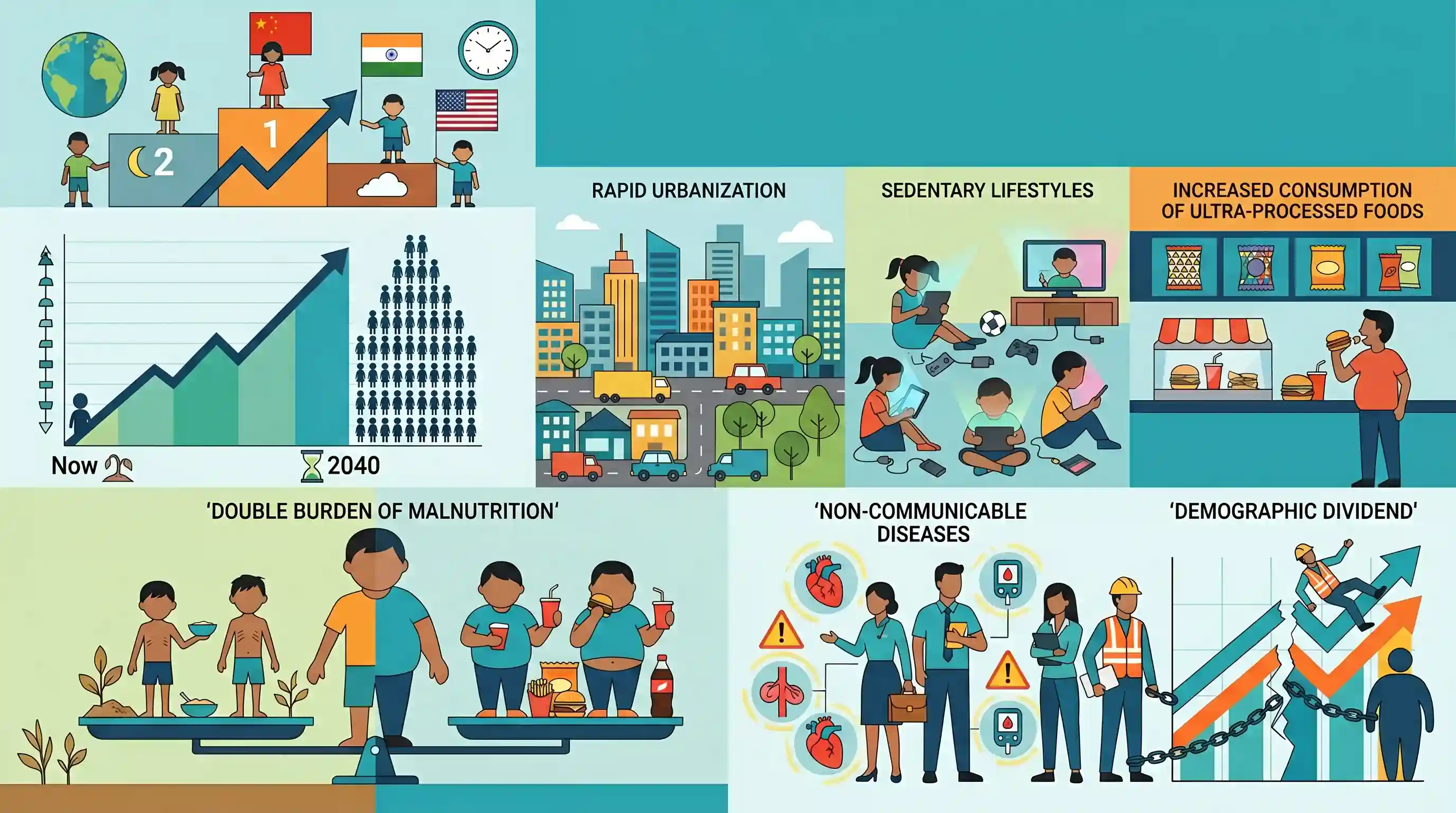
A recent global report reveals that India has overtaken the United States in childhood obesity rates, now ranking second globally only to China. It is projected that by 2040, India will have 20 million children living with obesity. This alarming trend points to a growing public health crisis driven by rapid urbanization, sedentary lifestyles, and the increased consumption of ultra-processed foods. It severely exacerbates India's 'double burden of malnutrition'—where undernutrition and overnutrition coexist—and raises concerns about the future prevalence of non-communicable diseases (NCDs) among the youth, which could undermine the country's demographic dividend.
Key Points
- India has surpassed the United States to rank second globally, just behind China, in the number of children living with obesity.
- A global report projects that by 2040, approximately 20 million Indian children will be affected by childhood obesity.
- The surge in obesity is largely attributed to urbanization, increasingly sedentary lifestyles, and the growing consumption of ultra-processed, calorie-dense foods.
- The data highlights India's severe 'double burden of malnutrition,' where the country simultaneously grapples with high rates of undernutrition (stunting and wasting) and rising obesity.
- This trend threatens to increase the future burden of non-communicable diseases (NCDs) like Type-2 diabetes and cardiovascular disorders, potentially affecting India's demographic dividend.
Important Terms
Double Burden of Malnutrition

The coexistence of undernutrition (stunting, wasting) and overnutrition (obesity, overweight) or diet-related non-communicable diseases within the same individual, household, or population.
UPSC context
GS Paper II (Issues Relating to Hunger and Health); crucial for analyzing India’s complex nutrition transition and public health policy challenges.
POSHAN Abhiyaan
India's flagship National Nutrition Mission launched in 2018 to reduce stunting, undernutrition, anemia, and low birth weight through a convergent, technology-driven approach and community participation (Jan Andolan).
UPSC context
GS Paper II (Government Policies and Interventions); essential for understanding social justice and child development schemes.
Eat Right India Movement
A flagship initiative by FSSAI aimed at transforming the country’s food system to ensure safe, healthy, and sustainable food for all citizens through social and behavioral change.
UPSC context
GS Paper II (Social Sector - Health); highlights preventative healthcare strategies and the role of regulatory bodies in nutrition.
Food Safety and Standards Authority of India (FSSAI)
An autonomous statutory body under the Ministry of Health & Family Welfare that regulates food manufacturing, storage, distribution, and import to ensure safe and wholesome food consumption.
UPSC context
GS Paper II (Statutory Bodies) and GS Paper III (Food Security); relevant for regulatory framework and food safety standards.
Non-Communicable Diseases (NCDs)
Chronic conditions like diabetes, cardiovascular diseases, and cancers that are not transmitted between people; they account for over 65% of deaths in India and are often linked to obesity.
UPSC context
GS Paper II (Health); critical for discussing India's epidemiological shift and long-term economic burden of disease.
Demographic Dividend
The economic growth potential resulting from a shift in a population's age structure, specifically when the share of the working-age population (15-64) exceeds the dependent population.
UPSC context
GS Paper I (Population) and GS Paper III (Indian Economy); tests how health crises like obesity can compromise future productivity.
Prelims Trap
India has the highest number of obese children globally, having recently surpassed the United States.
India ranks second globally in childhood obesity, strictly behind China. Aspirants often misread 'surpassed the US' as indicating India is now the global leader.
Static Concepts Connected
What constitutes the "double burden of malnutrition" in public health?
- Undernutrition: Includes wasting (low weight-for-height), stunting (low height-for-age), and micronutrient deficiencies.
- Overnutrition: Includes overweight, obesity, and diet-related non-communicable diseases (like Type-2 diabetes and cardiovascular issues).
- Coexistence: Both undernutrition and overnutrition manifest simultaneously within the same country, community, or even the same household.
How do early-onset NCDs threaten India's demographic dividend?
- Productivity Loss: Chronic illnesses reduce workforce participation and physical capacity, leading to lower economic output and productivity.
- Healthcare Costs: High out-of-pocket expenditure on NCD treatments pushes families into poverty, diverting funds from education and skill building.
- Demographic Burden: The working-age population becomes an economic liability if chronically sick, negating the advantage of a low dependency ratio.
Cross-Topic Patterns
Urbanization and ultra-processed food penetration
Rapid urban sprawl reduces physical activity spaces while increasing the availability and marketing of industrially formulated HFSS (High Fat, Sugar, Salt) foods.
FSSAI and Front-of-Pack Labeling (FOPL)
The obesity crisis underscores the urgent need for FSSAI’s proposed warning labels (Front-of-Pack Labeling) on packaged foods to curb the consumption of ultra-processed items.

Expect a GS2 Mains question linking the 'nutrition transition' to India's demographic dividend, or Prelims statements on obesity rankings.
Linked PYQs · 3
Linked PYQs · 3
- 2024MainsGS2
Poverty and malnutrition create a vicious cycle, adversely affecting human capital formation. What steps can be taken to break the cycle ?
- 2016PrelimsGS1
Which of the following is/are the indicator/indicators used by IFPRI to compute the Global Hunger Index Report? 1. Undernourishment 2. Child stunting 3. Child mortality Select the correct answer using the code given below.
- 2021MainsGS2
“Besides being a moral imperative of a Welfare State, primary health structure is a necessary precondition for sustainable development.” Analyze.
