India and US Bilateral Trade Agreement Negotiations and Tariffs
Source:The Hindu ↗
Why It Matters
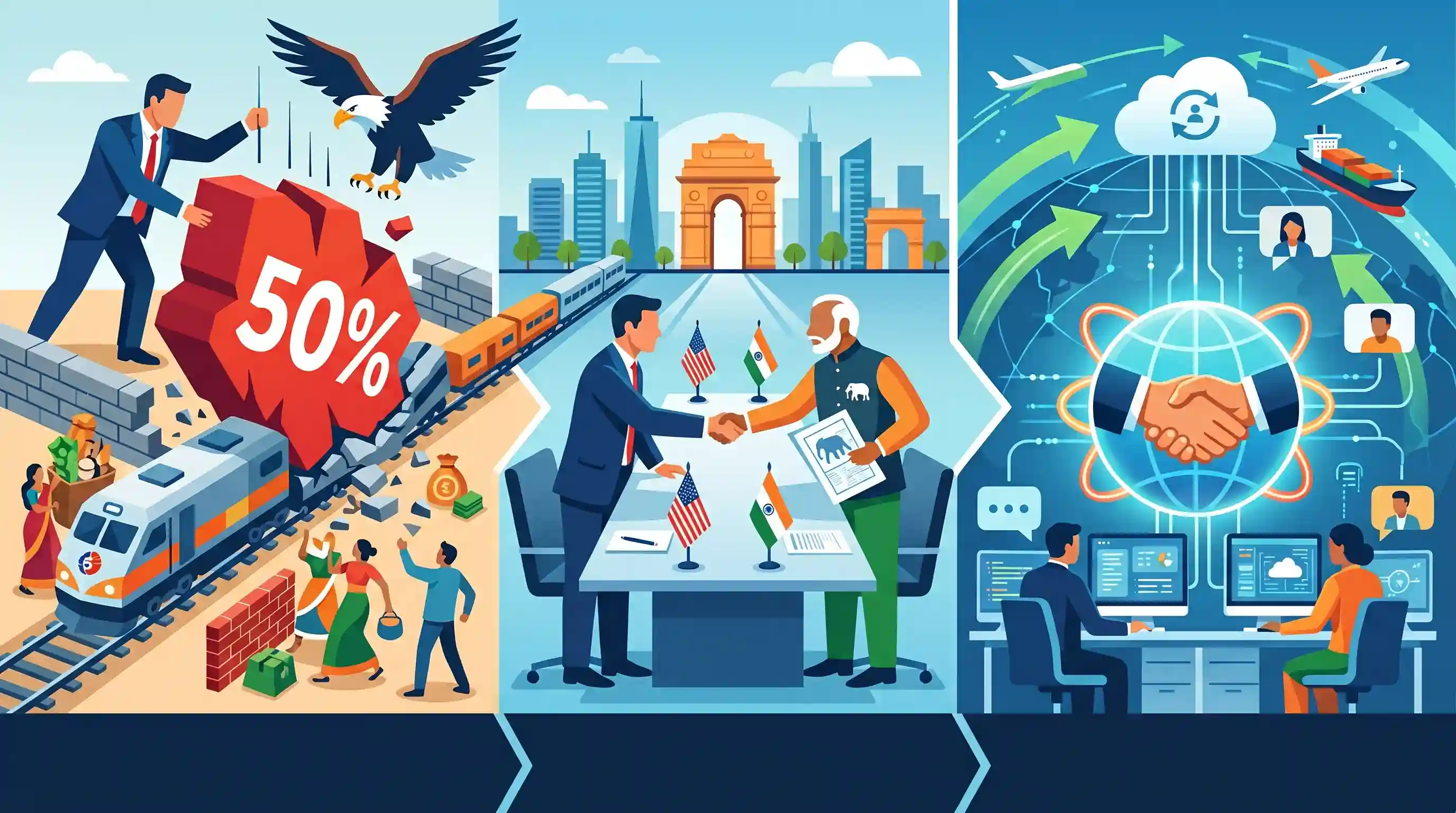
The progression of the India-U.S. Bilateral Trade Agreement is a crucial component of India's economic diplomacy. The friction caused by protectionist measures, such as the U.S. imposing 50% tariffs, highlights the complexities of negotiating trade deals in a globally fragmented economic environment. Understanding these dynamics is essential for answering questions on bilateral relations (GS2) and the challenges of global protectionism on the Indian economy (GS3).
Summary
India and the United States have agreed to intensify efforts towards an early conclusion of a Bilateral Trade Agreement (BTA). A recent meeting in New Delhi between U.S. Chief Negotiator Brendan Lynch and India’s Rajesh Agrawal aimed to revive discussions after the sixth official round was derailed by the U.S. imposing 50% tariffs on Indian goods. The negotiations, intended to resolve trade frictions and finalize a mutually beneficial economic framework, will now proceed through virtual channels.
Key Points
- India and the U.S. have agreed to intensify efforts to quickly conclude their Bilateral Trade Agreement (BTA).
- U.S. Chief Negotiator Brendan Lynch and India's Rajesh Agrawal met in New Delhi to revive the trade talks.
- The sixth official round of negotiations had previously been called off due to the U.S. imposing a steep 50% tariff on Indian imports.
- With the latest in-person meeting concluded, the negotiators will continue their discussions virtually to finalize the deal.
Important Terms
India-U.S. Bilateral Trade Agreement (BTA)

A proposed economic framework between India and the U.S. designed to reduce trade barriers, enhance market access in sectors like agriculture, and resolve tariff disputes.
UPSC context
GS Paper II (Bilateral Relations) and GS Paper III (Economic Development); tests knowledge of trade diplomacy and strategic economic partnerships.
United States Trade Representative (USTR)
The U.S. federal agency responsible for developing trade policy and conducting negotiations. Its Assistant USTR leads the American side in the India-U.S. BTA talks.
UPSC context
GS Paper II (International Relations); understanding key foreign institutions that shape India’s external economic environment.
Ministry of Commerce and Industry (India)
The nodal ministry in India for formulating foreign trade policy and negotiating international trade agreements, currently leading the BTA talks with the U.S. through its Department of Commerce.
UPSC context
GS Paper II (Governance); highlights the role of Indian ministries in safeguarding national economic interests abroad.
Reciprocal Tariffs
Duties imposed by a country on imports at the same level as those applied by the trading partner, used by the U.S. to counter India's high tariffs.
UPSC context
GS Paper III (Economy); tests understanding of protectionism, trade wars, and the impact of global trade policies on Indian exports.
Mission 500 (Trade Goal)
A joint strategic objective set by India and the U.S. to more than double their total bilateral trade value to $500 billion by the year 2030.
UPSC context
GS Paper II/III; represents long-term strategic targets and the scaling of the Comprehensive Global Strategic Partnership.
Prelims Trap
"India runs a structural trade deficit with the United States, similar to its trade dynamics with China."
India consistently enjoys a structural trade surplus with the US (surpassing $30 billion recently), making it one of India's few major net-export destinations.
Static Concepts Connected
What is the Generalized System of Preferences (GSP) in international trade?
- Tariff exemption: A preferential tariff system allowing exports from developing nations duty-free access to developed markets to promote economic growth.
- WTO compliance: It functions as a legal, recognized exception to the WTO's fundamental Most Favored Nation (MFN) principle under the Enabling Clause.
- India's status: The US withdrew India's GSP beneficiary status in 2019, citing lack of equitable market access for American dairy and medical devices.
What are the primary roadblocks to an India-US comprehensive Free Trade Agreement?
- Agriculture & Dairy: The US demands broader market access for its agricultural and dairy products, which India resists to protect the livelihoods of millions of domestic farmers.
- IPR Enforcement: The US pushes for stricter intellectual property regimes (TRIPS-plus provisions), often clashing with India's domestic patent laws and generic pharmaceutical policies.
- Labor Mobility: India seeks easier H-1B visa norms and reduced immigration hurdles to facilitate its IT service exports and skilled labor mobility.
Cross-Topic Patterns
Strategic ties vs. Trade friction
While India and the US align heavily on defense (iCET) and Indo-Pacific security (Quad), structural trade protectionism and tariff barriers remain an isolated friction point.
Visa curbs and Mode 4 services
Trade talks directly tie into WTO's GATS Mode 4 (movement of natural persons), as US visa restrictions heavily impact India's crucial IT service exports.

Expect a multi-statement Prelims question comparing India's trade surplus with the US against its deficit with China, alongside GSP rules.
Linked PYQs · 2
Linked PYQs · 2
- 2025MainsGS3
What are the challenges before the Indian economy when the world is moving away from free trade and multilateralism to protectionism and bilateralism? How can these challenges be met?
- 2018MainsGS2
India and USA are two large democracies. Examine the basic tenets on which the two political systems are based.
