India Unveils Green Metals Vision for 2047
Source:The Hindu ↗
Why It Matters
Aluminium and copper are foundational metals for the renewable energy ecosystem, including solar panels, wind turbines, and EVs. Understanding India's strategy to secure these metals is critical for UPSC aspirants analyzing resource security, industrial development, and India's pathways to fulfilling its climate commitments.
Summary
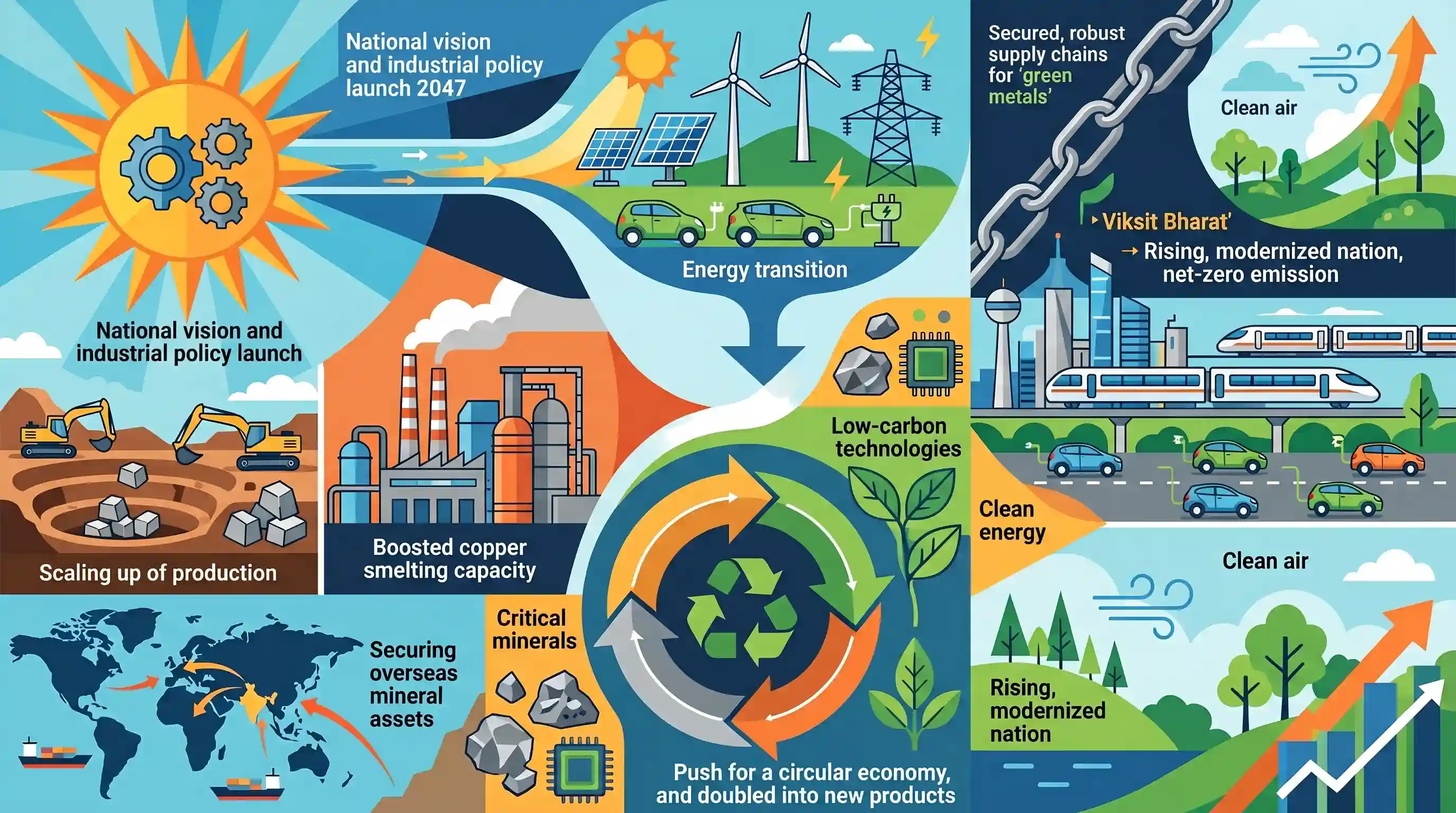
India has launched comprehensive 'vision documents' for its aluminium and copper sectors, aiming to significantly scale up domestic production by 2047 in alignment with 'Viksit Bharat' objectives. Anticipating a six-fold surge in demand driven by the energy transition, the plans target expanding bauxite extraction, boosting copper smelting capacity, and securing overseas mineral assets. Crucially, the strategy underscores a transition to low-carbon technologies and a push for a circular economy by doubling recycling rates. Securing robust supply chains for these 'green metals' is seen as essential for India's infrastructure development, electric vehicle (EV) adoption, and broader net-zero emission goals.
Key Points
- The newly unveiled vision documents project a six-fold increase in domestic demand and production for aluminium and copper by 2047, driven by the energy transition and infrastructure needs.
- To meet aluminium targets, India plans to scale its bauxite production capacity from the current levels to 50 MTPA by 2030, and eventually 150 MTPA by 2047.
- The copper strategy includes adding 5 MTPA in smelting and refining capacity by 2030 to reduce dependency on open-market imports and mitigate supply chain vulnerabilities.
- Doubling the recycling rate for both metals and expanding secondary refining are core strategies aimed at promoting a circular economy and reducing environmental impacts.
- Securing these critical metals, alongside overseas mineral assets, is recognized as vital for achieving India's net-zero ambitions and supporting the rapid adoption of electric vehicles.
Important Terms
Viksit Bharat 2047

The Government of India's roadmap to transform the nation into a developed, US$30 trillion economy by its 100th independence anniversary in 2047, focusing on structural reforms and self-reliance.
UPSC context
GS-III (Indian Economy); crucial for answers on long-term growth targets, infrastructure development, and sector-specific industrial policies.
Aluminium and Copper Vision Documents 2047
Strategic blueprints launched in 2024 to scale domestic production (e.g., 37 MTPA aluminium target), reduce import dependency, and align the non-ferrous metal sector with net-zero and infrastructure goals.
UPSC context
GS-III (Industrial Policy); tests understanding of strategic resource security and the energy transition's raw material requirements.
Critical Minerals
Elements essential for modern technology and the energy transition (e.g., lithium, cobalt, copper) whose supply is at risk; India has identified 30 such minerals for strategic focus.
UPSC context
GS-III (Resources/Science & Tech); a high-frequency topic regarding energy security, EV value chains, and geopolitical mineral diplomacy.
Circular Economy
An economic model focusing on resource efficiency through recycling, reuse, and waste reduction; the vision documents target doubling recycling rates for aluminium and copper.
UPSC context
GS-III (Environment/Economy); vital for questions on sustainable industrialization and India's 'LiFE' (Lifestyle for Environment) initiative.
Indian National Committee of the World Mining Congress (INC-WMC)
A UN-affiliated body (secretariat at Coal India Limited) that fosters international collaboration and sustainable practices in the mining sector; it organized the 2024 Hyderabad conference.
UPSC context
GS-II/III (Institutions/Mining); relevant for institutional roles in policy formulation and international scientific exchange in extractive industries.
Net-Zero Emissions
The goal of balancing greenhouse gas emissions with their removal; India aims for this by 2070, making 'green metals' like copper and aluminium indispensable.
UPSC context
GS-III (Environment); central to climate change debates and the strategic shift toward low-carbon manufacturing technologies.
Prelims Trap
"India is completely self-sufficient in copper ore extraction due to abundant reserves in Rajasthan and Madhya Pradesh."
While India has some reserves, it is highly deficient in copper ore. The country relies heavily on imported copper concentrate to feed its domestic smelting and refining industries.
Static Concepts Connected
What are the primary locational factors for the aluminium smelting industry?
- Raw Material: Proximity to bauxite mines is crucial, as massive amounts of bulky, weight-losing bauxite ore are needed to produce a smaller quantity of alumina.
- Cheap Power: Smelting via electrolysis is extremely energy-intensive. Continuous, affordable electricity (often sourced from captive thermal plants) accounts for 30-40% of production costs.
What is 'Red Mud' and how is it related to aluminium production?
- Bauxite Residue: It is a highly alkaline, toxic solid waste byproduct generated during the Bayer process when extracting alumina from raw bauxite ore.
- Environmental Threat: If improperly managed, it leaches into groundwater. Increasing aluminium recycling (circular economy) drastically reduces the need for primary extraction and minimizes red mud generation.
Cross-Topic Patterns
Green metals driving the energy transition
Copper and aluminium are essential for solar grids and EV manufacturing. Scaling domestic production directly links to India's NDC commitments and its 2070 net-zero emissions target.
KABIL and overseas critical mineral diplomacy
India's push for copper/aluminium vision documents aligns with KABIL's (Khanij Bidesh India Ltd) mandate to acquire overseas mineral assets, strategically countering China's dominance in global mineral processing.

Expect a multi-statement Prelims question combining India's copper import dependency, bauxite reserves in Odisha, and red mud pollution.
Linked PYQs · 4
Linked PYQs · 4
- 2023MainsGS3
The adoption of electric vehicles is rapidly growing worldwide. How do electric vehicles contribute to reducing carbon emissions and what are the key benefits they offer compared to traditional combustion engine vehicles?
- 2025MainsGS3
Mineral resources are fundamental to the country's economy and these are exploited by mining. Why is mining considered an environmental hazard? Explain the remedial measures required to reduce the environmental hazard due to mining.
- 2023PrelimsGS1
About three-fourths of world's cobalt, a metal required for the manufacture of batteries for electric motor vehicles, is produced by
- 2023PrelimsGS1
Ilmenite and rutile, abundantly available in certain coastal tracts of India, are rich sources of which one of the following?
