India Foreign Policy and Global Multilateral Order Realignment
Source:Indian Express ↗
Why It Matters
Essential for understanding India's evolving diplomatic stance, multilateral engagement, and pursuit of strategic autonomy amidst contemporary geopolitical conflicts like Gaza and Ukraine.
Summary
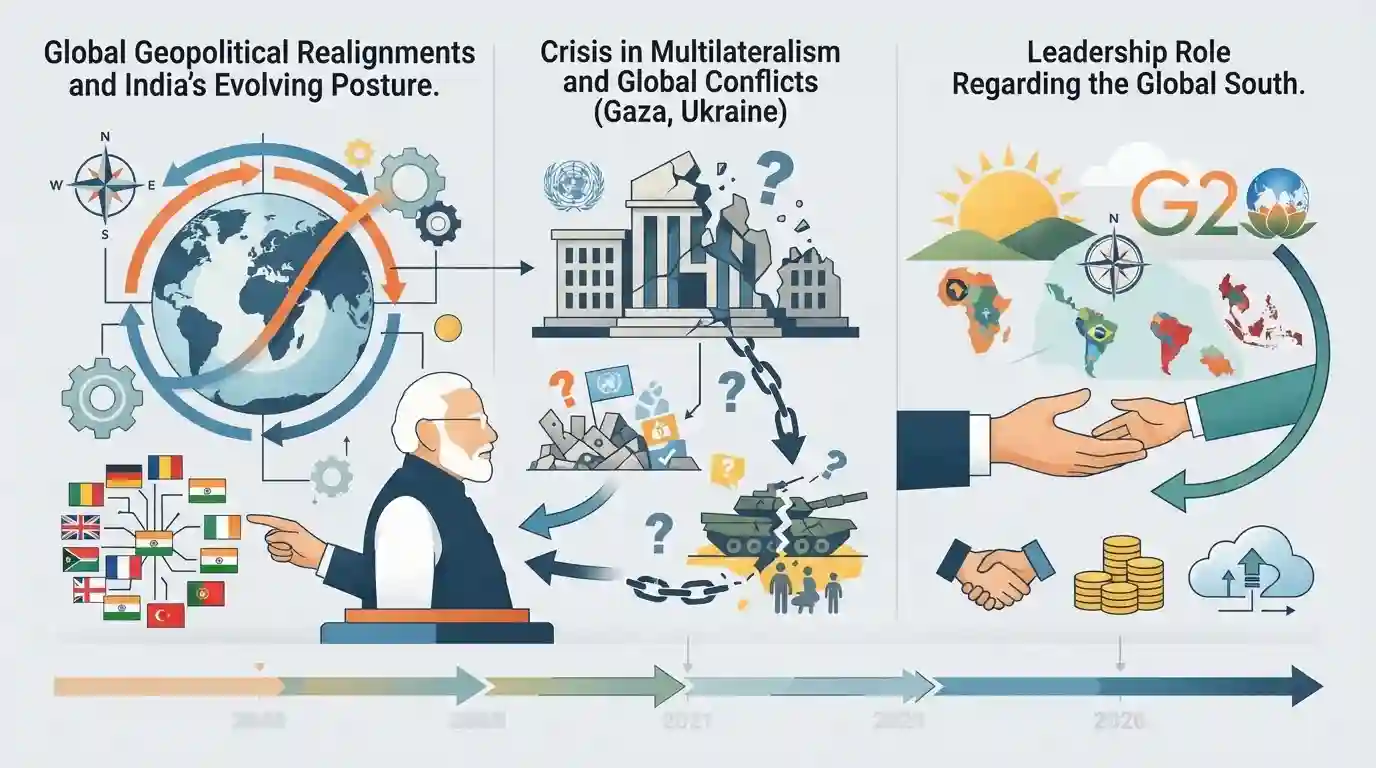
An analysis of India's evolving foreign policy posture amid global geopolitical realignments, the crisis in multilateralism, conflicts in Gaza and Ukraine, and its leadership role regarding the Global South.
Key Points
- India's foreign policy is navigating complex geopolitical shifts, balancing its traditional posture towards the Global South with strategic partnerships with major powers.
- The evolving global order, marked by conflicts in Gaza and Ukraine, poses challenges for multilateral institutions like the United Nations.
- New Delhi's diplomatic approach emphasizes strategic autonomy and reforming global governance architecture to reflect contemporary realities.
Important Terms
United Nations

An international organization founded in 1945 to promote global peace, security, and cooperation among member states, facing contemporary criticisms over reform and representation.
UPSC context
GS Paper II: International Relations — important international institutions, their structure, mandate, and India's quest for UNSC reforms.
Global South
A term grouping developing and emerging economies primarily in Asia, Africa, and Latin America, sharing common developmental challenges and advocating for equitable global governance.
UPSC context
GS Paper II: International Relations — India's foreign policy outreach, bilateral and group groupings involving developing nations.
Prelims Trap
India's abandonment of non-alignment in favor of formal military alliances with Western powers.
Aspirants often assume India has abandoned NAM for formal military alliances; however, India practices multi-alignment and strategic autonomy without entering into formal security pacts.
Static Concepts Connected
What are the key pillars and structural demands of India's policy on UN Security Council reforms?
- Permanent Seat: Permanent Representation: India demands a permanent seat in an expanded UNSC, citing its status as the most populous nation and a major economic power.
- Geographic Inequity: Geographic Representation: Correction of historical injustices that left the entire African continent and developing world underrepresented in decision-making bodies.
- G4 Coalition: G4 Alignment: India coordinates closely with G4 nations (Japan, Germany, Brazil, India) to push for mutual permanent membership and veto restructuring.
What is the doctrinal definition and evolution of 'Strategic Autonomy' in Indian foreign policy?
- Cold War Roots: Historical Roots: Evolved from the Non-Aligned Movement (NAM) during the Cold War, prioritizing independent judgment over bloc loyalty.
- Multi-alignment Shift: Multi-alignment: Modern adaptation where India engages simultaneously with competing power poles (e.g., QUAD and BRICS) based on national interest.
- Issue-based Focus: Issue-based Diplomacy: Maintaining autonomous decision-making on trade, energy security, and defense acquisitions without external dictates.
Cross-Topic Patterns
UNSC Reform + Global South Leadership
India's UN Security Council reform advocacy is consistently paired with its leadership claim over the Global South, linking multilateral diplomacy to developmental geopolitics.
Multi-alignment + Strategic Autonomy in Great Power Competition
Balancing ties with Russia over Ukraine while maintaining deep strategic partnerships with the US and Quad exemplifies India's practical multi-alignment strategy.

Strategic autonomy + multi-alignment in the context of UN reform and Global South representation will likely feature in Mains GS-2.
Linked PYQs · 3
Linked PYQs · 3
- 2025MainsGS2
"The reform process in the United Nations remains unresolved, because of the delicate imbalance of East and West and entanglement of the USA vs. Russo-Chinese alliance.” Examine and critically evaluate the East-West policy confrontations in this regard.
- 2019MainsGS2
‘The long-sustained image of India as a leader of the oppressed and marginalised nations has disappeared on account of its new found role in the emerging global order.’ Elaborate.
- 2022MainsGS2
How will I2U2 (India, Israel, UAE and USA) grouping transform India's position in global politics?
