India and UK partner to offer healthcare study scholarships
Source:Indian Express ↗
Why It Matters
Demonstrates how international academic-philanthropic partnerships can facilitate skill development and capacity building in specialized fields like biomedical engineering, which is crucial for modernizing India's healthcare infrastructure and achieving self-reliance.
Summary
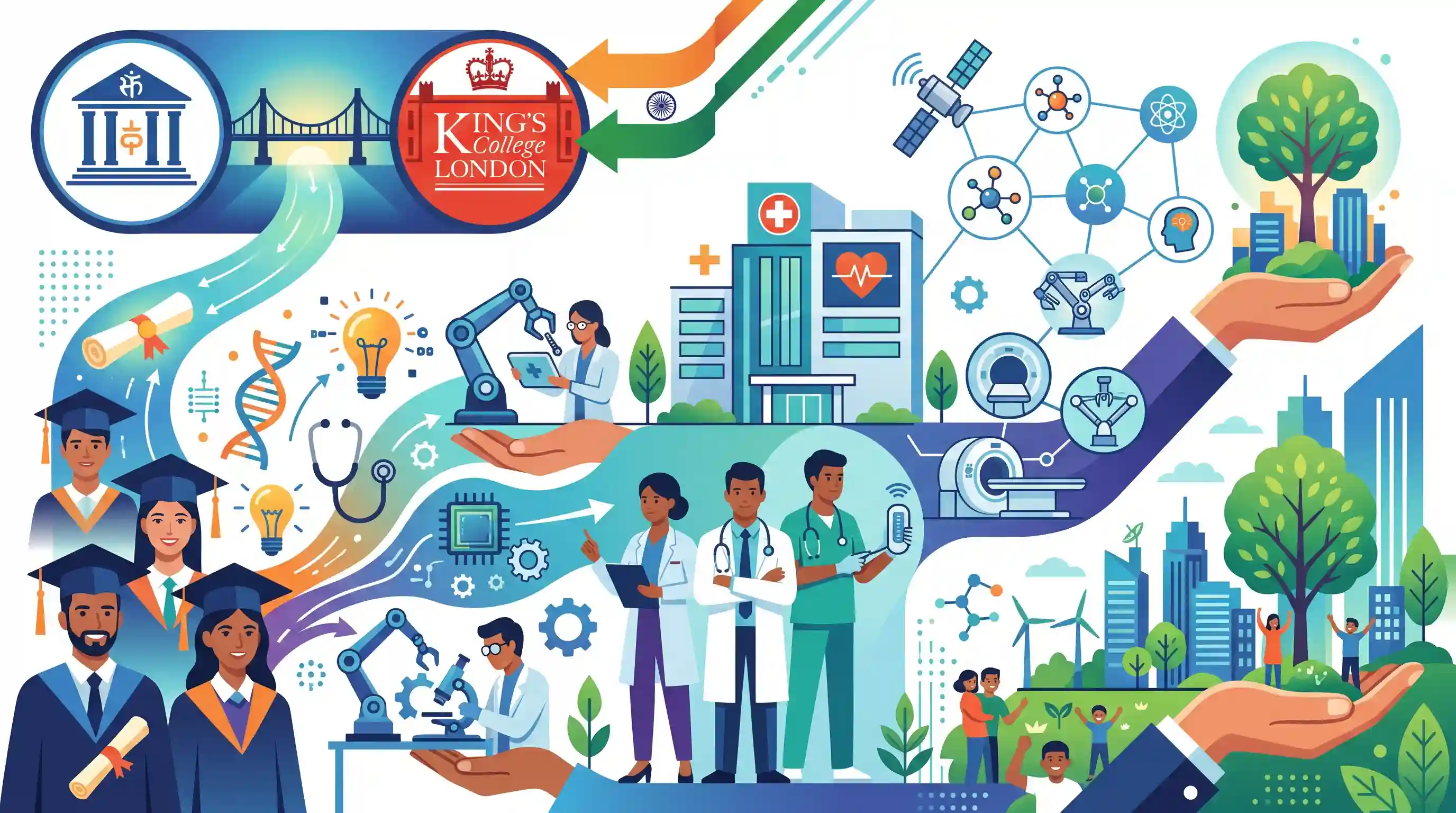
The Hinduja Foundation and King's College London have partnered to offer targeted scholarships for Indian students pursuing PhDs in healthcare technologies and MScs in MedTech Innovation. This India-UK educational collaboration aims to enhance India's domestic healthcare capabilities and biomedical engineering expertise. By facilitating international knowledge exchange, the initiative seeks to build a global-standard, resilient healthcare workforce in India, aligning with the nation's 'Viksit Bharat' vision.
Key Points
- The Hinduja Foundation and King's College London (KCL) have announced scholarships for Indian students pursuing higher studies in healthcare engineering and medical innovation.
- The initiative covers partial or full tuition for four-year PhD programs in healthcare technologies and one-year MSc programs in MedTech Innovation and Entrepreneurship.
- The collaboration aims to build future-ready talent and resilient healthcare systems in India aligned with global standards, directly supporting the 'Viksit Bharat' vision.
- This partnership emphasizes the importance of international educational collaborations in strengthening domestic capabilities in biomedical engineering and expanding global healthcare research.
Important Terms
Viksit Bharat @ 2047

Government of India's long-term vision to transform the country into a developed, self-reliant, and inclusive nation by the centenary of its independence in 2047.
UPSC context
GS II (Governance) and GS III (Economic Development). Tests understanding of India's long-term developmental targets and socio-economic transformation.
India-UK 2030 Roadmap
A comprehensive bilateral framework adopted in 2021 to elevate ties to a 'Comprehensive Strategic Partnership' across health, climate, trade, education, and science.
UPSC context
GS II (International Relations). Crucial for understanding India’s strategic partnerships and bilateral cooperation in global health and technology.
National Medical Devices Policy (2023)
A policy framework designed to reduce India’s 80% import dependence in medical devices, targeting a $50 billion market size by 2030 through domestic manufacturing and R&D.
UPSC context
GS III (Economy/S&T). Relevant for discussions on sectoral industrial policies, self-reliance (Atmanirbhar Bharat), and medical innovation.
MedTech (Medical Technology)
Healthcare innovations—including devices, diagnostics, and software—aimed at improving patient outcomes and streamlining medical care through engineering and digital tools.
UPSC context
GS III (Science and Technology). Tests knowledge of emerging healthcare technologies and their role in improving domestic health infrastructure.
Hinduja Foundation
The philanthropic arm of the global Hinduja Group conglomerate, focusing on healthcare, education, and rural development through international research and scholarship partnerships.
UPSC context
GS II (Governance/CSR). Represents the role of the Indian diaspora and corporate philanthropy in bilateral relations and education.
King’s College London (KCL)
A premier research university in the UK that collaborates with Indian institutions to enhance biomedical engineering, MedTech innovation, and healthcare leadership skills.
UPSC context
GS II (International Relations). Illustrates academic diplomacy and global human resource development between India and the UK.
Prelims Trap
The Hinduja-KCL MedTech scholarship is a centrally sponsored scheme operationalizing the India-UK Roadmap 2030.
It is a private philanthropic initiative by the Hinduja Foundation, not a government-funded bilateral scheme, even though it broadly aligns with India-UK Roadmap 2030 objectives.
Static Concepts Connected
What is the regulatory and economic status of India's Medical Device sector?
- Import heavy: India relies heavily on imports, sourcing nearly 80% of its high-end medical devices from abroad, which poses a vulnerability to healthcare security.
- FDI Policy: 100% Foreign Direct Investment (FDI) is permitted under the automatic route for both brownfield and greenfield medical device manufacturing setups.
- Regulatory body: Governed by the Medical Devices Rules, 2017, under the purview of the Central Drugs Standard Control Organisation (CDSCO).
How do Track II and Track III diplomacy differ in International Relations?
- Track II: Unofficial, non-governmental dialogues involving academics, retired officials, and think tanks to build trust and resolve conflicts outside formal channels.
- Track III: Grassroots, people-to-people diplomacy driven by private individuals, NGOs, and philanthropic foundations (like the Hinduja Foundation).
Cross-Topic Patterns
MedTech imports & PLI push
India's 80% reliance on imported medical devices links this educational capacity-building goal directly to the government's Production Linked Incentive (PLI) scheme aimed at boosting domestic medical device manufacturing.
Brain Circulation vs. Brain Drain
Modern educational tie-ups focus on 'brain circulation'—where returning scholars bring niche technological expertise back to domestic sectors—contrasting with historical anxieties over capital-flight and 'brain drain'.

India's MedTech sector—specifically its 100% automatic FDI route and CDSCO regulatory framework—is ripe for Prelims statement questions.
Linked PYQs · 4
Linked PYQs · 4
- 2023MainsGS2
The crucial aspect of development process has been the inadequate attention paid to Human Resource Development in India. Suggest measures that can address this inadequacy.
- 2023MainsGS2
Skill development programmes have succeeded in increasing human resources supply to various sectors. In the context of the statement analyse the linkages between education, skill and employment.
- 2023MainsGS3
Introduce the concept of Artificial Intelligence (AI). How does Al help clinical diagnosis? Do you perceive any threat to privacy of the individual in the use of Al in healthcare?
- 2019MainsGS2
The need for cooperation among various service sectors has been an inherent component of development discourse. Partnership bridges the gap among the sectors. It also sets in motion a culture of 'collaboration' and 'team spirit'. In the light of statements above examine India's development process.
