India and United Kingdom Sign Comprehensive Free Trade Agreement
Source:Indian Express ↗
Why It Matters
The India-UK FTA is a monumental milestone in India's contemporary foreign policy and economic diplomacy. For UPSC aspirants, it is highly relevant for GS Paper 2 (Bilateral agreements and policies affecting India's interests) and GS Paper 3 (Economy - foreign trade, exports, and investment). It exemplifies India's strategic pivot toward securing high-standard trade deals with developed Western economies to boost manufacturing and service exports.
Summary
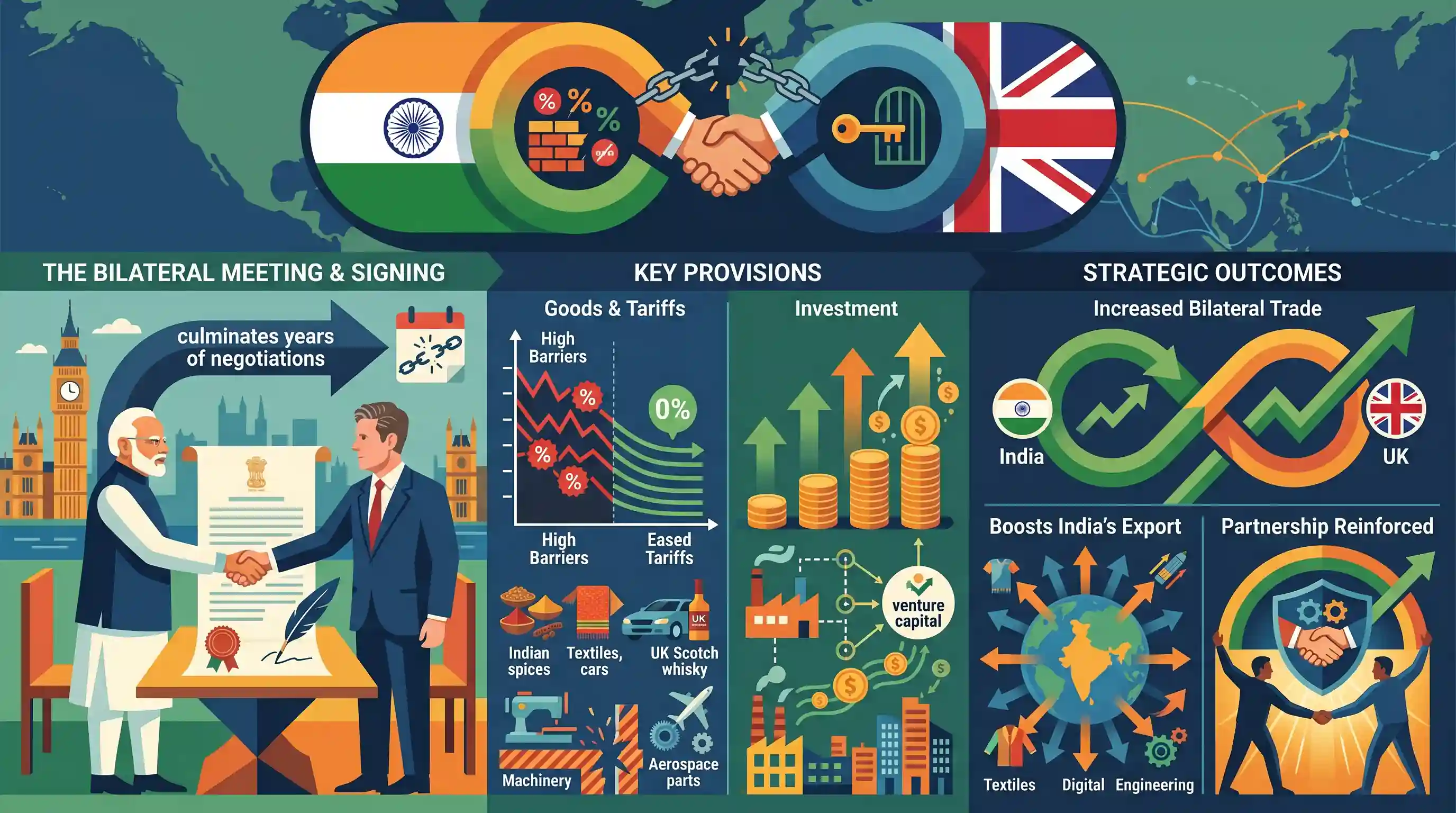
During Prime Minister Narendra Modi's official visit to the UK, India and the United Kingdom formally signed a long-awaited Free Trade Agreement following a bilateral meeting with UK Prime Minister Keir Starmer. The agreement marks the culmination of years of intense negotiations, aiming to comprehensively lower trade barriers, ease tariffs on goods and services, and boost cross-border investments. This strategic economic pact is expected to substantially enhance bilateral trade volumes, providing a major impetus to India's export objectives and reinforcing the India-UK Comprehensive Strategic Partnership.
Key Points
- India and the United Kingdom signed a historic Free Trade Agreement (FTA) during PM Narendra Modi's official visit to the UK and his meeting with UK Prime Minister Keir Starmer.
- The landmark agreement concludes years of rigorous and complex negotiations concerning bilateral trade in goods, services, intellectual property, and cross-border investments.
- The FTA aims to significantly reduce or eliminate tariffs on key exports, expand market access for businesses in both countries, and drive bilateral trade volumes.
- This deal constitutes a crucial pillar of India's economic diplomacy, elevating the India-UK Comprehensive Strategic Partnership and deepening India's economic integration with major Western economies.
Important Terms
India-UK Free Trade Agreement (FTA/CETA)

An ambitious trade pact signed in 2025 to reduce tariffs on goods (like whisky and cars) and services, aiming to double bilateral trade and enhance professional mobility between India and Britain.
UPSC context
GS Paper II (Bilateral Agreements) and GS Paper III (Indian Economy); tests knowledge of trade diplomacy and post-Brexit economic realignments.
Comprehensive Strategic Partnership
A bilateral status established in 2021, elevating ties across five pillars: people-to-people, trade, defense, climate, and health, supported by a long-term roadmap.
UPSC context
GS Paper II (International Relations); focuses on the institutional framework governing strategic, security, and economic cooperation between India and major Western powers.
Double Contribution Convention (DCC)
A social security agreement signed alongside the FTA to prevent professionals from paying mandatory insurance/social security contributions in both countries simultaneously, benefiting Indian IT and healthcare workers.
UPSC context
GS Paper II & III; relevant for topics on the Indian diaspora, labor mobility, and ease of doing business in bilateral treaties.
India-UK Roadmap 2030
A strategic 10-year framework launched in 2021 to guide the India-UK relationship, targeting a doubling of trade value and deeper collaboration in defense and health by the decade's end.
UPSC context
GS Paper II; essential for understanding the timeline and specific targets of India's multi-sectoral engagement with the United Kingdom.
India-UK Vision 2035
A future-oriented strategic document endorsed in 2025 to advance the partnership through five core pillars: growth, technology, defense, climate, and education, extending the horizon of cooperation.
UPSC context
GS Paper II; highlights long-term strategic planning and technology-driven diplomacy in India's foreign policy.
Prelims Trap
"Rules of Origin in FTAs mandate that 100% of the product must be domestically sourced to qualify for tariff exemptions."
Rules of Origin require a specified minimum 'domestic value addition' (often 30-40%), not 100% domestic sourcing. This allows global supply chain integration while preventing trade deflection.
Static Concepts Connected
What are the four modes of services trade under the WTO's GATS?
- Mode 1: Cross-border supply (e.g., software services or telemedicine provided from India to clients in the UK).
- Mode 2: Consumption abroad (e.g., British tourists, patients, or students consuming services within India).
- Mode 3: Commercial presence (e.g., an Indian IT multinational setting up a corporate branch or subsidiary in London).
- Mode 4: Presence of natural persons (e.g., Indian software engineers travelling temporarily to the UK for a project).
What is a Totalisation Agreement (Mutual Social Security Agreement)?
- Avoids Dual Contribution: Prevents expatriate workers from having to pay social security taxes in both their home and host countries simultaneously, ensuring they only contribute to one system.
- Benefit Portability: Allows professionals to repatriate their accumulated social security and pension savings when returning to their home country, preventing sunk costs.
Cross-Topic Patterns
Mode 4 vs Domestic Protectionism
India's FTAs consistently trade domestic tariff cuts on sensitive goods (like Scotch whisky or automobiles) to secure 'Mode 4' services access for Indian IT and healthcare professionals, a recurring GS2/GS3 theme.
Totalisation Pacts & Diaspora Economics
Securing a Totalisation Agreement with the UK highlights India's ongoing, stalled efforts to secure a similar pact with the USA, which currently costs the Indian diaspora billions in sunk payroll taxes.

WTO GATS 'Mode 4' (services) and 'Rules of Origin' (goods) are prime targets for a comparative multi-statement Prelims question.
Linked PYQs · 5
Linked PYQs · 5
- 2023MainsGS2
Compare and contrast the British and Indian approaches to Parliamentary sovereignty.
- 2020MainsGS2
The judicial systems in India and UK seem to be converging as well as diverging in recent times. Highlight the key points of convergence and divergence between the two nations in terms of their judicial practices.
- 2017PrelimsGS1
Consider the following statements: 1. India has ratified the Trade Facilitation Agreement (TFA) of WTO. 2. TFA is a part of WTO's Bali Ministerial Package of 2013. 3. TFA came into force in January 2016. Which of the statements given above is/are correct?
- 2017MainsGS3
Account for the failure of manufacturing sector in achieving the goal of labour-intensive exports. Suggest measures for more labour-intensive rather than capital-intensive exports.
- 2023MainsGS2
‘The expansion and strengthening of NATO and a stronger US-Europe strategic partnership works well for India.’ What is your opinion about this statement ? Give reasons and examples to support your answer.
