India UK Comprehensive Trade Agreement Set for July Implementation
Source:The Hindu ↗
Why It Matters
The India-U.K. CETA serves as a key case study for UPSC aspirants on navigating non-tariff barriers, quotas, and protectionist tendencies (like the steel tariff dispute) within modern Free Trade Agreements. The accompanying Social Security Agreement underscores India's focus on securing human capital mobility and addressing the concerns of its professional diaspora.
Summary
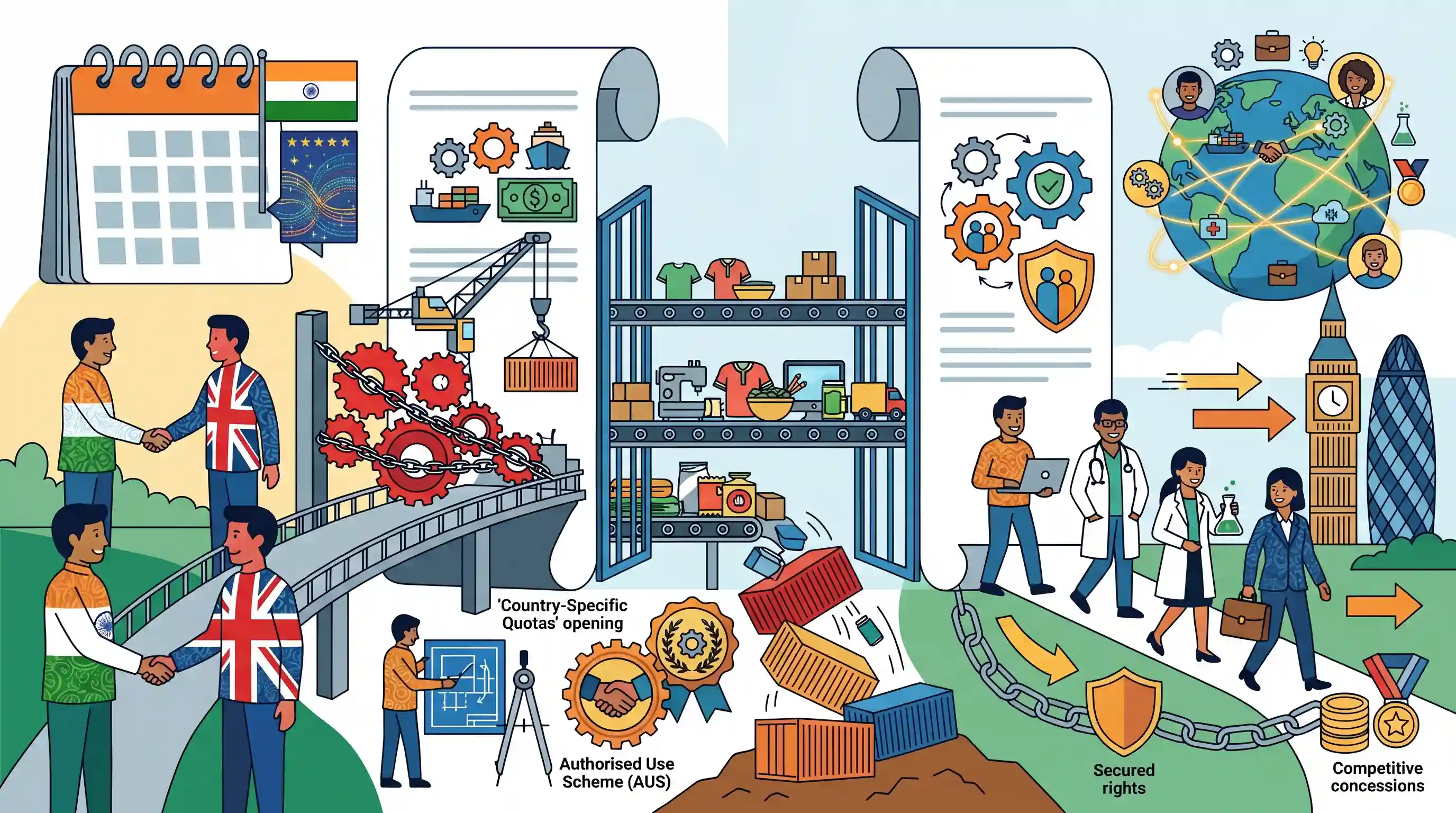
India and the U.K. have finalized July 15, 2026, as the implementation date for their landmark Comprehensive Economic and Trade Agreement (CETA) after resolving a late-stage dispute over steel tariffs. The U.K. had initially imposed protectionist measures by slashing duty-free steel quotas and doubling tariffs on excess imports, but Indian negotiators successfully secured country-specific quotas and access through an Authorised Use Scheme (AUS). Crucially, the rollout of CETA—which will eliminate tariffs on 99% of U.K. product lines—will be accompanied by the Agreement on Social Security, or Double Contribution Convention (DCC). This secondary agreement secures vital mobility rights and competitive concessions for Indian professionals working in the U.K., solidifying a major bilateral economic partnership.
Key Points
- India and the U.K. will officially implement their Comprehensive Economic and Trade Agreement (CETA) on July 15, 2026.
- A major dispute over steel tariffs was resolved after the U.K. had unilaterally cut duty-free steel quotas by 60% and doubled tariffs on above-quota imports to 50%.
- The compromise guarantees country-specific steel quotas for India, residual quotas, and access under an Authorised Use Scheme (AUS).
- The implementation is paired with the Agreement on Social Security, also known as the Double Contribution Convention (DCC), protecting the mobility and competitive advantages of Indian professionals in the U.K.
- Under CETA, the U.K. will remove tariffs on 99% of its product lines, boosting Indian exports.
Important Terms
Comprehensive Economic and Trade Agreement (CETA)

The formal name for the India-UK Free Trade Agreement (FTA). It aims to eliminate tariffs on 99% of product lines and double bilateral trade to $100 billion by 2030.
UPSC context
GS Paper II (International Relations) and GS Paper III (Economy). Tests knowledge of India's major bilateral trade frameworks and economic diplomacy.
Double Contribution Convention (DCC)
A bilateral pact ensuring that workers on temporary overseas assignments pay social security taxes in only one country. It prevents dual taxation for professionals and companies.
UPSC context
GS Paper II (Indian Diaspora) and GS Paper III (Services Trade). Crucial for understanding service-sector competitiveness and professional mobility.
Authorised Use Scheme (AUS)
A trade provision where specific goods (like steel) are granted reduced or zero duty rates provided they are used for a prescribed industrial or end-use purpose.
UPSC context
GS Paper III (Economy). Illustrates technical trade negotiation strategies used to bypass protectionist barriers and protect domestic industrial exports.
Steel Safeguard Measures
Trade barriers (tariffs or quotas) used by a nation to protect domestic industries from sudden import surges. UK's application of these on steel was a major CETA hurdle.
UPSC context
GS Paper III (International Trade). Tests understanding of non-tariff barriers and the conflict between domestic protectionism and free trade principles.
Country-Specific Quota (CSQ)
A trade allocation giving a specific country a dedicated volume of exports under lower tariffs, preventing it from being outcompeted by global "first-come, first-served" quotas.
UPSC context
GS Paper III (International Trade). Relevant for understanding how India secures preferential market access in the face of rising global trade restrictions.
Prelims Trap
The Double Contribution Convention requires Indian professionals to simultaneously contribute to both U.K. and Indian social security systems.
It does the exact opposite. The convention eliminates dual taxation, ensuring temporary workers are exempt from U.K. national insurance if they contribute to India's EPFO.
Static Concepts Connected
What are the differences between an FTA, CECA, and CEPA/CETA?
- Free Trade Agreement (FTA): Reduces or eliminates customs duties on traded goods, but often has a narrower scope regarding services, intellectual property, and cross-border investments.
- Comprehensive Economic Cooperation Agreement (CECA): Usually serves as a stepping stone or early-harvest scheme, focusing primarily on tariff reduction and basic economic cooperation.
- Comprehensive Economic Partnership/Trade Agreement (CEPA/CETA): Highly comprehensive, going beyond goods to deeply integrate services, investments, mobility rights, regulatory harmonization, and government procurement.
How do Tariff Rate Quotas (TRQs) function in international trade?
- In-Quota Imports: Allows a specified, limited quantity of imported products to enter a country at a reduced or zero tariff rate.
- Above-Quota Tariffs: Imports exceeding this specified quota limit are subjected to a significantly higher, often prohibitive, tariff rate to protect domestic industries.
- WTO Compliance: WTO rules allow TRQs to balance the protection of domestic producers with the need to maintain a managed supply of essential imports.
Cross-Topic Patterns
U.K. steel tariffs vs. CBAM
Bilateral tariff resolutions like this steel quota will increasingly clash with unilateral climate-trade policies, particularly the U.K. and EU's upcoming Carbon Border Adjustment Mechanisms (CBAM).
Mode 4 Services and FTAs
The Double Contribution Convention (DCC) directly supports Mode 4 (movement of natural persons) service exports under GATS, highlighting India's core negotiating strategy with developed nations.

Expect a paired Prelims question matching recent trade agreements (CEPA, CETA, ECTA) with their respective partner countries and features.
Linked PYQs · 4
Linked PYQs · 4
- 2025MainsGS3
What are the challenges before the Indian economy when the world is moving away from free trade and multilateralism to protectionism and bilateralism? How can these challenges be met?
- 2018MainsGS3
How would the recent phenomena of protectionism and currency manipulations in world trade affect macroeconomic stability of India?
- 2016PrelimsGS1
The term 'Regional Comprehensive Economic Partnership' often appears in the news in the context of the affairs of a group of countries known as
- 2023MainsGS2
Indian diaspora has scaled new heights in the West. Describe its economic and political benefits for India.
