India and UK Chart Defence Cooperation Roadmap
Source:The Hindu ↗
Why It Matters
India-UK defence and trade synergies are critical in the post-Brexit era. A comprehensive FTA and defence industrial roadmap will diversify India's strategic procurements, boost indigenous defence manufacturing, and strengthen technological exchange, enhancing India's broader geopolitical footprint.
Summary
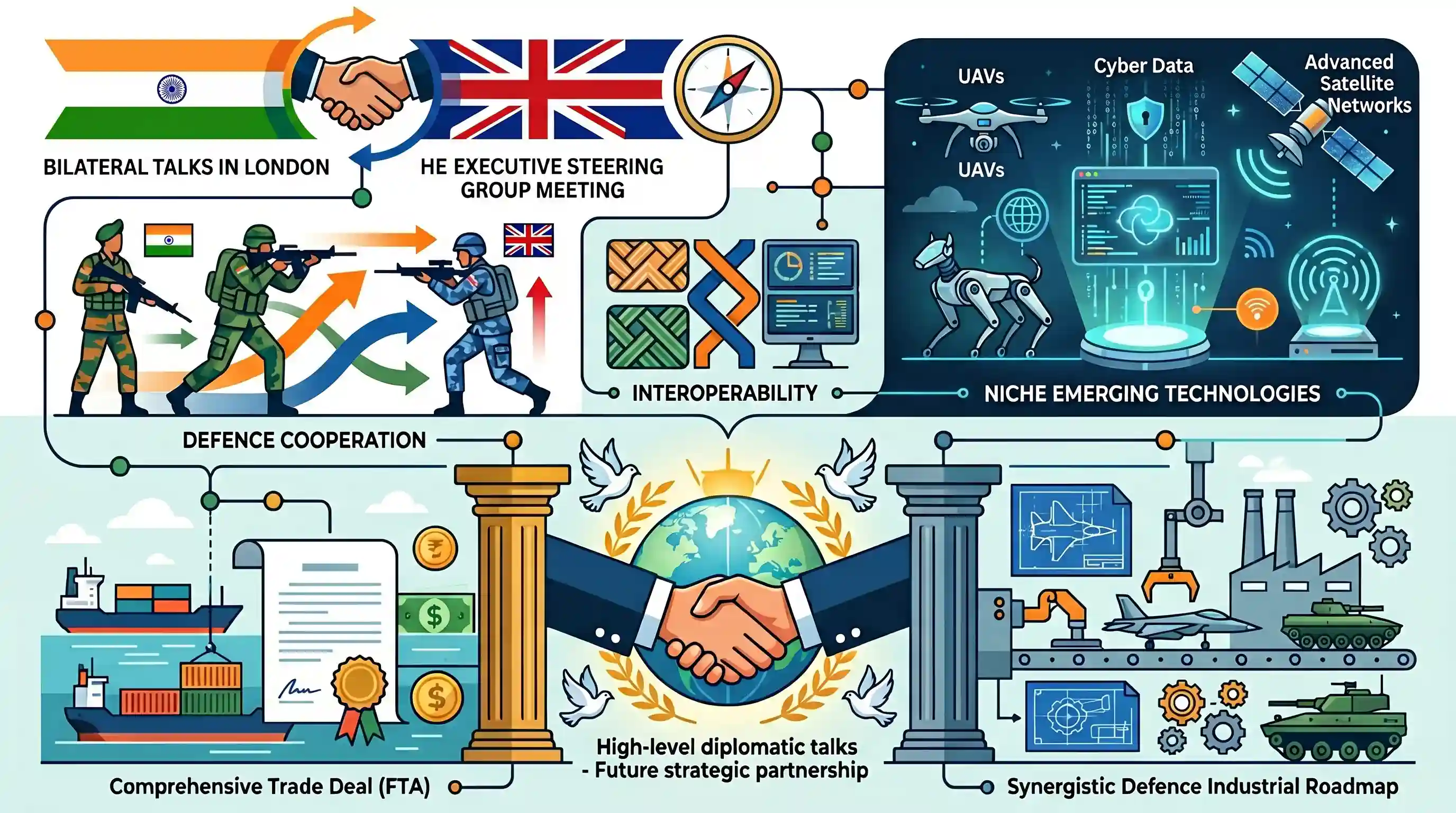
India and the United Kingdom held the 15th Executive Steering Group (ESG) meeting in London to expand their bilateral defence cooperation. The Indian and British armies focused discussions on interoperability, joint military exercises, and niche emerging technologies. In tandem, high-level diplomatic talks between the two nations highlighted the shared goal of forging a future-oriented strategic partnership. This enhanced relationship is expected to be anchored by an impending comprehensive trade deal (FTA) and a synergistic defence industrial roadmap.
Key Points
- The 15th India-United Kingdom Executive Steering Group (ESG) meeting convened in London to strengthen bilateral defence cooperation.
- Key military discussions centered on enhancing interoperability, conducting joint exercises, and sharing expertise in emerging military technologies.
- Diplomatic engagements between External Affairs Minister S. Jaishankar and UK Foreign Secretary Yvette Cooper emphasized a future-oriented partnership.
- Both nations are prioritizing a comprehensive trade deal and a robust defence industrial roadmap to deepen strategic and economic ties.
Important Terms
Executive Steering Group (ESG)

A bilateral institutional mechanism between Indian and British armies to review and plan military-to-military cooperation, joint exercises, training, and technology exchange.
UPSC context
GS Paper 2: Bilateral agreements. Tests knowledge of institutional frameworks driving India's strategic partnerships.
India-UK Free Trade Agreement (FTA)
Formally known as CETA, this landmark deal (effective July 2026) aims to double bilateral trade by 2030 through significant tariff reductions on goods like automobiles and textiles.
UPSC context
GS Paper 2/3: International trade and economy. Critical for understanding post-Brexit dynamics and India's trade architecture.
Defence Industrial Roadmap
A 10-year strategic framework for shifting India-UK ties from a buyer-seller model to joint co-design, co-development, and co-production of advanced military technologies like jet engines.
UPSC context
GS Paper 3: Indigenization of technology. Relevant for 'Aatmanirbhar Bharat' in the defence sector.
MBDA
A major European missile developer collaborating with India on complex weapons, including Advanced Short-Range Air-to-Air Missiles (ASRAAM) and Lightweight Multirole Missile (LMM) systems.
UPSC context
Prelims/GS Paper 3: Science and Technology. Illustrates international collaboration in advanced weaponry.
Interoperability
The ability of different military forces to operate together effectively using shared standards, communication systems, and tactics; a core goal of India-UK joint exercises.
UPSC context
GS Paper 3: Security challenges. Essential for joint operations in the Indo-Pacific region.
India-UK Vision 2035
A comprehensive bilateral framework signed in 2025 to elevate India-UK relations to a higher strategic level across trade, technology, and security by the mid-2030s.
UPSC context
GS Paper 2: Foreign policy. Represents the long-term strategic trajectory of India-UK ties.
Prelims Trap
"Roadmap 2030 is a bilateral framework between India and the European Union."
"Roadmap 2030" was adopted in 2021 specifically to elevate India-UK relations to a Comprehensive Strategic Partnership, not an India-EU or UN initiative.
Static Concepts Connected
What are the primary bilateral military exercises conducted by India and the UK?
- Army: 'Ajeya Warrior', a joint military exercise focused on counter-terrorism operations and enhancing interoperability.
- Navy: 'Konkan', a maritime exercise designed to build synergy between the Indian Navy and the Royal Navy.
- Air Force: 'Indradhanush', focusing on tactical operations and the sharing of best practices between the two air forces.
How does defence co-development differ from traditional offset clauses in procurement?
- Offset Clauses: Mandates foreign suppliers to invest a specific percentage of the contract value back into the purchasing country's domestic industry.
- Co-development: Involves joint R&D, design, and manufacturing from inception, allowing both nations to share Intellectual Property (IP) and build deeper industrial synergy.
Cross-Topic Patterns
Defence co-production & Atmanirbhar Bharat
The UK-India 'Defence Industrial Roadmap' mirrors India's broader shift from buyer-seller dynamics to co-production, aiming to integrate domestic MSMEs into global defence supply chains.
UK's Indo-Pacific tilt & AUKUS
Post-Brexit, the UK's strategic "Indo-Pacific tilt" and AUKUS commitments compel it to deepen maritime interoperability and emerging tech cooperation with India to stabilize the region.

Expect a 2026 Prelims match-the-following question pairing bilateral frameworks like 'Roadmap 2030' with their respective partner nations.
Linked PYQs · 2
Linked PYQs · 2
- 2020MainsGS2
The judicial systems in India and UK seem to be converging as well as diverging in recent times. Highlight the key points of convergence and divergence between the two nations in terms of their judicial practices.
- 2020MainsGS2
What is the significance of Indo-US defence deals over Indo-Russian defence deals? Discuss with reference to stability in the Indo-Pacific region.
