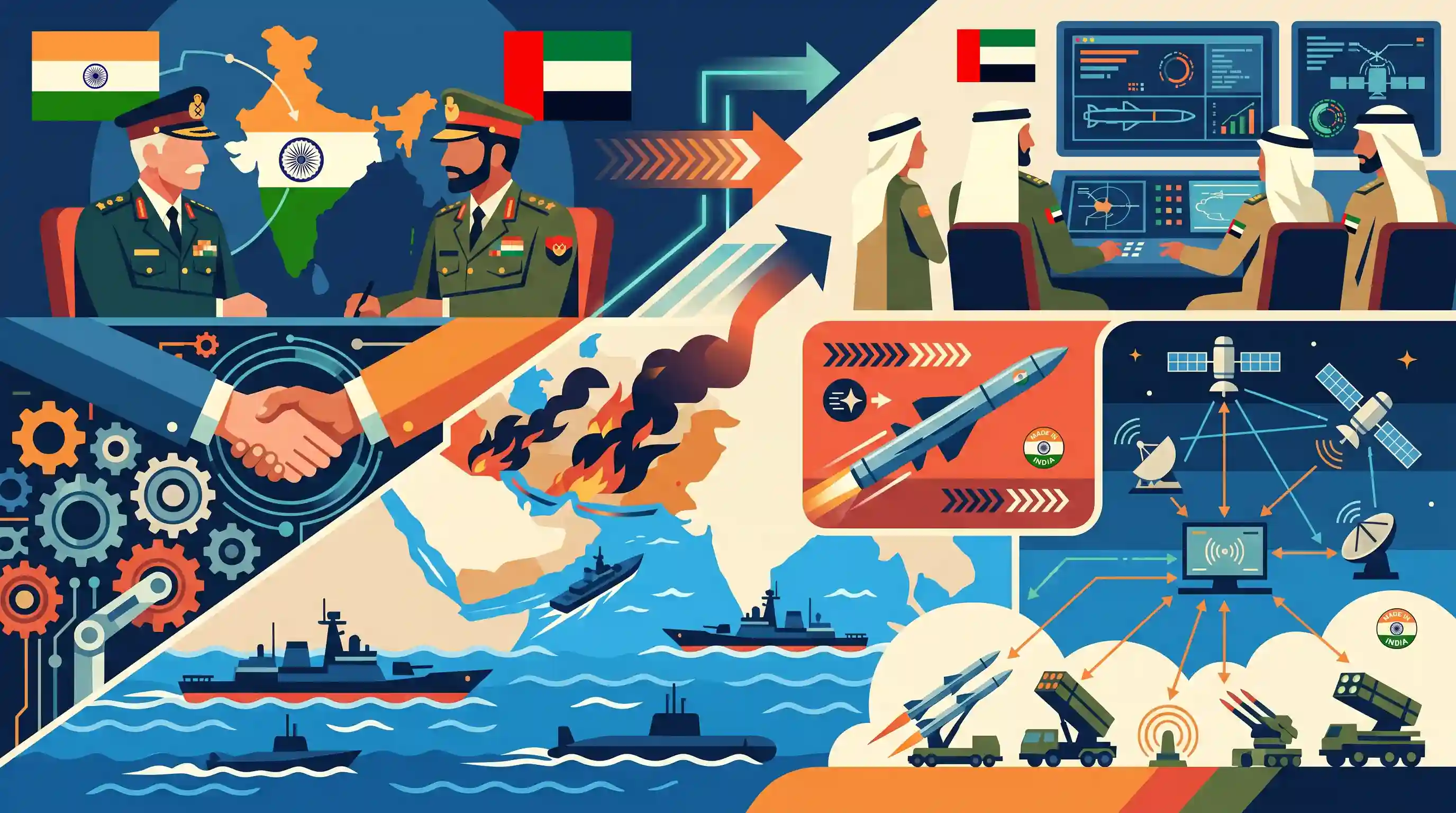
India and UAE Review Strategic Defence Partnership
Source:The Hindu ↗
Why It Matters
It illustrates India's expanding footprint as an exporter of advanced military hardware like BrahMos and Akashteer, and underscores the deepening strategic, security, and maritime ties with a critical Gulf partner amidst regional instability.
Summary
India and the UAE reviewed their Strategic Defence Partnership during a key meeting in New Delhi, focusing on expanding defence industry cooperation and maritime security. Amid ongoing conflicts in West Asia, the UAE is evaluating Indian defence systems to strengthen its air and missile defence, notably showing interest in the BrahMos supersonic cruise missile and the indigenous 'Akashteer' air defence command-and-control network.
Key Points
- The 12th India-UAE Joint Defence Cooperation Committee (JDCC) meeting in New Delhi reviewed progress under the bilateral Strategic Defence Partnership framework signed in May 2026.
- Discussions focused on expanding defence industry cooperation, joint innovation, advanced technology, and enhancing maritime security in the Gulf and Indian Ocean region.
- The UAE has shown keen interest in acquiring the Indo-Russian BrahMos supersonic cruise missile to bolster its deterrence capabilities amidst ongoing conflicts in West Asia.
- The UAE is also evaluating 'Akashteer', an indigenous automated air defence command-and-control network developed by Bharat Electronics Limited (BEL).
Important Terms
Joint Defence Cooperation Committee (JDCC)

The core institutional mechanism (established 2006) co-chaired at the Ministry level to steer India-UAE military ties, including joint exercises, training, and defense industrial collaboration.
UPSC context
GS-II (International Relations); tests knowledge of bilateral institutional frameworks and defense diplomacy in West Asia.
Strategic Defence Partnership Framework
The governing framework that transitions India-UAE relations from a buyer-seller model to a collaborative partnership focused on joint production, co-development, and advanced technology transfer.
UPSC context
GS-II (IR); significant for India's 'Look West' policy and evolving strategic corridors in the Gulf.
BrahMos Missile
A supersonic cruise missile jointly developed by India (DRDO) and Russia (NPOM); it is a flagship product of India’s growing defense export portfolio, currently under evaluation by the UAE.
UPSC context
GS-III (Security/S&T); crucial for defense indigenisation, export targets, and 'Aatmanirbhar Bharat' initiatives.
Project Akashteer
An indigenous, automated air defense control and reporting system developed by BEL to integrate sensors and radars into a unified network for real-time situational awareness.
UPSC context
GS-III (Security); relates to technological absorption in the Indian Army and indigenous air defense command-and-control systems.
Bharat Electronics Limited (BEL)
A premier Navratna Public Sector Undertaking under the Ministry of Defence that specializes in advanced aerospace and electronic products for the Indian Armed Forces.
UPSC context
GS-III (Economy/Security); tests understanding of the role of PSUs in achieving defense self-reliance.
Maritime Security
A strategic pillar of India-UAE cooperation involving joint naval exercises, anti-piracy operations, and information sharing to protect critical energy trade routes like the Strait of Hormuz.
UPSC context
GS-II (IR) & GS-III (Security); vital for energy security and regional stability in the Indian Ocean Region.
Prelims Trap
"Akashteer is a newly developed indigenous surface-to-air missile system."
Akashteer is NOT a missile or weapon system. It is an automated air defence command-and-control network designed to digitize and manage ground-based air defence operations.
Static Concepts Connected
What are the key technical specifications of the BrahMos missile?
- Propulsion: It is a two-stage missile: solid propellant booster engine (first stage) and liquid ramjet (second stage), making it supersonic.
- Cruise vs Ballistic: It is a cruise missile (guided throughout its flight within the atmosphere), unlike ballistic missiles which follow a parabolic, unpowered trajectory after launch.
- MTCR Impact: India's 2016 entry into the Missile Technology Control Regime (MTCR) allowed the extension of its range beyond the original 290 km restriction.
Which key bilateral military exercises take place between India and the UAE?
- Zayed Talwar: A bilateral naval exercise aimed at enhancing maritime security, interoperability, and regional stability in the Gulf region.
- Desert Cyclone: A joint military (Army) exercise focusing on sub-conventional operations, urban warfare, and counter-terrorism under UN mandate.
- Desert Flag: A biennial multilateral air exercise hosted by the UAE, in which the Indian Air Force regularly participates alongside other global powers.
Cross-Topic Patterns
From Energy Buyers to Security Providers
India's West Asia policy has evolved beyond diaspora and oil dependencies to include hard-power diplomacy, exemplified by active defence exports, the I2U2 grouping, and maritime security provisioning.
Indigenisation Lists driving export economics
The surge in defence exports (₹38,000 crore) and interest in systems like Akashteer directly validate the economic impact of the MoD's 'Positive Indigenisation Lists' and expanding domestic manufacturing.

Expect a 2026 Prelims pairs question matching indigenous defence systems (Akashteer, Samar, Akash) to their exact functional classes.
Linked PYQs · 3
Linked PYQs · 3
- 2025MainsGS2
"Energy security constitutes the dominant kingpin of India's foreign policy, and is linked with India's overarching influence in Middle Eastern countries.” How would you integrate energy security with India's foreign policy trajectories in the coming years?
- 2021MainsGS3
How is S-400 air defence system technically superior to any other system presently available in the world?
- 2023PrelimsGS1
Consider the following statements: 1. Ballistic missiles are jet-propelled at subsonic speeds throughout their flights, while cruise missiles are rocket-powered only in the initial phase of flight. 2. Agni-V is a medium-range supersonic cruise missile, while BrahMos is a solid-fuelled intercontinental ballistic missile. Which of the statements given above is/are correct?
