India and UAE Expand Joint Defence and Maritime Ties
Source:The Hindu ↗
Why It Matters
Demonstrates India's growing strategic and defence footprint in the Middle East, transforming the UAE relationship from traditional energy and diaspora dependence toward high-tech defence manufacturing and maritime security cooperation in the Indian Ocean Region.
Summary
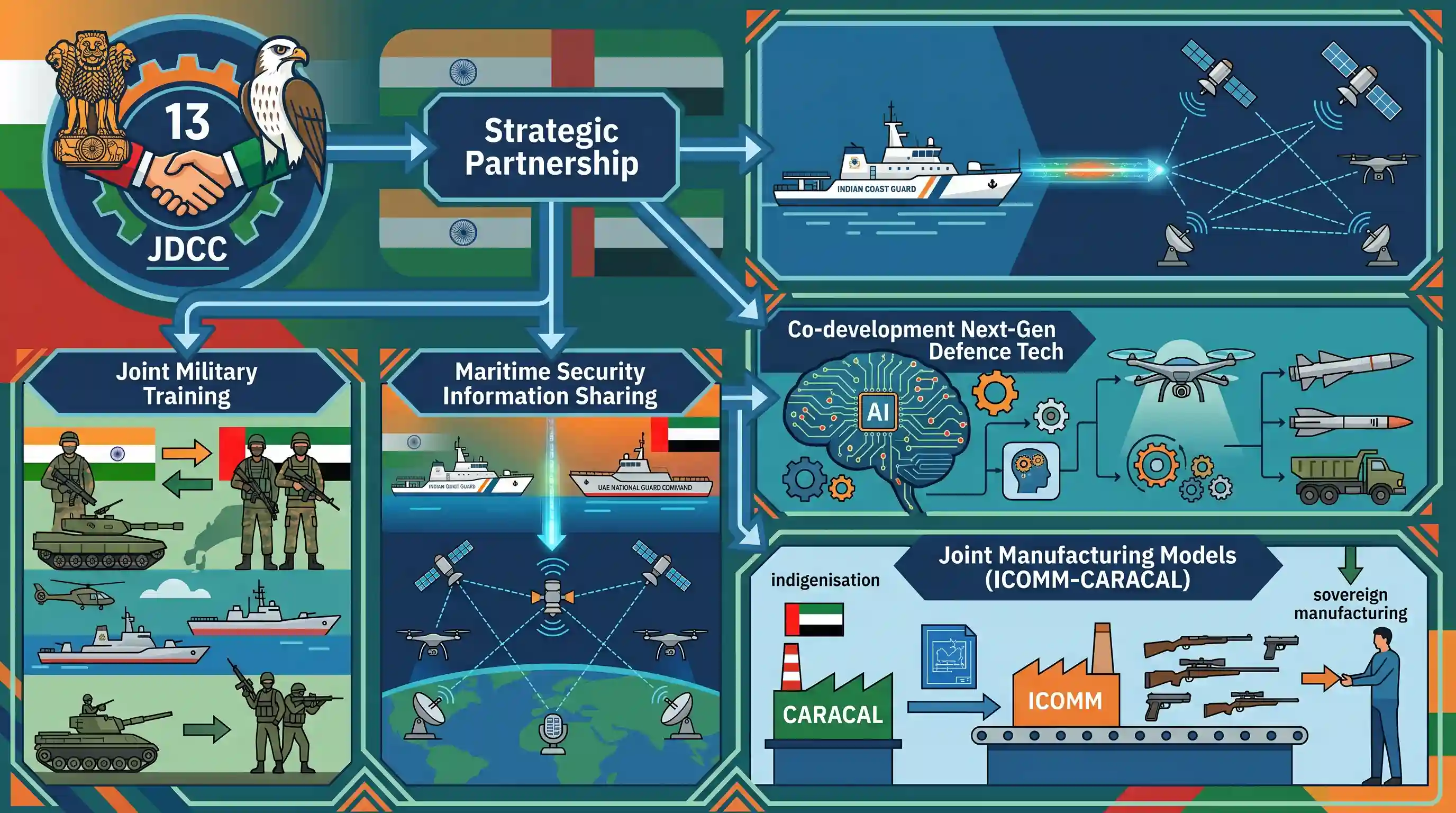
At the 13th Joint Defence Cooperation Committee (JDCC) meeting in New Delhi, India and the UAE agreed to elevate their bilateral defence ties. Expanding upon their Comprehensive Strategic Partnership, the two nations finalized initiatives spanning joint military training, real-time maritime security information sharing, and the co-development of next-generation defence technologies such as AI. Highlights included an MoU between the Indian Coast Guard and the UAE National Guard Command, as well as advancing joint manufacturing models like the ICOMM-CARACAL partnership for small arms production.
Key Points
- India and the UAE co-chaired the 13th Joint Defence Cooperation Committee (JDCC) meeting in New Delhi, elevating defence ties to align with growing trade and investment momentum.
- The countries agreed to enhance military training cooperation and pursue joint manufacturing initiatives, highlighted by the ongoing collaboration between ICOMM (India) and CARACAL (UAE) for small arms production.
- Maritime security took center stage with an MoU signed between the Indian Coast Guard and the UAE National Guard Command, emphasizing real-time information sharing.
- They explored the co-development of next-generation defence technologies, including artificial intelligence (AI), shipbuilding, refits, and platform upgrades.
- The JDCC meeting was preceded by extensive staff-level talks across all three military branches (Army, Navy, and Air Force), underscoring the Comprehensive Strategic Partnership established in 2015.
Important Terms
Comprehensive Strategic Partnership

A high-level bilateral framework established in 2017 to deepen India-UAE cooperation across multi-sectoral domains, including defense, energy, and trade, moving beyond traditional transactional oil-based ties.
UPSC context
GS-2: Bilateral Agreements. Crucial for understanding India's "Extended Neighborhood" policy and strategic autonomy in West Asia.
Joint Defence Cooperation Committee (JDCC)
An institutional mechanism co-chaired at the Secretary level to review and finalize defense initiatives between India and the UAE, spanning joint training, manufacturing, and technology co-development.
UPSC context
GS-2/GS-3: International Relations & Security. Tests knowledge of institutional frameworks that manage bilateral security and defense diplomacy.
MoU on Maritime Security and Safety Cooperation
A 2025 agreement between the Indian Coast Guard and UAE National Guard focusing on search and rescue (SAR), anti-piracy, and pollution response in the Indian Ocean Region.
UPSC context
GS-2/GS-3: Maritime Security. Relevant for SAGAR vision and collaborative security architectures in the Western Indian Ocean.
ICOMM-CARACAL Partnership
A landmark defense manufacturing collaboration between India's ICOMM and UAE's Caracal for the Transfer of Technology (ToT) and local production of small arms in Hyderabad.
UPSC context
GS-3: Indigenization of Technology. Demonstrates private sector roles in 'Make in India' and reducing defense import dependency.
Indian Coast Guard (ICG)
A multi-mission maritime force under the Ministry of Defence responsible for offshore security, marine environment protection, and search and rescue within India's Exclusive Economic Zone.
UPSC context
GS-3: Internal Security. Vital for maritime law enforcement and implementing "SAGAR" security protocols.
UAE National Guard Command (UAE NGC)
The federal security entity in the UAE responsible for protecting vital installations and performing maritime security roles, serving as the primary counterpart to the Indian Coast Guard.
UPSC context
GS-2: International Relations. Represents the key counterpart for India’s maritime and internal security agencies in bilateral cooperation.
Prelims Trap
"CARACAL, recently in the news for small arms joint manufacturing with India, is an Israeli defence firm."
CARACAL is a UAE-based entity partnering with India's ICOMM. Aspirants often default to Israel or Russia for small arms JVs, missing this historic Gulf defence ToT.
Static Concepts Connected
What distinguishes a 'Comprehensive Strategic Partnership' in Indian diplomacy?
- Broader Scope: Elevates standard ties by integrating high-level defence, real-time security data sharing, and critical technology co-development alongside traditional economic trade.
- Institutional Dialogues: Mandates structured, multi-ministerial frameworks like the Joint Defence Cooperation Committee (JDCC) or 2+2 dialogues to sustain strategic momentum and high-level engagement.
- Paradigm Shift: Moves bilateral relations from transactional dependencies (like energy imports or basic trade) to long-term geopolitical, military, and strategic alignment.
What mechanisms secure India's Maritime Domain Awareness (MDA) in the IOR?
- IFC-IOR: The Information Fusion Centre (IFC-IOR) acts as the nodal maritime security hub in Gurugram, coordinating real-time intelligence with partner nations and liaison officers.
- White Shipping Agreements: Bilateral pacts that facilitate the exchange of advance information on the identity and movement of commercial, non-military merchant vessels to track anomalies.
- Coast Guard MoUs: Institutionalized cooperation with foreign maritime agencies (like the UAE National Guard) allows for seamless joint anti-piracy, surveillance, and search-and-rescue (SAR) operations.
Cross-Topic Patterns
Gulf pivot to defence co-production
The bilateral relationship is shifting from transactional energy-trade to defence co-production under 'Make in India', reflecting India's strategy to diversify its military-industrial complex beyond traditional Russian and Western partners.
Net Security Provider in the Arabian Sea
The Coast Guard MoU for real-time information sharing bolsters India's maritime domain awareness and anti-piracy capabilities, consolidating its status as the first responder in the Western Indian Ocean.

The evolution of India-UAE ties from CEPA trade to defence ToTs (CARACAL) and AI co-development is highly probable for a 2026 Mains IR question.
Linked PYQs · 3
Linked PYQs · 3
- 2025MainsGS2
"Energy security constitutes the dominant kingpin of India's foreign policy, and is linked with India's overarching influence in Middle Eastern countries.” How would you integrate energy security with India's foreign policy trajectories in the coming years?
- 2025MainsGS3
Why is maritime security vital to protect India's sea trade? Discuss maritime and coastal security challenges and the way forward.
- 2022MainsGS3
What are the maritime security challenges in India ? Discuss the organisational, technical and procedural initiatives taken to improve the maritime security.
