India Affirms Strategic Autonomy Amid US Tariff Pressures
Source:Indian Express ↗
Why It Matters
This event is a key case study in India's balancing act between managing protectionist trade policies from the US (a major strategic partner) and maintaining its independent foreign policy, especially regarding ties with Russia and energy security.
Summary
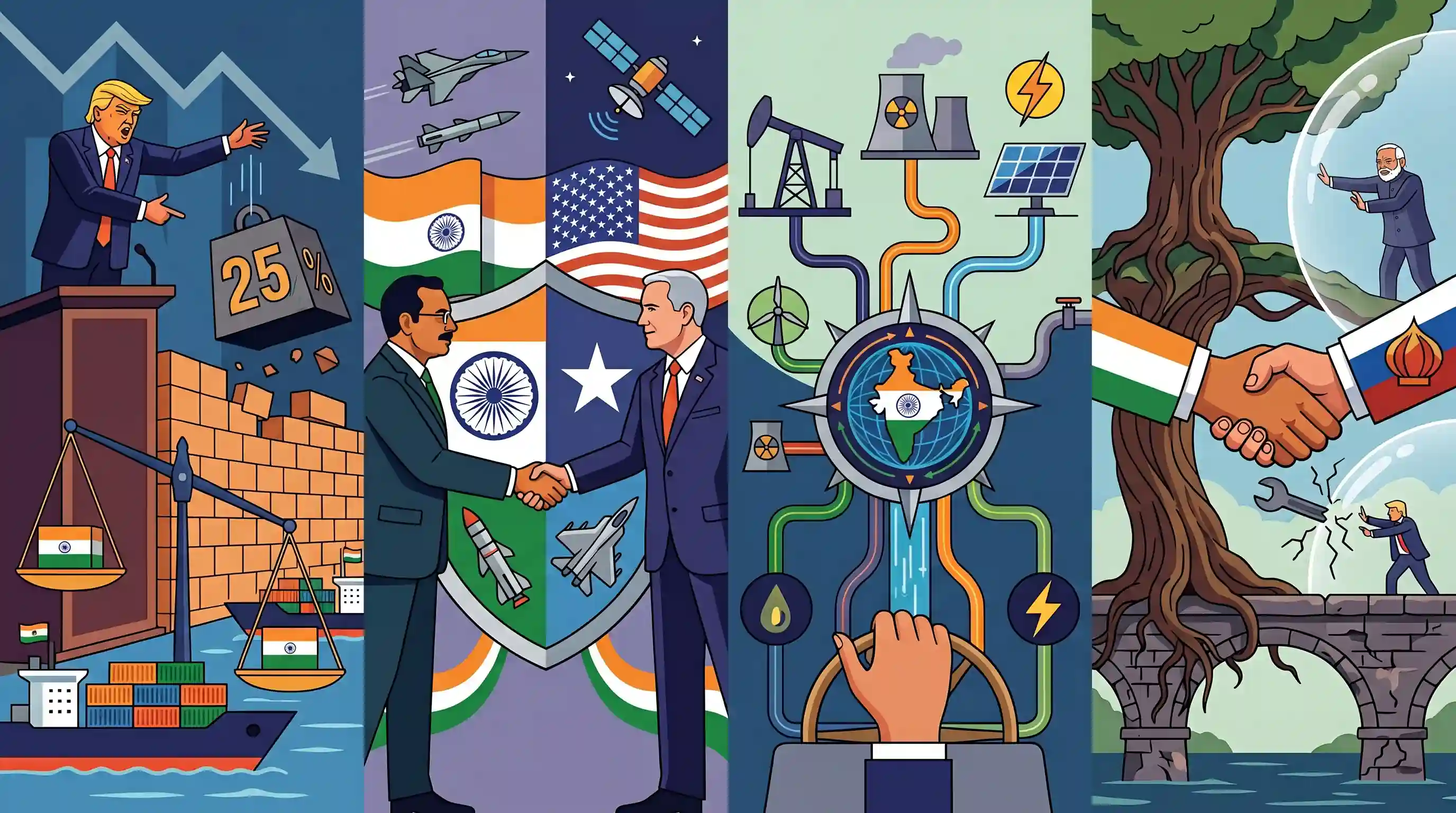
In response to US President Donald Trump's imposition of a 25% tariff and his critical remarks on India's economy, the Ministry of External Affairs affirmed the resilience of India-US ties, highlighting their strong defense and strategic partnership. India also defended its strategic autonomy, stating that energy procurement is based on international market dynamics and that its time-tested relations with Russia are independent of third-party influence.
Key Points
- The Ministry of External Affairs (MEA) emphasized that the India-US partnership is resilient, anchored in shared interests, democratic values, and a strong defense partnership.
- The statement came in response to US President Donald Trump's recent imposition of a 25% tariff on Indian goods and his remarks describing the Indian economy as "dead" and overly protectionist.
- On energy procurement, the MEA clarified that India’s strategies are guided by market offers and global circumstances rather than external pressures.
- India reiterated its strategic autonomy, stating that its steady, time-tested ties with Russia stand on their own merit and should not be viewed through the prism of a third country.
Important Terms
Ministry of External Affairs (MEA)

The Government of India's central agency responsible for managing foreign relations, drafting foreign policy, and representing the nation globally through its diplomatic missions and the Indian Foreign Service (IFS).
UPSC context
GS Paper II: Essential for understanding the institutional framework of India's foreign policy and executive roles in international relations.
Strategic Autonomy
The principle of maintaining independence in foreign policy decision-making, allowing India to pursue national interests through 'multi-alignment' without being constrained by formal military alliances or external pressure from superpowers.
UPSC context
GS Paper II: A cornerstone concept of Indian diplomacy tested by balancing ties with the US and Russia.
Trade Protectionism
Economic policies, such as tariffs and quotas, intended to restrict imports to protect domestic industries from foreign competition. In the US-India context, this often manifests as 'reciprocal tariffs.'
UPSC context
GS Paper III: Relevant to 'Effects of Liberalization' and trade dynamics between major global economies.
Energy Security
The uninterrupted availability of energy sources at an affordable price, which for India involves diversifying imports (e.g., from Russia and the Middle East) to safeguard economic growth.
UPSC context
GS Paper II & III: Critical driver of foreign policy and a key component of national infrastructure and security.
Comprehensive Global Strategic Partnership
The highest tier of India-US bilateral ties, covering defense, high technology (iCET), space, and trade, aimed at ensuring a free and open Indo-Pacific.
UPSC context
GS Paper II: Fundamental to questions on 'Bilateral groupings involving India and affecting India's interests.'
Reciprocal Tariffs
Duties imposed by one country on imports from another in response to similar tariffs previously levied, often used as diplomatic leverage to force trade policy changes.
UPSC context
GS Paper III: Important for understanding trade wars and their impact on India’s export competitiveness.
Prelims Trap
India's continued procurement of discounted Russian oil violates international UN sanctions.
Sanctions on Russia are unilateral (imposed by the US and EU), not UN-mandated. India officially recognizes only UN sanctions, making its Russian trade legally compliant internationally.
Static Concepts Connected
What is the difference between Non-Alignment and Strategic Autonomy?
- Non-Alignment: Staying away from Cold War military blocs to avoid entanglement. It was historically a more defensive posture.
- Strategic Autonomy: Actively engaging with multiple global powers simultaneously based on issue-based partnerships, maximizing national interest without formal alliance constraints.
- De-hyphenation: Dealing with two rival nations (e.g., US and Russia, Israel and Palestine) independently without viewing one through the lens of the other.
What are the exceptions to the WTO's Most-Favoured-Nation (MFN) principle?
- FTAs/RTAs: Members can grant special concessions within Free Trade Agreements (FTAs) or Regional Trade Agreements (RTAs) without extending them to all WTO members.
- Developing Nations (GSP): Developed nations can offer non-reciprocal preferential tariff treatment to developing countries under frameworks like the Generalized System of Preferences (GSP).
- National Security: Article XXI allows a member to suspend MFN and apply tariffs or trade restrictions to protect essential security interests.
Cross-Topic Patterns
Defense convergence vs. Trade friction
While strategic frameworks like iCET and Quad deepen, trade remains volatile due to tariffs and IP disputes. Expect this dual-track paradox to be a core analytical theme in GS-2 Mains.
Energy Security vs. Western Sanctions
Procuring Russian oil links GS-2 (Foreign Policy) with GS-3 (Inflation control), showing how domestic macroeconomic stability drives external strategic autonomy despite Western pressures.

A GS-2 Mains question analyzing the paradox of deepening India-US defense ties amid escalating trade and tariff wars is probable in 2026.
Linked PYQs · 3
Linked PYQs · 3
- 2020MainsGS2
What is the significance of Indo-US defence deals over Indo-Russian defence deals? Discuss with reference to stability in the Indo-Pacific region.
- 2012MainsGS2
Discuss the likely negative impact of the protectionist measures proposed by the US on India's software industry.
- 2025MainsGS2
"Energy security constitutes the dominant kingpin of India's foreign policy, and is linked with India's overarching influence in Middle Eastern countries.” How would you integrate energy security with India's foreign policy trajectories in the coming years?
