India Rejects Pakistan Claims Over Islamabad Bombing
Source:The Hindu ↗
Why It Matters
The exchange highlights the persistent diplomatic hostility and mutual distrust between India and Pakistan, as well as India's consistent diplomatic messaging concerning Pakistan's internal state-sponsored terrorism structures.
Summary
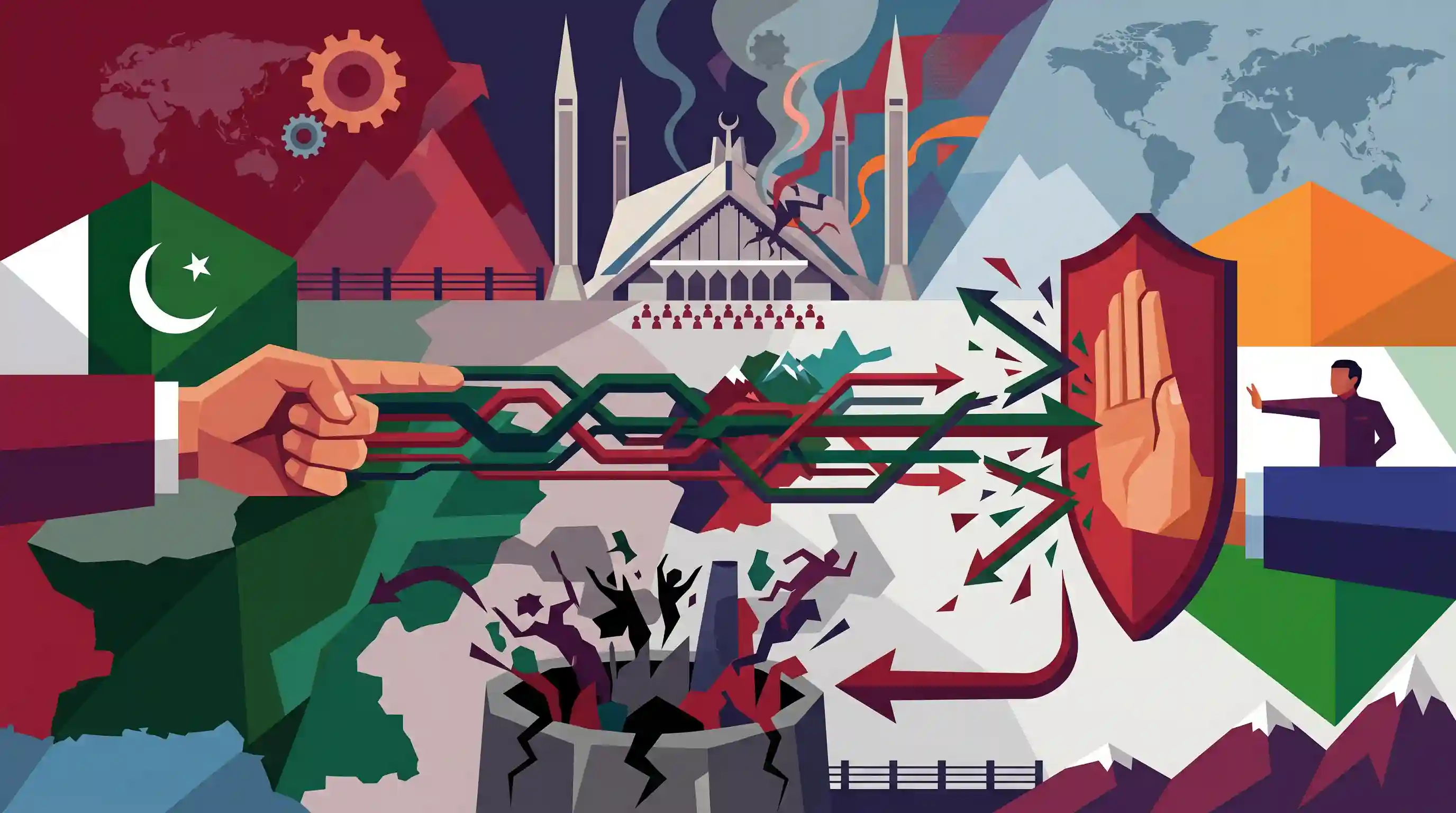
India strongly dismissed Pakistan's claims that New Delhi and Kabul were involved in a deadly suicide bombing at a Shia mosque in Islamabad that claimed 31 lives. The Ministry of External Affairs condemned the blast but criticized Pakistan for projecting its "home-grown ills" onto others without evidence. The remarks came in response to allegations by Pakistan's Defence Minister Khawaja Asif of a collusion between India and Afghanistan behind the terror attack.
Key Points
- India categorically rejected Pakistan's allegations of an Indian and Afghan link to a suicide bombing at a Shia mosque in Islamabad.
- The bombing killed at least 31 people and injured 169 others during Friday prayers.
- The Ministry of External Affairs (MEA) condemned the attack but stated Pakistan was blaming others for its "home-grown ills" instead of addressing internal issues.
- Pakistan's Defence Minister Khawaja Asif claimed, without providing evidence, that India and Afghanistan were colluding in the attack.
Important Terms
Ministry of External Affairs (MEA)

The central government agency responsible for formulating and implementing India's foreign policy, managing diplomatic missions, and safeguarding national interests on the global stage.
UPSC context
GS Paper 2: International Relations; essential for understanding India's diplomatic responses and formal foreign policy stance.
Cross-border Terrorism
Terrorist activities originating from one country to cause violence and instability in another, often used as a tool of 'proxy war' to bleed a nation.
UPSC context
GS Paper 3: Internal Security; a central theme in India-Pakistan relations and national security challenges.
Non-state Actors
Entities like extremist outfits or criminal networks that lack formal state backing but possess significant power to influence security and international events.
UPSC context
GS Paper 3: Internal Security; tests understanding of asymmetric threats and the role of terror groups.
External State Actors
Sovereign states or their formal agencies (e.g., intelligence, military) that use unconventional methods like proxy warfare to undermine another country's security.
UPSC context
GS Paper 3: Internal Security; crucial for analyzing state-sponsored terrorism and diplomatic tensions.
Sectarian Violence
Conflict or violence between different religious sects (e.g., Shia-Sunni) within a country, often fueled by extremist ideologies and used for political mobilization.
UPSC context
GS Paper 1 & 2: Social Issues and International Relations; relevant to understanding regional stability and neighborhood dynamics.
Internal Security
The maintenance of peace and law within a nation’s borders by fending off threats from both domestic and external sources.
UPSC context
GS Paper 3: Internal Security; the primary syllabus pillar for questions on terrorism and border management.
Prelims Trap
The UN has formally adopted the Comprehensive Convention on International Terrorism (CCIT) proposed by India.
India proposed the CCIT in 1996, but it remains stalled at the UN due to global disagreements over the exact definition of terrorism.
Static Concepts Connected
What is Pakistan's 'Strategic Depth' doctrine?
- Origins: Originally formulated by the Pakistani military to install a compliant, pro-Pakistan government in Afghanistan.
- Core Objective: To secure a rear fallback area in case of an Indian invasion, attempting to prevent a two-front war scenario.
- Current Status: Largely collapsed, as the Afghan Taliban now asserts independence and shelters anti-Pakistan groups like the TTP, causing severe internal blowback.
What is the Comprehensive Convention on International Terrorism (CCIT)?
- Genesis: A proposed treaty initiated by India at the UN General Assembly in 1996 to establish a universal framework against terrorism.
- Key Provisions: Aims to criminalize all forms of international terrorism, deny safe havens, and make cross-border terror funding actionable under international law.
- Major Roadblock: Stalled primarily due to lack of consensus on distinguishing terrorist acts from legitimate national liberation movements.
Cross-Topic Patterns
FATF and State-Sponsored Terror
Pakistan's struggle with internal terror networks is frequently linked in UPSC to FATF's grey-listing mechanisms and India's diplomatic strategy to financially isolate state sponsors of terror.
Durand Line & Proxy Blowback
Friction between the Afghan Taliban and Pakistan over the Durand Line and TTP safe havens exposes the severe blowback of utilizing non-state proxy actors for regional leverage.

Expect a GS-2 Mains question on the failure of Pakistan's 'Strategic Depth' doctrine and its implications for India's border security.
Linked PYQs · 4
Linked PYQs · 4
- 2015MainsGS2
Terrorist activities and mutual distrust have clouded India-Pakistan relations. To what extent the use of soft power like sports and cultural exchanges could help generate goodwill between the two countries? Discuss with suitable examples.
- 2016MainsGS2
Increasing cross-border terrorist attacks in India and growing interference in the internal affairs of several member-states by Pakistan are not conducive for the future of SAARC (South Asian Association for Regional Cooperation)." Explain with suitable examples.
- 2021MainsGS3
Analyse the complexity and intensity of terrorism, its causes, linkages and obnoxious nexus. Also suggest measures required to be taken to eradicate the menace of terrorism.
- 2025MainsGS3
Terrorism is a global scourge. How has it manifested in India? Elaborate with contemporary examples. What are the counter measures adopted by the State? Explain.
