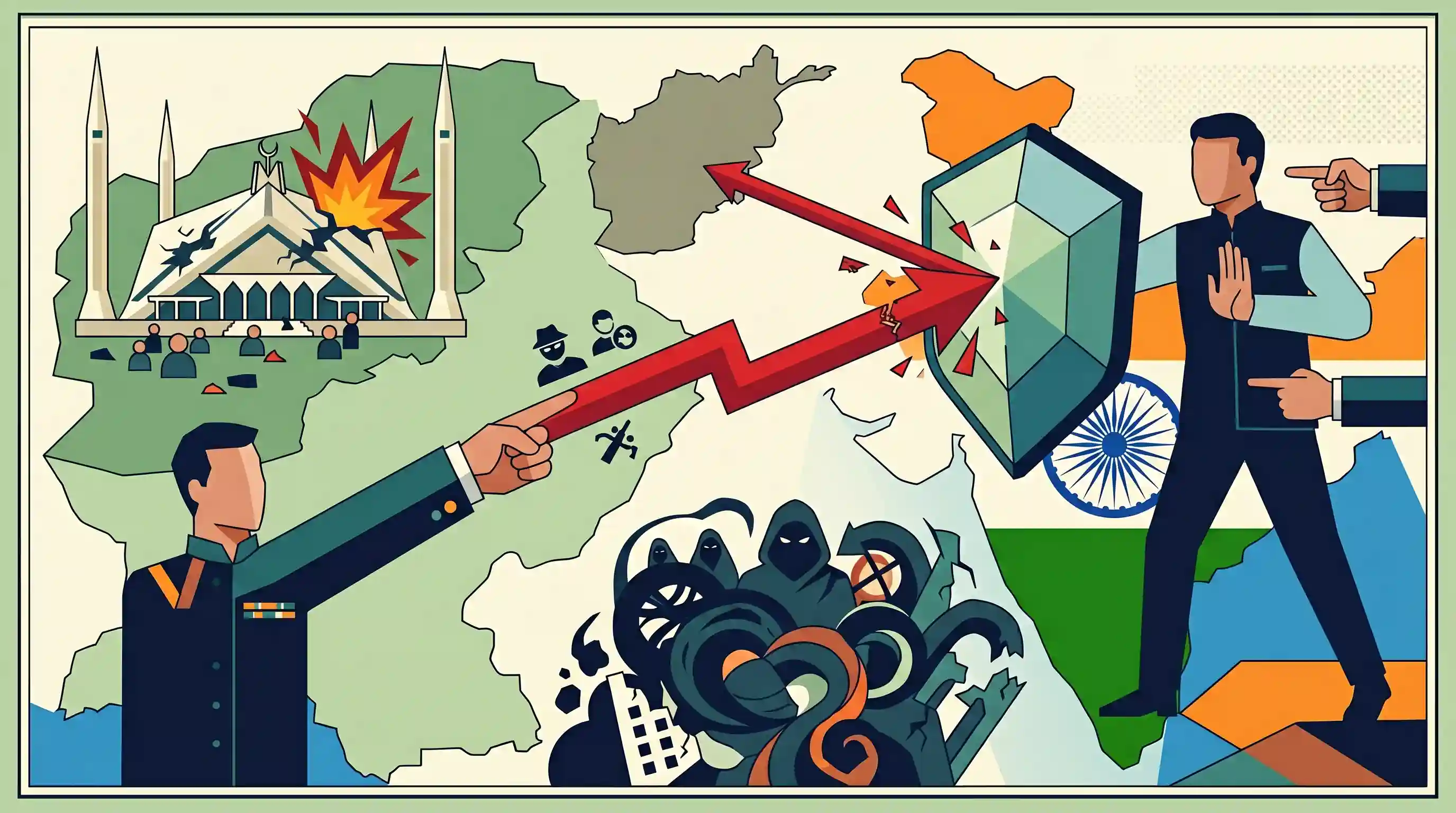
India rejects Pakistan allegations regarding Islamabad mosque bombing
Source:The Hindu ↗
Why It Matters
The exchange underscores the persistent trust deficit and hostility in India-Pakistan relations, characterized by mutual allegations regarding cross-border terrorism and internal destabilization. It highlights how domestic security failures, such as sectarian violence in Pakistan, frequently spill over into bilateral diplomatic tensions in the South Asian region.
Summary
India has categorically rejected allegations made by Pakistan linking India and Afghanistan to a devastating suicide bombing at a Shia mosque in Islamabad. The attack, which claimed at least 31 lives, was blamed on foreign collusion by Pakistan's Defence Minister. In response, India's Ministry of External Affairs dismissed the claims as baseless, urging Pakistan to focus on its own 'home-grown ills' and the underlying sectarian and internal security issues plaguing its society.
Key Points
- A suicide bombing at a Shia mosque (Khadijah al-Kubra mosque-cum-imambargah) in Islamabad killed 31 people and injured 169.
- Pakistan's Defence Minister alleged that India and Afghanistan were linked to the attack.
- India's Ministry of External Affairs strongly rejected the allegations as 'baseless' and 'pointless'.
- The MEA advised Pakistan to address its own internal social fabric and 'home-grown ills' rather than deflecting blame onto neighboring countries.
Important Terms
Ministry of External Affairs (MEA)

India's central government agency responsible for foreign relations, representing the country at international forums, managing diplomatic missions, and formulating foreign policy.
UPSC context
GS Paper II: International Relations and Governance; tests knowledge of India's diplomatic machinery and foreign policy implementation.
Cross-border Terrorism
Terrorist activities originating in one country to cause violence in another, often involving infiltration and external support to destabilize a nation.
UPSC context
GS Paper III: Security challenges; central to India-Pakistan relations and the management of border security threats.
Non-state Actors
Entities with significant political or social influence that are not part of a sovereign state, including NGOs, insurgent groups, and terrorist organizations.
UPSC context
GS Paper III: Internal Security; tests the role of external actors in creating internal security challenges.
Sectarian Violence
Violent conflict or prejudice between different sects within the same religion (e.g., Shia-Sunni), often fueled by ideological or political differences.
UPSC context
GS Paper I: Social Issues/Communalism; also relevant for GS III security challenges within the social fabric.
Internal Security
The act of maintaining peace and order within a nation's borders by addressing threats like terrorism, insurgency, and organized crime.
UPSC context
GS Paper III: Security; the primary theme for managing domestic challenges to the state's integrity.
Prelims Trap
Pakistan is currently on the FATF Grey List due to continuous state-sponsored terrorism.
Pakistan was officially removed from the FATF Grey List in October 2022 after being on it since 2018. It is not currently on the list.
Static Concepts Connected
What is the Comprehensive Convention on International Terrorism (CCIT)?
- Origin: Proposed by India at the UN General Assembly in 1996.
- Objective: Aims to provide a universal legal framework to criminalize all forms of international terrorism and deny terror safe havens.
- Deadlock: Stalled primarily due to disagreements among UN members on defining 'terrorism' versus 'legitimate freedom struggles'.
What is the mandate of the Financial Action Task Force (FATF)?
- Origin: Established in 1989 by the G7 originally to combat money laundering.
- Mandate Expansion: Expanded in 2001 (post-9/11) to include combating terrorist financing and later proliferation financing.
- Compliance Lists: Maintains 'Black' (High-Risk) and 'Grey' (Under Increased Monitoring) lists to pressure non-cooperative jurisdictions.
Cross-Topic Patterns
Sectarian fractures and state deflection
Pakistan's internal Shia-Sunni sectarian violence is frequently externalized to distract from domestic governance failures, linking GS2 (Neighborhood Relations) directly to GS3 (Internal Security & Extremism).
Non-state actors as state proxies
The ongoing use of militant groups highlights the limits of bilateral dialogue, shifting India's diplomatic strategy toward multilateral financial and legal pressure mechanisms (FATF, UN).

Expect 2026 exams to test FATF mechanics or CCIT provisions, while mains link neighborhood sectarian fractures to India's border security.
Linked PYQs · 3
Linked PYQs · 3
- 2016MainsGS2
Increasing cross-border terrorist attacks in India and growing interference in the internal affairs of several member-states by Pakistan are not conducive for the future of SAARC (South Asian Association for Regional Cooperation)." Explain with suitable examples.
- 2015MainsGS2
Terrorist activities and mutual distrust have clouded India-Pakistan relations. To what extent the use of soft power like sports and cultural exchanges could help generate goodwill between the two countries? Discuss with suitable examples.
- 2021MainsGS3
Analyse the multidimensional challenges posed by external state and non-state actors, to the internal security of India. Also discuss measures required to be taken to combat these threats.
