UP Reiterates Target of Achieving One Trillion Economy by 2030
Source:freepressjournal ↗
Why It Matters
The quantitative macroeconomic targets of Uttar Pradesh ($1T by 2030) and the specific coverage statistics of social security schemes (like PM-KISAN, Ayushman Bharat, and Swachh Bharat in UP) are critical facts frequently evaluated in the UPPSC PCS Prelims.
Summary
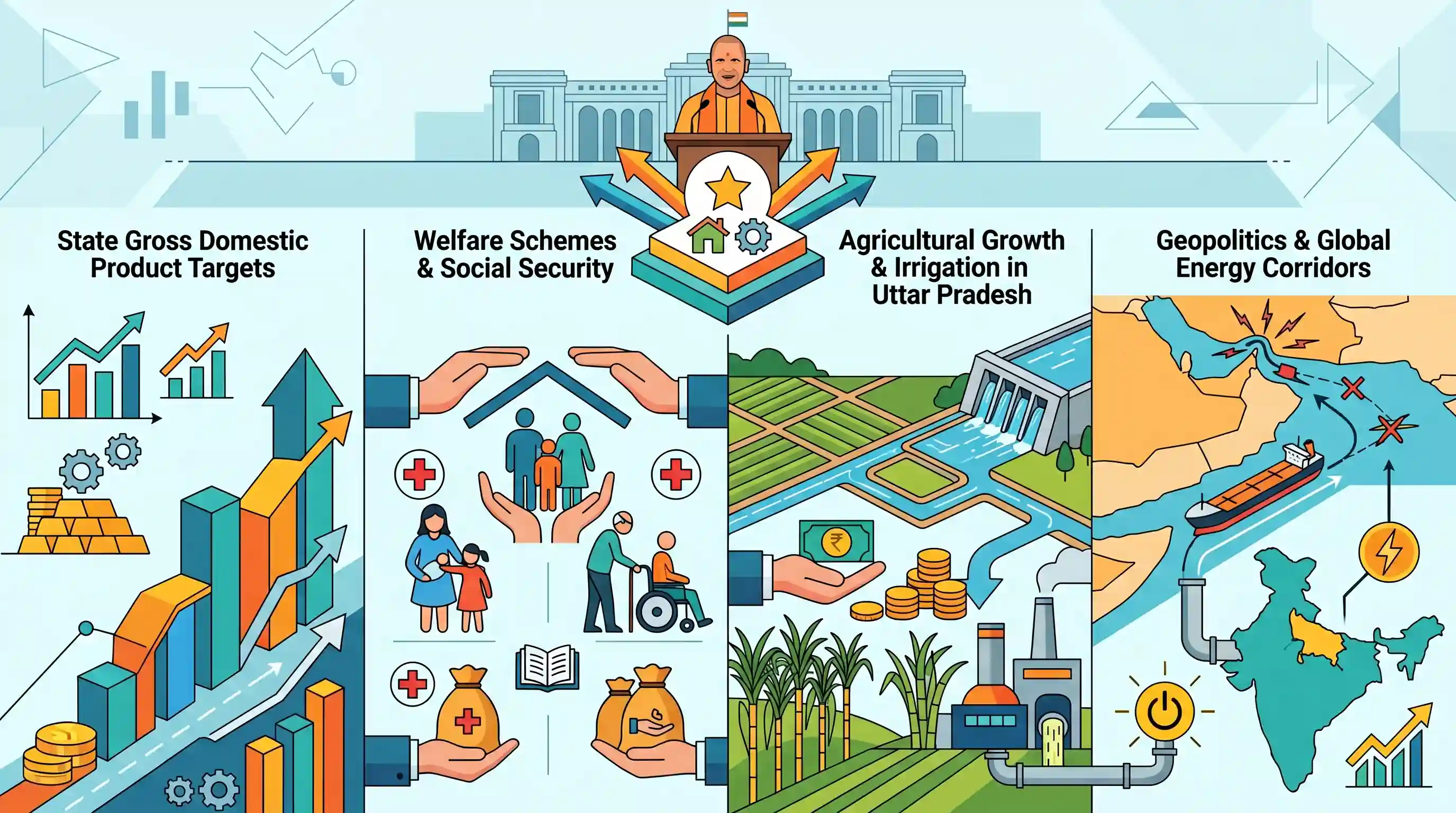
Uttar Pradesh Chief Minister Yogi Adityanath addressed a media interaction at Lok Bhavan in Lucknow, marking the completion of 12 years of the PM Narendra Modi-led NDA government. He outlined the state's vision document to transition UP into a $1 trillion economy by 2030, a $2 trillion economy by 2036, and a $5 trillion economy by 2047. The address highlighted extensive welfare achievements, infrastructural growth in irrigation, sugarcane farmer payments, and geopolitical resilience in the face of West Asian oil supply challenges in the Strait of Hormuz.
Key Points
- UP Economic Milestones: Yogi Adityanath reiterated Uttar Pradesh's commitment to achieving a $1 trillion economy by 2030, a $2 trillion economy by 2036, and a $5 trillion economy by 2047.
- Agriculture Sector: In UP, more than 3 crore farmers benefit from PM Kisan Samman Nidhi, sugarcane farmers have received payments exceeding ₹3.22 lakh crore, and an additional 24 lakh hectares of land has been brought under irrigation facilities.
- Welfare Penetration: Under central and state initiatives, UP has delivered housing to 65 lakh people (PM Awas Yojana), toilets to 3 crore families (Swachh Bharat Mission), LPG connections to nearly 2 crore families (Ujjwala Yojana), and health security to 15 crore beneficiaries (Ayushman Bharat).
- Geopolitical & Energy Security: Despite international crises in West Asia and shipping challenges in the Strait of Hormuz, India managed to secure its energy supplies and control domestic inflation.
- Cultural Renaissance: The CM highlighted key cultural achievements, including the construction of the Ram Mandir in Ayodhya, and the redevelopment of Kashi Vishwanath Dham, Mahakal Lok, and Kedarpuri.
Important Terms
Nari Shakti Vandan Adhiniyam

The 106th Constitutional Amendment Act, 2023, which reserves one-third (33%) of all seats in the Lok Sabha, state legislative assemblies, and the Delhi Legislative Assembly for women.
UPSC context
GS Paper II (Polity/Women Empowerment). Tests understanding of legislative gender quotas, representation, and constitutional amendments.
Pradhan Mantri Jan Dhan Yojana
A national mission launched in 2014 to ensure affordable access to financial services, including basic savings accounts, remittance, credit, insurance, and pensions, for the unbanked population.
UPSC context
GS Paper III (Inclusive Growth/Financial Inclusion) and GS Paper II. Tests knowledge of digital governance and direct benefit transfers.
Ayushman Bharat Yojana
India's flagship public health assurance scheme that provides cashless secondary and tertiary hospitalisation cover of up to ₹5 lakh per family per year to poor and vulnerable households.
UPSC context
GS Paper II (Social Justice/Health). Tests understanding of universal health coverage, healthcare governance, and government welfare programs.
Pradhan Mantri MUDRA Yojana
A central scheme launched in 2015 to provide collateral-free micro-credit of up to ₹10 lakh (recently expanded to ₹20 lakh) to non-corporate, non-farm small and micro-enterprises.
UPSC context
GS Paper III (Indian Economy/Employment). Tests knowledge of micro-enterprise financing, self-employment, and credit facilitation mechanisms.
Mukhyamantri Kanya Sumangala Yojana
A flagship welfare scheme by the Uttar Pradesh government that provides milestone-based financial assistance of up to ₹25,000 to eligible girl children from birth through higher education.
UPSC context
GS Paper II (Social Justice/Welfare Schemes). Tests knowledge of state-level social security and girl-child empowerment initiatives.
Swachh Bharat Mission
A national cleanliness campaign launched in 2014 to eliminate open defecation, manage solid waste scientifically, and foster sustainable hygiene practices across rural and urban India.
UPSC context
GS Paper II (Governance) & GS Paper III (Environment/Sanitation). Tests understanding of community-led sanitation and sustainable urban waste management.
Prelims Trap
The State Advised Price (SAP) for sugarcane is a non-binding guideline, as the Union's FRP takes legal precedence under Union List jurisdiction.
Sugarcane pricing falls under the Concurrent List. The Supreme Court confirmed that states have concurrent power to set a legally binding SAP, which is typically higher than the Central FRP.
Static Concepts Connected
How does the dual pricing mechanism (FRP vs SAP) for sugarcane function in India?
- FRP determination: Fixed by the Central Government (CCEA) based on the recommendations of the Commission for Agricultural Costs and Prices (CACP) under the Sugarcane (Control) Order, 1966.
- State Advised Price: Announced by key states like Uttar Pradesh and Punjab; it is legally binding on sugar mills and is historically higher than the Central FRP.
- Constitutional basis: Falls under Concurrent List (Entry 33); the Supreme Court validated that states have the power to enforce SAP alongside the federal FRP.
What is the strategic geography and significance of the Strait of Hormuz?
- Connective waters: Links the Persian Gulf to the Gulf of Oman and the Arabian Sea, serving as a vital corridor for global maritime trade.
- Geographic borders: Bounded by Iran to the north and the Musandam Peninsula (an exclave of Oman) and the UAE to the south.
- Energy choke point: Handles approximately 20% of global petroleum liquids transit, making it highly sensitive to West Asian geopolitical conflicts.
Cross-Topic Patterns
Cooperative Federalism + Planning Bodies
UP replacing its Planning Commission with the State Transformation Commission mirrors NITI Aayog, illustrating the structural alignment of cooperative and competitive federalism.
Hormuz Chokepoint + Strategic Reserves
Energy vulnerabilities in West Asian chokepoints directly link to India's Strategic Petroleum Reserves (SPR) policy and accelerated transition to biofuel blending.

The constitutional validity of State Advised Price (SAP) versus FRP for sugarcane is prime for a polity-meets-agriculture question by 2026.
Linked PYQs · 3
Linked PYQs · 3
- 2021UPPSC_PRELIMSGS1
Which of the following Schemes in Uttar Pradesh were introduced in Budget of 2021-22? I. Atmanirbhar Krishak Samanvit Vikas Yojna II. Mukhya Mantri Saksham Suposhan Yojna III. Mukhya Mantri Pravasi Shramik Udyamita Vikas Yojna IV. Yuva Udyamita Vikas Abhiyan Select the correct answer from the codes given below.
- 2024UPPSC_PRELIMSGS1
Match List-I (Yojana Name): (A) Pradhan Mantri Awas (B) Jal Jeevan Mission (C) Swachh Bharat (D) Pradhan Mantri List-II: 1. May, 2016 Yojana - Gramin 2. October, 2014 3. August, 2019 Mission - Gramin 4. November, 2016 Ujjwala Yojana
- 2020UPPSC_PRELIMSGS1
According to the Report released by NITI Aayog in December 2019 on 'Sustainable Development Goals India Index 2019-20', the Uttar Pradesh is grouped under which of the following categories ?
