US Drug Price Controls Pose Strategic Challenges for Indian Pharma
Source:Indian Express ↗
Why It Matters
It demonstrates the direct impact of domestic policies of developed nations (like the US) on India's critical export sectors (pharmaceuticals). This is highly relevant for GS Paper 2 (International Relations) and GS Paper 3 (Economy and Intellectual Property).
Summary
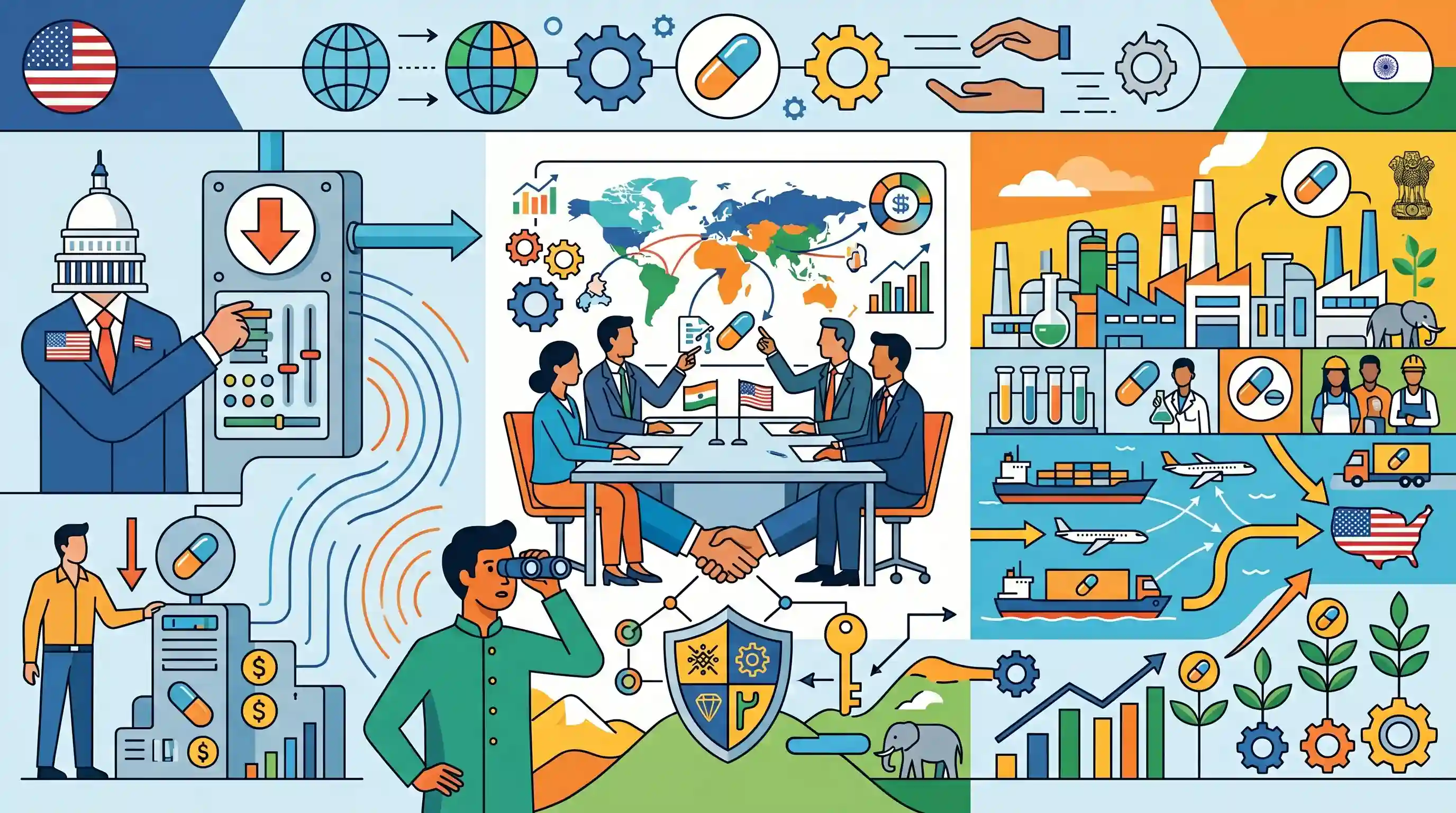
The article highlights the potential impact of US domestic healthcare policies, specifically drug price control orders initiated under Donald Trump, on India's pharmaceutical industry. It argues that Indian trade negotiators must remain alert to the "spinoffs" or unintended consequences of these measures. Because India is a global leader in supplying generic drugs to the US market, any alteration in US drug pricing, intellectual property enforcement, or procurement strategies could significantly affect Indian pharmaceutical exports. The piece underscores the need for proactive trade diplomacy to protect India's commercial interests while navigating the complexities of India-US bilateral trade and global pharmaceutical supply chains.
Key Points
- US domestic policies aimed at controlling drug prices can have significant secondary effects (spinoffs) on global pharmaceutical supply chains.
- India, as a major exporter of generic medicines, needs its trade negotiators to be highly vigilant about changes in US drug pricing and procurement rules.
- Measures to lower drug costs in the US might impact the profit margins and market access of Indian generic pharmaceutical companies.
- The issue highlights the broader complexities in India-US trade relations, where intellectual property rights (IPR) and healthcare economics frequently intersect.
Important Terms
TRIPS Agreement

A WTO agreement establishing minimum global standards for intellectual property rights, including pharmaceutical patents, to harmonize IP protection across member nations.
UPSC context
GS Paper 3 (IPR); tests the balance between innovation-incentives and public health (access to affordable medicines).
Most Favored Nation (MFN)
A WTO principle requiring member nations to treat all trading partners equally; also used as a US benchmarking policy to link domestic drug prices to the lowest global rates.
UPSC context
GS Paper 2 (International Relations/WTO); tests knowledge of non-discriminatory trade and its application in bilateral policy.
US Food and Drug Administration (FDA)
The US regulatory body that sets quality and safety standards for medical products; it conducts inspections (Form 483) of Indian pharmaceutical facilities exporting to the US market.
UPSC context
GS Paper 2 (International Relations); tests understanding of non-tariff barriers and regulatory compliance in global trade.
Generic Drugs
Bioequivalent versions of brand-name medicines produced after patent expiry, forming the backbone of India's pharmaceutical exports to the United States and global markets.
UPSC context
GS Paper 3 (Economy); tests India’s competitive advantage as the 'Pharmacy of the World' and export-led growth.
Compulsory Licensing
A TRIPS flexibility allowing a government to authorize the production of a patented invention without the patent holder's consent, typically during public health emergencies.
UPSC context
GS Paper 3 (Economy/IPR); tests specific legal tools used to ensure medicine affordability in developing nations.
Active Pharmaceutical Ingredients (APIs)
The primary chemical components of a drug responsible for the intended health effect; India heavily depends on imports, particularly from China, for these raw materials.
UPSC context
GS Paper 3 (Economy); tests supply chain resilience, strategic autonomy, and the Atmanirbhar Bharat initiative.
Prelims Trap
US drug price controls inherently boost Indian generic exports due to their established cost advantage.
While Indian generics are cheaper, aggressive US price caps and localized procurement rules can severely squeeze margins and restrict market access for Indian exporters.
Static Concepts Connected
What is the evergreening of patents and how does Indian law prevent it?
- Definition: Extending monopolies by making minor, non-therapeutic modifications to existing, previously patented drug molecules.
- Section 3(d): The Indian Patent Act prohibits patenting new forms of known substances unless they demonstrate significantly enhanced therapeutic efficacy.
- Novartis Case: A landmark 2013 Supreme Court judgment denied a patent for the cancer drug Glivec, strictly upholding Section 3(d) against pharmaceutical MNCs.
What is Compulsory Licensing under the WTO-TRIPS agreement?
- Definition: Authorization granted by a government to a third party to produce a patented product without the patent owner's consent.
- Doha Declaration: Affirms the right of WTO members to use TRIPS flexibilities like compulsory licensing to protect public health and promote access to medicines.
- Indian Provision: Section 84 of the Patents Act allows issuance if the patented drug is unaffordable, unavailable to the public, or not worked in India.
Cross-Topic Patterns
US Protectionism + Supply Chain Vulnerability
US domestic procurement policies intersect with India's heavy API dependence on China (70%), exposing a dual threat to India's pharmaceutical export dominance.
IPR Friction + USTR Watch Lists
India balances its 'Pharmacy of the World' status against continuous pressure from the US Special 301 Report, highlighting the clash between domestic health access and developed-nation IPR enforcement.

Expect a 2026 GS2/GS3 question linking API import dependency, Section 3(d), and secondary impacts of US protectionism on Indian pharma.
Linked PYQs · 3
Linked PYQs · 3
- 2024MainsGS3
What is the present world scenario of intellectual property rights with respect to life materials? Although, India is second in the world to file patents, still only a few have been commercialized. Explain the reasons behind this less commercialization.
- 2019MainsGS3
How is the Government of India protecting traditional knowledge of medicine from patenting by pharmaceutical companies?
- 2019MainsGS2
‘What introduces friction into the ties between India and the United States is that Washington is still unable to find for India a position in its global strategy, which would satisfy India's national self-esteem and ambitions.’ Explain with suitable examples.
