India Bilateral Trade Negotiations Leverage Economic Growth Potential
Source:The Hindu ↗
Why It Matters
Highlights India's evolving strategy in economic diplomacy and free trade negotiations, reflecting a shift towards leveraging domestic market size and protecting sensitive sectors like agriculture in international treaties.
Summary
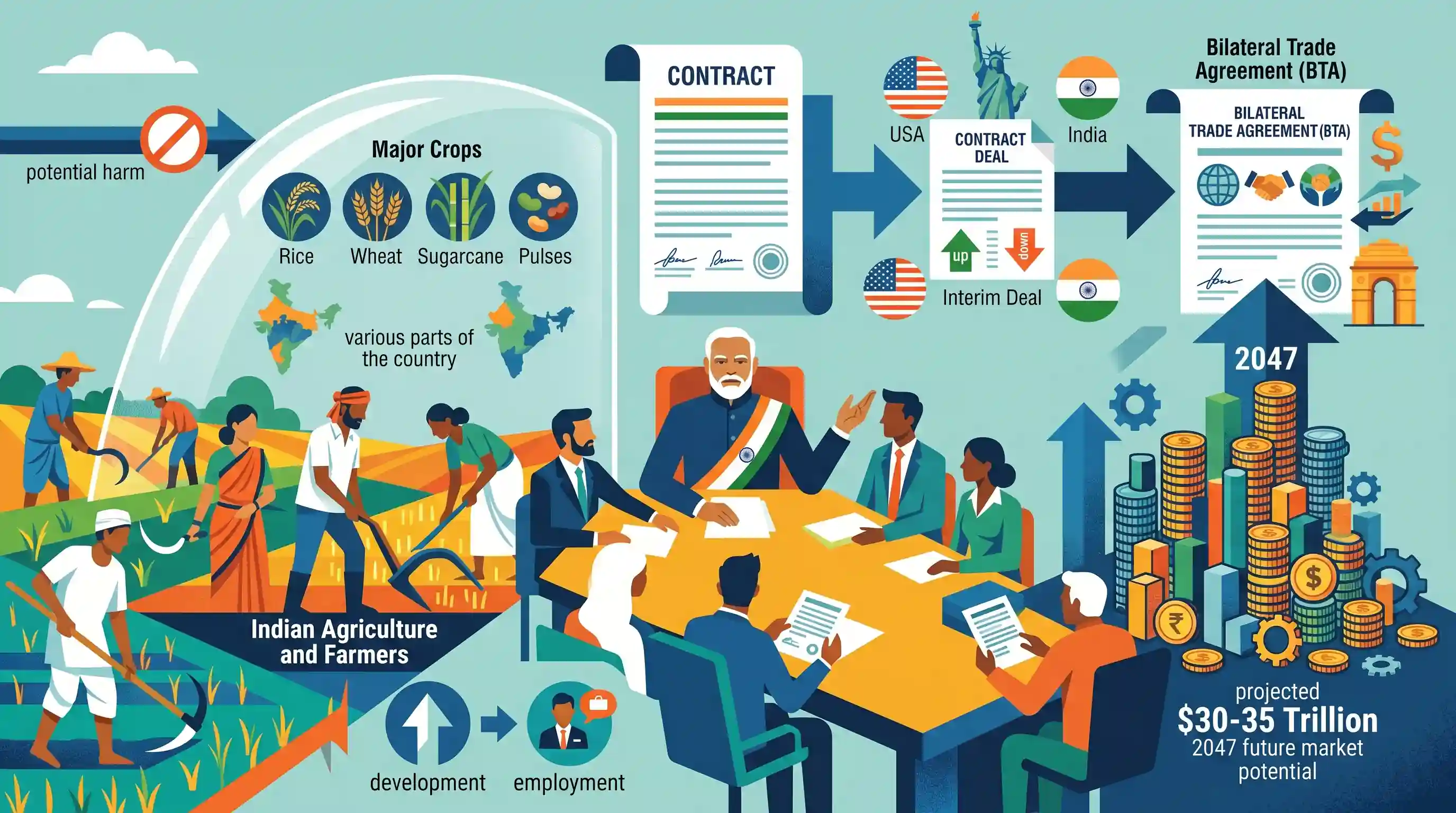
Union Commerce and Industry Minister Piyush Goyal asserted that India is negotiating global trade deals from a position of strength, using its massive future market potential—projected to reach $30-35 trillion by 2047—as leverage. He cited the recent tariff agreement with the United States as a precursor to a Bilateral Trade Agreement (BTA) and assured that the deal does not contain provisions that would harm Indian farmers.
Key Points
- India is leveraging its projected growth from a $4 trillion economy to a $30-35 trillion developed economy by 2047 as a major asset in trade negotiations.
- A recent tariff agreement between India and the U.S. is considered a stepping stone towards finalizing a comprehensive Bilateral Trade Agreement (BTA).
- The government asserts that the trade agreement with the U.S. carefully safeguards the interests of Indian farmers, avoiding any detrimental clauses.
Important Terms
Bilateral Trade Agreement (BTA)

A trade treaty between two nations aimed at reducing barriers like tariffs and quotas. In the India-US context, it serves as a precursor to a comprehensive Free Trade Agreement (FTA).
UPSC context
GS Paper-II & III; tests knowledge of bilateral trade diplomacy and India's economic integration with major partners like the US.
Viksit Bharat @ 2047
India's long-term vision to transform into a developed nation with a projected $30-40 trillion economy by its 100th year of independence (2047), focusing on inclusive development.
UPSC context
GS Paper-III (Economy/Planning); central to questions regarding long-term growth targets and the "Amrit Kaal" developmental strategy.
Non-Tariff Barriers (NTBs)
Trade restrictions other than direct taxes, including technical standards (SPS/TBT), licensing, and quotas, which can hinder the free flow of goods and services across borders.
UPSC context
GS Paper-III (Economy/Trade); critical for understanding modern trade disputes, export competitiveness, and India's position in global value chains.
Rules of Origin
Specific criteria used in trade agreements to determine the "economic nationality" of a product, ensuring that only goods produced within the signatory countries receive preferential tariff treatment.
UPSC context
GS Paper-III (Economy); essential for understanding how India prevents third-party countries from bypassing duties through FTA partners (e.g., trade deflection).
Market Access
The ease with which foreign products can enter a domestic market. India often uses its massive market access potential as leverage in negotiations to secure better terms for its exports.
UPSC context
GS Paper-III (Economy); fundamental to discussions on trade liberalisation, domestic industry protection, and global economic negotiations.
Sensitive Products/Sectors
Items, particularly in the agriculture and dairy sectors, that India excludes from tariff concessions in trade deals to protect domestic livelihoods and food security.
UPSC context
GS Paper-III (Agriculture/Economy); vital for analyzing how India balances global trade commitments with the interests of its agrarian population.
Prelims Trap
India and the U.S. have finalized a comprehensive Bilateral Trade Agreement (BTA) covering agriculture.
Current India-U.S. deals are targeted tariff rationalizations (resolving WTO disputes), acting as precursors or 'Early Harvest' measures, not a finalized comprehensive BTA.
Static Concepts Connected
What is an 'Early Harvest Scheme' (EHS) in trade agreements?
- Precursor to FTA: A confidence-building measure where trading partners reduce tariffs on a limited set of goods before concluding a full Free Trade Agreement (FTA).
- WTO Compliance: EHS can face WTO scrutiny if not followed by a comprehensive pact covering "substantially all trade" under GATT Article XXIV.
How are domestic farmers protected in Free Trade Agreements?
- Exclusion/Sensitive Lists: Keeping highly sensitive agricultural commodities entirely out of tariff reduction commitments to shield domestic producers from subsidized foreign competition.
- Tariff Rate Quotas (TRQ): Allowing a predetermined quantity of imports at a lower tariff, while applying significantly higher, prohibitive tariffs on excess volumes.
Cross-Topic Patterns
Agri safeguards vs. Export push
India routinely uses 'sensitive lists' to protect domestic agriculture and dairy while aggressively seeking market access for labor-intensive manufacturing (textiles, gems) in Western FTAs.
Market size as diplomatic leverage
India's shift from defensive WTO multilateralism to aggressive bilateral deal-making relies heavily on its projected $30 trillion consumer market as a primary geopolitical negotiating asset.

Expect a 2026 Prelims question linking India's FTA strategies, Early Harvest schemes, Tariff Rate Quotas, and WTO Article XXIV compliance.
Linked PYQs · 3
Linked PYQs · 3
- 2023MainsGS3
What are the direct and indirect subsidies provided to farm sector in India? Discuss the issues raised by the World Trade Organization (WTO) in relation to agricultural subsidies.
- 2022MainsGS3
Economic growth in the recent past has been led by increase in labour productivity." Explain this statement. Suggest the growth pattern that will lead to creation of more jobs without compromising labour productivity.
- 2023MainsGS3
Faster economic growth requires increased share of the manufacturing sector in GDP, particularly of MSMEs. Comment on the present policies of the Government in this regard.
