India Asserts Economic Resilience and Resolve Amid US Tariff Actions
Source:The Hindu ↗
Why It Matters
The article is a pivotal case study for GS2 (International Relations) and GS3 (Economy), demonstrating the real-world clash between India's pursuit of strategic autonomy (trading with Russia and Iran) and protectionist policies from major economic partners like the US. It directly highlights the modern challenges of multi-alignment and trade negotiations.
Summary
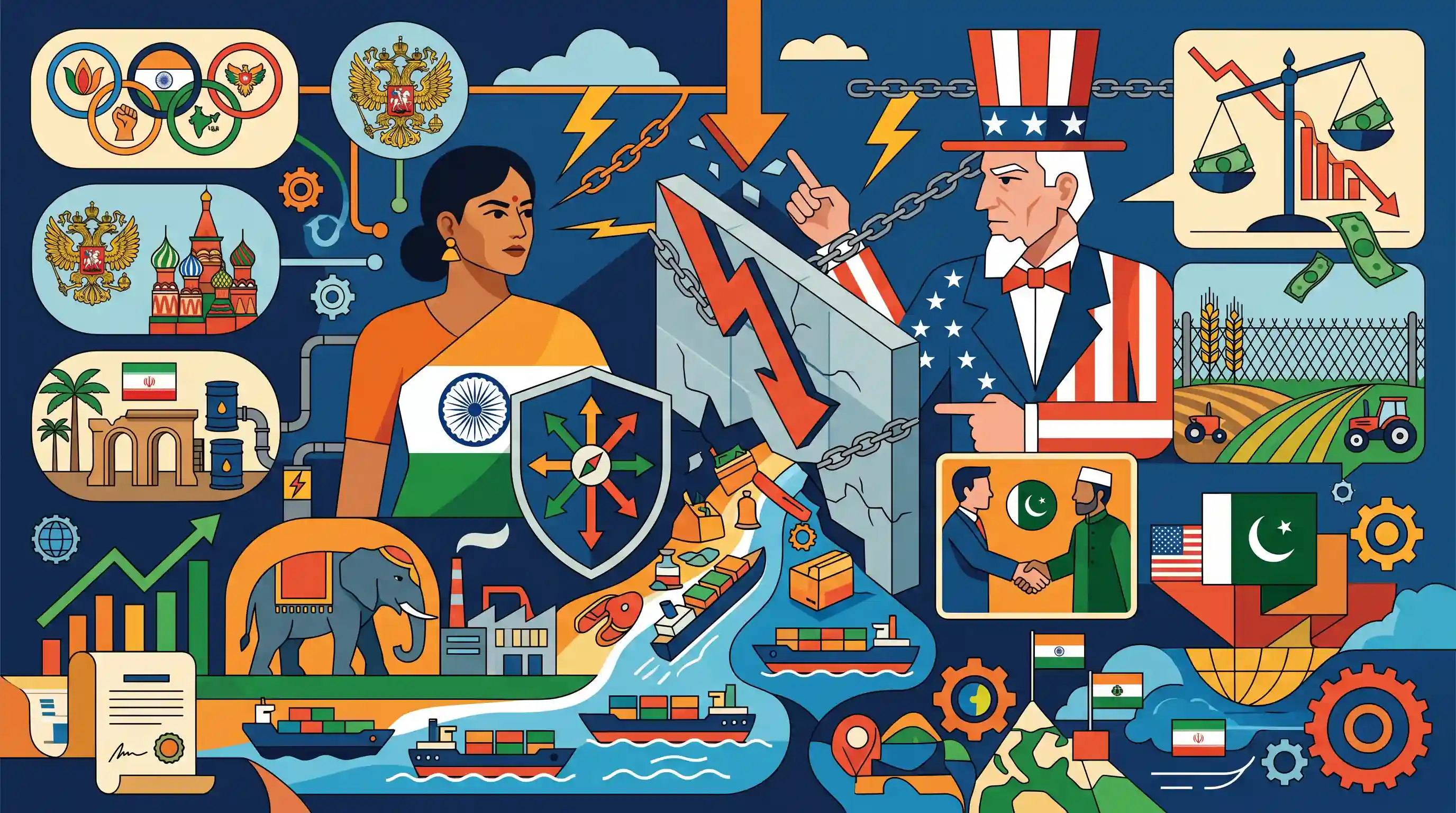
Commerce and Industry Minister Piyush Goyal emphasized that India will prioritize its national interest and assess the impact of US President Donald Trump's announcement of a 25% tariff on Indian imports. The US move is coupled with threats of penalties over India's continued ties with Russia, energy trade with Iran, and its active role in BRICS. While the US criticizes India's trade deficit and agricultural barriers, Goyal countered by highlighting India's robust economy and successful negotiation of FTAs with other nations. These developments, along with recent US-Pakistan engagements, mark a highly complex period for India-US relations, testing India's policy of strategic autonomy amid rising global protectionism.
Key Points
- The US announced a 25% tariff on Indian imports, citing a high trade deficit and non-tariff trade barriers.
- US President Donald Trump threatened additional penalties on India for purchasing military hardware and energy from Russia and criticized India's BRICS membership.
- The US sanctioned several Indian entities for engaging in energy trade with Iran.
- India’s Commerce Minister Piyush Goyal defended India's policies, citing recent successful FTAs, economic resilience, and asserting that India will take all steps to protect its national interests.
- Complications have deepened with the US working closely with Pakistan on oil reserves following recent regional security incidents.
Important Terms
CAATSA (Countering America's Adversaries Through Sanctions Act)

A 2017 US federal law imposing sanctions on countries engaging in "significant transactions" with Russia, Iran, or North Korea. It aims to deter third parties from deep military or energy engagements with US adversaries.
UPSC context
GS-2 (International Relations); critical for understanding India-US friction over S-400 missile deals and Russian energy imports.
Strategic Autonomy
A foreign policy doctrine where a nation makes sovereign decisions based on national interests without external coercion. India has evolved this from Cold War non-alignment to a pragmatic "multi-alignment" strategy.
UPSC context
GS-2 (Foreign Policy); central to analyzing India's independent stance amidst US-Russia and US-China rivalries.
BRICS
A multilateral grouping of major emerging economies (Brazil, Russia, India, China, South Africa, and expanded members) promoting a multipolar world order and alternatives to Western-dominated financial systems.
UPSC context
GS-2 (International Groupings); tests India’s leadership in the Global South and its role in "de-dollarization" efforts.
EFTA (European Free Trade Association)
A regional trade organization of four non-EU countries: Iceland, Liechtenstein, Norway, and Switzerland. India signed a landmark Trade and Economic Partnership Agreement (TEPA) with EFTA in 2024.
UPSC context
GS-3 (Economy); represents a new model of FTAs featuring binding investment commitments from developed partners.
Free Trade Agreements (FTAs)
International treaties designed to reduce or eliminate trade barriers like tariffs and quotas. India uses these to diversify export markets and counter rising global protectionism.
UPSC context
GS-3 (External Sector); relevant for India's strategy to integrate with global value chains and boost manufacturing.
Trade Deficit
An economic condition where the value of a country's imports exceeds its exports. A persistent deficit often triggers protectionist policies, such as tariffs, by the importing nation.
UPSC context
GS-3 (Economy); essential for analyzing the economic friction behind US-India trade disputes.
Prelims Trap
US secondary sanctions on Indian entities trading with Iran are legally binding under United Nations Security Council mandates.
These are unilateral US sanctions under its domestic law. India's official stance historically recognizes only UN-mandated sanctions, not unilateral secondary sanctions by individual nations.
Static Concepts Connected
What is CAATSA and how does it impact India?
- US Domestic Law: Countering America's Adversaries Through Sanctions Act is a US federal law penalizing countries doing significant business with Russia, Iran, and North Korea.
- Secondary Sanctions: It targets non-US entities via secondary sanctions, threatening India's strategic defense imports (like the S-400 system from Russia) and energy security.
- Waiver Provision: The US President can grant a waiver to partner nations if the transaction is deemed aligned with broader US national security interests.
What constitute Non-Tariff Barriers (NTBs) in global trade?
- Broad Definition: Trade restrictions that do not involve import duties, such as import quotas, embargoes, export restrictions, and domestic content requirements.
- Sanitary & Phytosanitary (SPS): Measures applied by developed nations (like the US and EU) to protect human, animal, or plant life, often used restrictively against Indian agricultural exports.
- Technical Barriers (TBTs): Complex packaging, labeling rules, or rigorous product quality standards that disproportionately increase compliance costs for exporters from developing nations.
Cross-Topic Patterns
Minilateral FTAs as economic hedging
As the US weaponizes tariffs and secondary sanctions, India is hedging by accelerating bilateral FTAs (like EFTA and Australia) rather than relying on multilateral WTO consensus.
Iran sanctions constrain Chabahar strategy
Unilateral US sanctions on energy trade with Iran directly threaten India’s broader strategic investments in the Chabahar Port and INSTC connectivity initiatives.
BRICS expansion vs US financial hegemony
US criticism of India's BRICS membership highlights Western anxiety over multipolar initiatives like de-dollarization and alternative payment mechanisms designed to bypass unilateral sanctions.

A 2026 Mains question will likely test how US protectionism and unilateral sanctions force India to pivot towards middle-power FTAs and BRICS.
Linked PYQs · 5
Linked PYQs · 5
- 2025MainsGS3
What are the challenges before the Indian economy when the world is moving away from free trade and multilateralism to protectionism and bilateralism? How can these challenges be met?
- 2018MainsGS3
How would the recent phenomena of protectionism and currency manipulations in world trade affect macroeconomic stability of India?
- 2012MainsGS2
How have the US sanctions against Iran affected India's bilateral relations with Iran?
- 2018MainsGS2
In what ways would the ongoing US-Iran Nuclear Pact Controversy affect the national interest of India? How should India respond to this situation?
- 2018PrelimsGS1
Consider the following countries: 1. Australia 2. Canada 3. China 4. India 5. Japan 6. USA Which of the above are among the 'free-trade partners' of ASEAN?
