India Updated Nationally Determined Contributions and COP30 Pledge
Source:The Hindu ↗
Why It Matters
Understanding India's climate commitments (NDCs) and the underlying geopolitics of climate finance is critical for UPSC candidates. The article touches on fundamental syllabus areas like global environmental governance, UNFCCC frameworks, India's transition to renewable energy, and the principle of Common but Differentiated Responsibilities (CBDR).
Summary
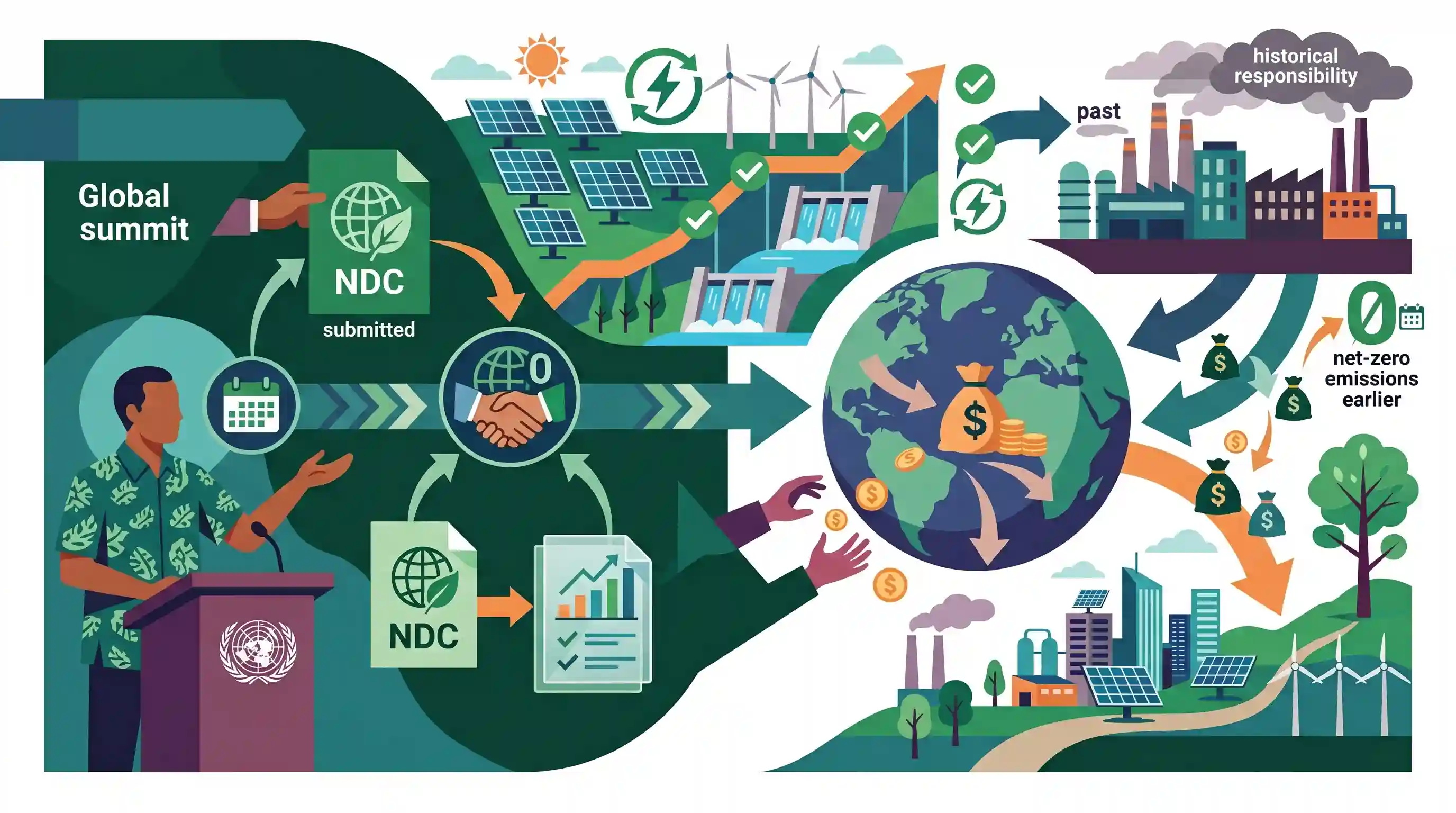
Union Environment Minister Bhupender Yadav announced at the COP30 summit in Belem, Brazil, that India will submit its updated Nationally Determined Contribution (NDC) and its first Biennial Transparency Report (BTR) by December 2025. These documents are crucial components of the Paris Agreement, detailing the nation’s climate action targets until 2035 and progress updates. While highlighting India's achievement of its prior non-fossil power capacity targets, Yadav emphasized the ongoing global hurdle of inadequate and unaffordable climate finance. India continues to advocate that developed countries must assume historical responsibility by reaching net-zero emissions earlier and fulfilling their financial commitments to support the costly energy transitions of developing nations.
Key Points
- India announced it will submit its updated Nationally Determined Contribution (NDC) and first Biennial Transparency Report (BTR) by December 2025 at the COP30 summit.
- The new NDC will outline voluntary actions up to 2035 for reducing fossil fuel reliance and improving energy efficiency.
- India previously pledged in its 2022 NDC to reduce emission intensity of GDP by 45% by 2030 and achieve 50% installed power capacity from non-fossil sources.
- India has reportedly already achieved its non-fossil fuel power capacity target ahead of the 2030 schedule.
- The Environment Minister reiterated the demand for developed nations to reach net zero sooner and deliver affordable public climate finance in the trillions to aid energy transitions.
- The BTR is a mandatory biannual report tracking national inventory, progress on NDCs, and financial/technology support needs.
Important Terms
Nationally Determined Contribution (NDC)

Non-binding national climate action plans submitted every five years under the Paris Agreement, outlining specific targets for reducing emissions and adapting to climate impacts based on a country's capabilities.
UPSC context
GS Paper III (Environment); vital for questions on India's climate commitments and global mitigation efforts.
Paris Agreement
A legally binding international treaty on climate change adopted in 2015, aiming to limit global warming to well below 2°C, preferably to 1.5°C, compared to pre-industrial levels.
UPSC context
GS Paper III (Environment) & II (IR); the fundamental framework for modern global environmental governance and climate negotiations.
Biennial Transparency Report (BTR)
A mandatory report submitted every two years by parties to the Paris Agreement under the Enhanced Transparency Framework to track progress on climate targets, emissions, and support.
UPSC context
GS Paper III (Environment); a new reporting requirement testing transparency and accountability in international climate obligations.
UNFCCC
The 1992 treaty that established the primary framework for international cooperation to combat climate change by stabilizing greenhouse gas concentrations in the atmosphere.
UPSC context
GS Paper III (Environment); essential for understanding the history and structure of global climate COPs.
Climate Finance
Financial resources—provided by public, private, or alternative sources—to support mitigation and adaptation actions that will address climate change, particularly for developing nations.
UPSC context
GS Paper III (Environment & Economy); a critical hurdle in global climate justice and energy transition debates.
Council on Energy, Environment and Water (CEEW)
A leading New Delhi-based independent, not-for-profit policy research institution that provides data-driven insights on energy, environment, and water resource management.
UPSC context
GS Paper III (Environment); frequently cited think tank for climate policy data and vulnerability assessments in India.
Prelims Trap
India achieved its target of 50% electricity generation from non-fossil fuel sources well ahead of 2030.
The 2022 NDC target specifies 50% installed capacity, not actual electricity generation. India's actual power generation remains heavily dependent on coal base-load.
Static Concepts Connected
What is the Enhanced Transparency Framework (ETF)?
- Paris Agreement mechanism: Instituted under the Paris Agreement to replace older MRV systems, it mandates countries to submit Biennial Transparency Reports (BTRs).
- Tracking progress: Monitors national GHG inventories, progress toward Nationally Determined Contributions (NDCs), and tracks financial/technological support.
- Inbuilt flexibility: Provides flexibility to developing nations that need it in light of their capacities regarding reporting scope and detail.
What is the CBDR-RC principle in climate treaties?
- Core meaning: Common But Differentiated Responsibilities and Respective Capabilities acknowledges a shared but unequal global responsibility for addressing climate change.
- Historical emissions: Developed nations have a substantially higher historical contribution to atmospheric GHGs, justifying faster mitigation timelines like earlier net-zero targets.
- Financial obligation: It legally and morally mandates developed countries to provide adequate public climate finance to developing nations for energy transitions.
Cross-Topic Patterns
Climate Finance & Sovereign Debt
Meeting NDC targets requires massive capital. Without concessional public climate finance, developing nations risk escalating sovereign debt burdens to fund their green energy transitions.
Installed Capacity vs Grid Stability
Achieving 50% non-fossil capacity highlights the gap with actual generation. Managing renewable intermittency connects directly to the infrastructure need for Battery Energy Storage Systems (BESS) and smart grids.

Expect a multi-statement question confusing the Paris Agreement's Biennial Transparency Reports (BTR) with older Biennial Update Reports.
Linked PYQs · 5
Linked PYQs · 5
- 2025PrelimsGS1
Consider the following statements : Statement I: Article 6 of the Paris Agreement on climate change is frequently discussed in global discussions on sustainable development and climate change. Statement II: Article 6 of the Paris Agreement on climate change sets out the principles of carbon markets. Statement III : Article 6 of the Paris Agreement on climate change intends to promote inter-country non-market strategies to reach their climate targets. Which one of the following is correct in respect of the above statements?
- 2016PrelimsGS1
The term 'Intended Nationally Determined Contributions' is sometimes seen in the news in the context of
- 2022PrelimsGS1
"Climate Action Tracker" which monitors the emission reduction pledges of different countries is a :
- 2022MainsGS3
Do you think India will meet 50 percent of its energy needs from renewable energy by 2030 ? Justify your answer. How will the shift of subsidies from fossil fuels to renewables help achieve the above objective ? Explain.
- 2025MainsGS3
Write a review on India's climate commitments under the Paris Agreement (2015) and mention how these have been further strengthened in COP26 (2021). In this direction, how has the first Nationally Determined Contribution intended by India been updated in 2022?
