India Updated Nationally Determined Contributions and Climate Goals
Source:The Hindu ↗
Why It Matters
It outlines India's strategic path in international climate negotiations, focusing on updated commitments (NDCs) under the Paris Agreement and highlighting the persistent North-South divide over historical emissions and climate finance. Crucial for GS3 environment questions and GS2 global groupings.
Summary
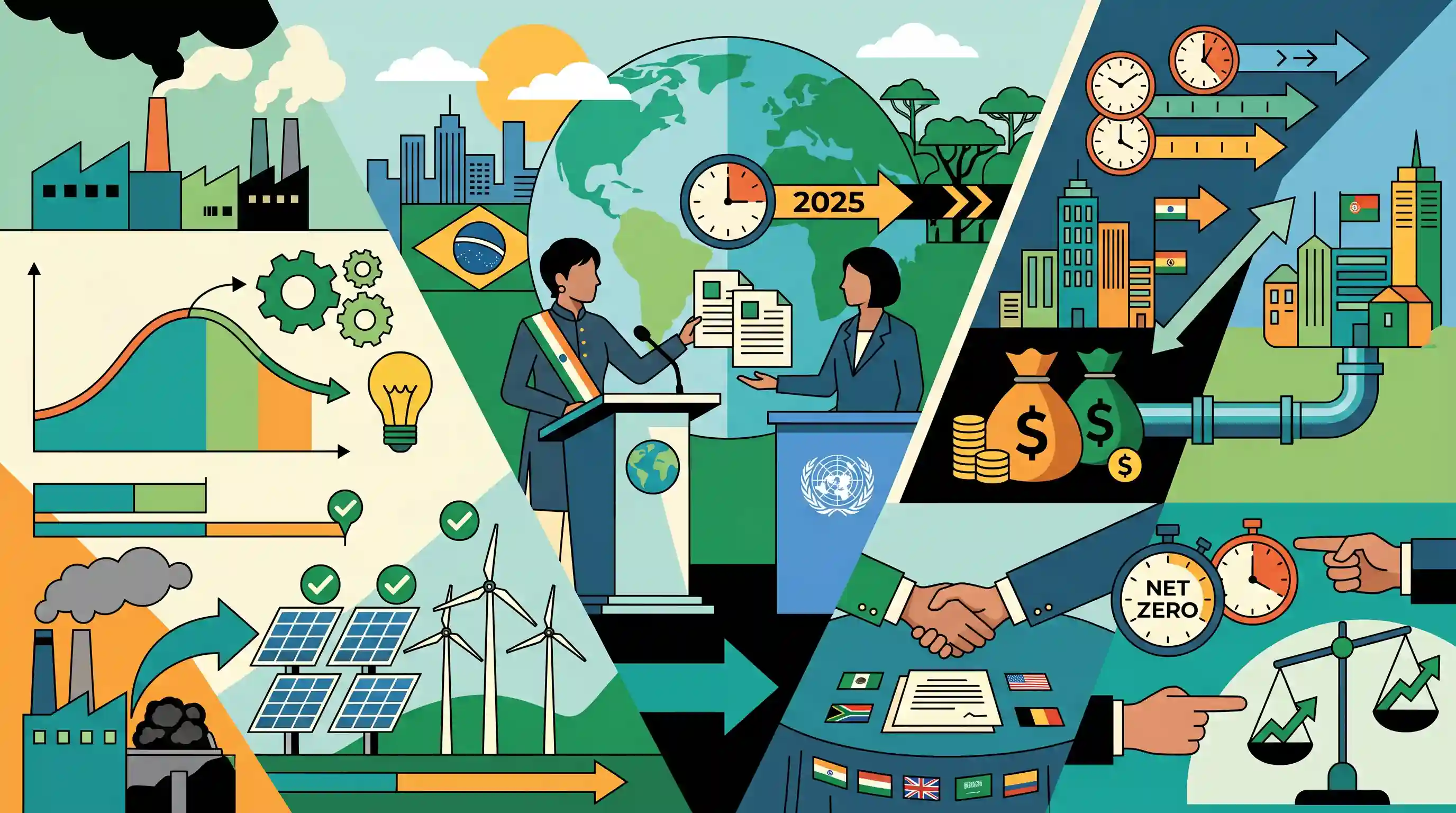
India is set to submit its updated Nationally Determined Contribution (NDC) and its first Biennial Transparency Report (BTR) to the United Nations by December 2025, as announced by Environment Minister Bhupender Yadav at COP30 in Belem, Brazil. The updated NDC will outline voluntary actions towards energy efficiency and fossil fuel transition. While India's emissions will continue to grow, the rate of growth is expected to slow. India has already achieved its previous non-fossil power capacity targets ahead of the 2030 deadline. Furthermore, Yadav underscored the urgency for developed countries to expedite their net-zero targets and fulfill their climate finance obligations under Article 9.1 of the Paris Agreement to support developing nations in achieving their climate goals.
Key Points
- India will submit its updated Nationally Determined Contribution (NDC) and its first Biennial Transparency Report (BTR) to the UN by December 2025.
- The announcement was made by Environment Minister Bhupender Yadav at the 30th Conference of Parties (COP30) to the UNFCCC, held in Belem, Brazil.
- India's updated NDC will feature voluntary goals for transitioning away from fossil fuels and increasing energy efficiency.
- India achieved its 2022 goal of 50% installed power capacity from non-fossil sources ahead of the 2030 schedule.
- India stressed the importance of developed nations reaching net-zero earlier and fulfilling climate finance commitments under Article 9.1 of the Paris Agreement.
Important Terms
Nationally Determined Contributions (NDC)

Voluntary national climate action plans under the Paris Agreement where countries outline emission reduction and adaptation targets. Updated every five years to reflect increasingly higher ambition.
UPSC context
GS-III (Environment). Vital for understanding India's international climate commitments and its transition toward a low-carbon economy.
Biennial Transparency Report (BTR)
A comprehensive reporting mechanism under the Paris Agreement's Enhanced Transparency Framework (ETF) to track national progress on emissions, climate action, and financial support.
UPSC context
GS-III (Environment). Key for technical questions on global climate accountability and the transition from the Kyoto to the Paris reporting regime.
Article 9.1 of the Paris Agreement
A specific provision in the Paris Agreement mandating that developed countries provide financial resources to assist developing nations with climate mitigation and adaptation efforts.
UPSC context
GS-II (International Relations) and GS-III (Environment). Central to debates on 'Climate Justice' and 'Common but Differentiated Responsibilities' (CBDR).
Paris Agreement
The 2015 legally binding international treaty aiming to limit global warming to well below 2°C, preferably 1.5°C, compared to pre-industrial levels.
UPSC context
GS-III (Environment). The primary framework for all modern global climate policy and India's environmental diplomacy.
UNFCCC
The 1992 parent treaty for international climate negotiations, established to stabilize greenhouse gas concentrations and prevent dangerous human interference with the climate system.
UPSC context
GS-III (Environment). Fundamental institutional knowledge for all environmental governance topics and the history of COP summits.
Prelims Trap
India's updated NDC commits to generating 50% of its total electricity from non-fossil fuel sources by 2030.
The target is 50% of installed electric power *capacity*, not actual electricity *generation*. Because renewables are intermittent, coal still dominates actual base-load generation.
Static Concepts Connected
What is the Enhanced Transparency Framework (ETF) under the Paris Agreement?
- Reporting Mechanism: Established to build trust and confidence, it requires countries to track and report progress on their NDCs and adaptation actions.
- BTR shift: Transitions developing nations from older Biennial Update Reports (BURs) to mandatory Biennial Transparency Reports (BTRs) starting December 2024/2025.
- Inbuilt flexibility: Provides built-in flexibility in reporting scope and frequency for developing country Parties that need it in light of their capacities.
What are the specific obligations under Article 9 of the Paris Agreement?
- Developed nation mandate: Legally obligates developed countries to provide financial resources to assist developing countries with respect to both mitigation and adaptation.
- Biennial communication: Requires developed nations to biennially communicate indicative quantitative information on projected public financial resources to be provided to developing countries.
- Progression principle: Demands that climate finance mobilization represents a progression beyond previous efforts, recognizing the specific needs of developing country Parties.
Cross-Topic Patterns
Climate Finance & CBDR-RC debates
India's invocation of Article 9.1 highlights the friction between climate finance as grants versus loans, linking directly to the sovereign debt burden and macroeconomic stability of Global South nations.
50% non-fossil capacity vs grid reality
Reaching 50% non-fossil installed capacity emphasizes the urgent need for battery energy storage systems (BESS) and pumped hydro storage to handle renewable intermittency without relying heavily on coal base-loads.

Expect a multi-statement question on Paris Agreement mechanisms: matching ETF with BTRs, Global Stocktake, and Article 9.1 finance.
Linked PYQs · 4
Linked PYQs · 4
- 2016PrelimsGS1
The term 'Intended Nationally Determined Contributions' is sometimes seen in the news in the context of
- 2016PrelimsGS1
With reference to the Agreement at the UNFCCC Meeting in Paris in 2015, which of the following statements is/are correct? 1. The Agreement was signed by all the member countries of the UN and it will go into effect in 2017. 2. The Agreement aims to limit the greenhouse gas emissions so that the rise in average global temperature by the end of this century does not exceed 2°C or even 1.5°C above pre-industrial levels. 3. Developed countries acknowledged their historical responsibility in global warming and committed to donate $ 1000 billion a year from 2020 to help developing countries to cope with climate change. Select the correct answer using the code given below.
- 2025MainsGS3
Write a review on India's climate commitments under the Paris Agreement (2015) and mention how these have been further strengthened in COP26 (2021). In this direction, how has the first Nationally Determined Contribution intended by India been updated in 2022?
- 2021MainsGS3
Describe the major outcomes of the 26th session of the Conference of the Parties (COP) to the United Nations Framework Convention on Climate Change (UNFCCC). What are the commitments made by India in this conference?
