Country Platforms and Green Climate Fund Resource Mobilisation
Source:The Hindu ↗
Why It Matters
Climate finance is the central point of contention between developed and developing nations in global climate negotiations. Understanding India's structural interventions (like the new country platform) and its diplomatic stances (on Article 9.1 and GGA indicators) is crucial for UPSC Mains GS3 (Environment) and GS2 (Global Groupings/Agreements), as well as Prelims questions on institutions like the Green Climate Fund.
Summary
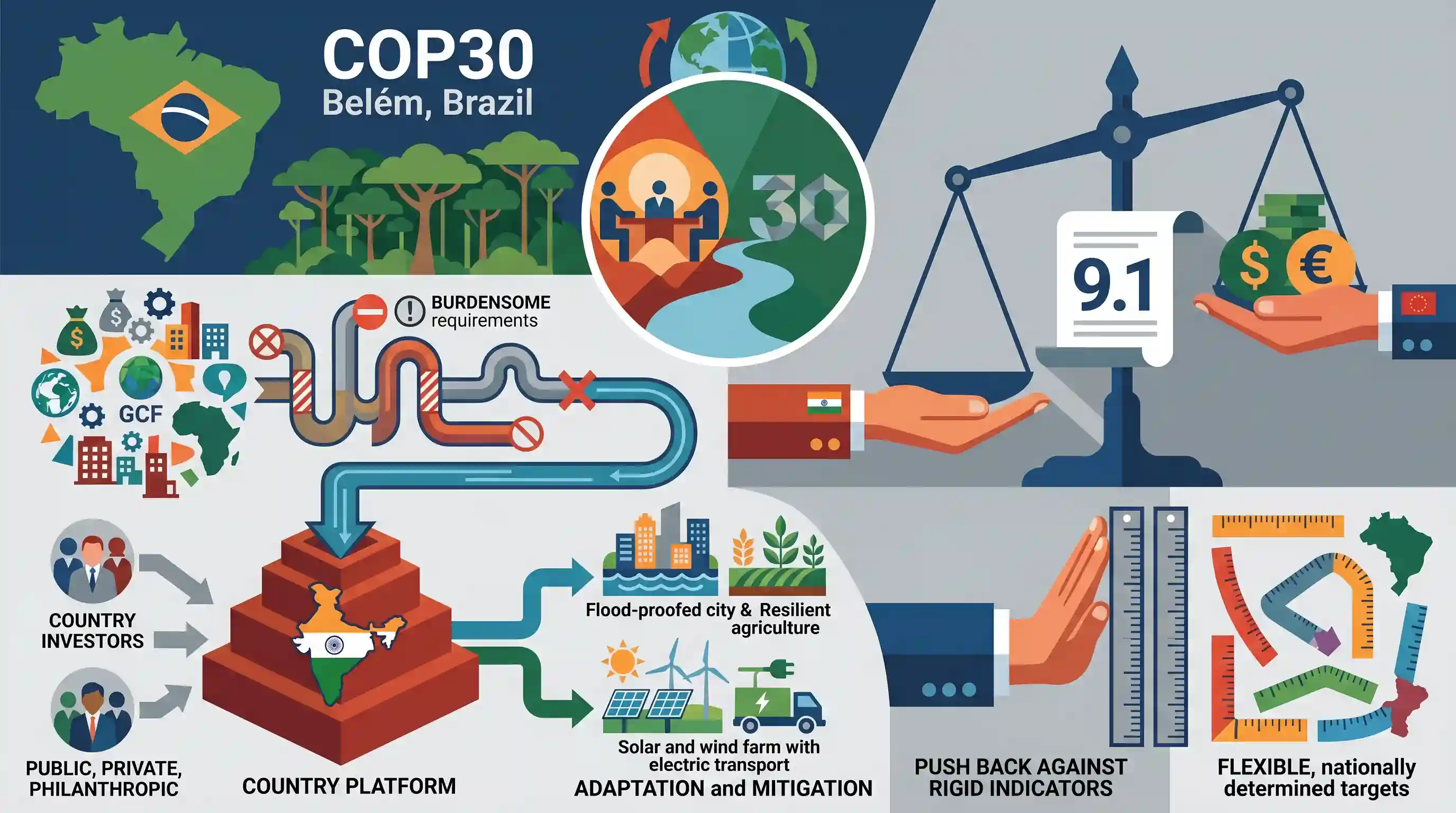
In a bid to streamline access to climate finance, India has announced the creation of a dedicated "country platform" during the COP30 climate negotiations in Belem, Brazil. This platform, developed in collaboration with the Green Climate Fund (GCF) and the Africa Climate Foundation (ACF), aims to consolidate fragmented climate funding and mobilize public, private, and philanthropic investments for adaptation and mitigation projects. The move addresses long-standing grievances from developing countries about the complex, burdensome requirements for drawing down funds from the GCF. Alongside this initiative, India reiterated its firm stance on the Paris Agreement, demanding that developed countries adhere to their financial obligations under Article 9.1, and pushed back against rigid international indicators for the Global Goal on Adaptation (GGA) in favor of flexible, nationally determined targets.
Key Points
- India, along with 12 other countries and an African alliance, has announced plans to establish a national 'country platform' for climate and nature finance during the COP30 negotiations in Belem, Brazil.
- The country platform aims to overcome the fragmented nature of current funding by offering a unified strategic investment plan to pool public, private, and philanthropic resources for both mitigation and adaptation projects.
- This initiative responds to significant criticism from developing nations regarding the cumbersome procedures and lack of technical support associated with accessing funds from the Green Climate Fund (GCF).
- The initiative will be coordinated by the GCF with support from the Africa Climate Foundation, while India's Environment Ministry will oversee the platform as the Nodal Designated Authority.
- At COP30, India also strongly advocated for a targeted discussion on Article 9.1 of the Paris Agreement, urging developed nations to fulfill their obligations to provide climate funds with distinct allocations for mitigation and adaptation.
- Additionally, India opposed rigid, globally standardized metrics for the Global Goal on Adaptation (GGA), arguing for indicators that are country-driven and nationally determined.
Important Terms
Paris Agreement

A legally binding international treaty adopted in 2015 to limit global warming to well below 2°C, aiming for 1.5°C, through national climate commitments (NDCs).
UPSC context
GS Paper III: Central to international environmental governance and India's climate policy framework.
Article 9.1 of the Paris Agreement
A provision of the Paris Agreement mandating that developed nations provide financial resources to assist developing countries in both climate change mitigation and adaptation efforts.
UPSC context
GS Paper III: Key focus of climate finance negotiations and North-South equity debates.
Global Goal on Adaptation (GGA)
A framework established under the Paris Agreement (Article 7) to enhance adaptive capacity, strengthen resilience, and reduce global vulnerability to climate impacts.
UPSC context
GS Paper III: Important for negotiations on adaptation metrics and implementation of the Baku-to-Belem roadmap.
Green Climate Fund (GCF)
The world's largest dedicated climate fund, established under the UNFCCC in 2010, to support developing nations in reducing emissions and adapting to climate change.
UPSC context
GS Paper III: Primary financial mechanism for climate action; tests knowledge of multilateral funding structures.
United Nations Framework Convention on Climate Change (UNFCCC)
The 1992 treaty that serves as the primary international framework for stabilizing greenhouse gas concentrations to prevent dangerous human interference with the climate system.
UPSC context
GS Paper III: The foundational legal body for all annual COP climate negotiations.
Africa Climate Foundation (ACF)
An African-led independent foundation established in 2020 that integrates climate action with economic development and partners on innovative climate finance initiatives.
UPSC context
GS Paper II/III: Significant for South-South cooperation and India's new "country platform" for climate finance.
Prelims Trap
The Ministry of Finance serves as India's Nodal Designated Authority for accessing the Green Climate Fund.
The Ministry of Environment, Forest and Climate Change (MoEFCC) is India's actual National Designated Authority (NDA) for the GCF, not the Ministry of Finance.
Static Concepts Connected
What are the primary operating entities of the UNFCCC Financial Mechanism?
- Global Environment Facility: Established in 1991, it serves as a financial mechanism not just for UNFCCC, but also for the UNCCD, CBD, and Minamata Convention.
- Green Climate Fund: Created at COP16 (2010), it is a dedicated fund helping developing countries reduce greenhouse gas emissions and adapt to climate change impacts.
What is the Global Goal on Adaptation (GGA) under the Paris Agreement?
- Article 7 Mandate: Established under Article 7 to enhance adaptive capacity, strengthen resilience, and reduce vulnerability to climate change, placing it on par with mitigation.
- Nationally Determined Metrics: Unlike mitigation, adaptation is deeply localized. India opposes rigid, standardized global metrics for the GGA, demanding they remain nationally determined.
Cross-Topic Patterns
Blended Finance & Sovereign Green Bonds
India's new platform pooling private and philanthropic capital mirrors its domestic push for blended finance, including Sovereign Green Bonds, to meet its Nationally Determined Contributions (NDCs).
Article 9.1 & Historical Responsibility
India’s demand for developed nations to fulfill Article 9.1 financial obligations is deeply rooted in the core UNFCCC principles of Historical Responsibility and Common But Differentiated Responsibilities (CBDR).

Expect a 2026 prelims question testing the distinctions between GCF, GEF, and Loss & Damage Fund, alongside their nodal ministries in India.
Linked PYQs · 3
Linked PYQs · 3
- 2015PrelimsGS1
Which of the following statements regarding 'Green Climate Fund' is/are correct? 1. It is intended to assist the developing countries in adaptation and mitigation practices to counter climate change. 2. It is founded under the aegis of UNEP, OECD, Asian Development Bank and World Bank. Select the correct answer using the code given below.
- 2025PrelimsGS1
Consider the following statements : Statement I: Article 6 of the Paris Agreement on climate change is frequently discussed in global discussions on sustainable development and climate change. Statement II: Article 6 of the Paris Agreement on climate change sets out the principles of carbon markets. Statement III : Article 6 of the Paris Agreement on climate change intends to promote inter-country non-market strategies to reach their climate targets. Which one of the following is correct in respect of the above statements?
- 2025MainsGS3
Write a review on India's climate commitments under the Paris Agreement (2015) and mention how these have been further strengthened in COP26 (2021). In this direction, how has the first Nationally Determined Contribution intended by India been updated in 2022?
