IMD Monsoon Forecast and El Nino Conditions in India
Source:The Hindu ↗
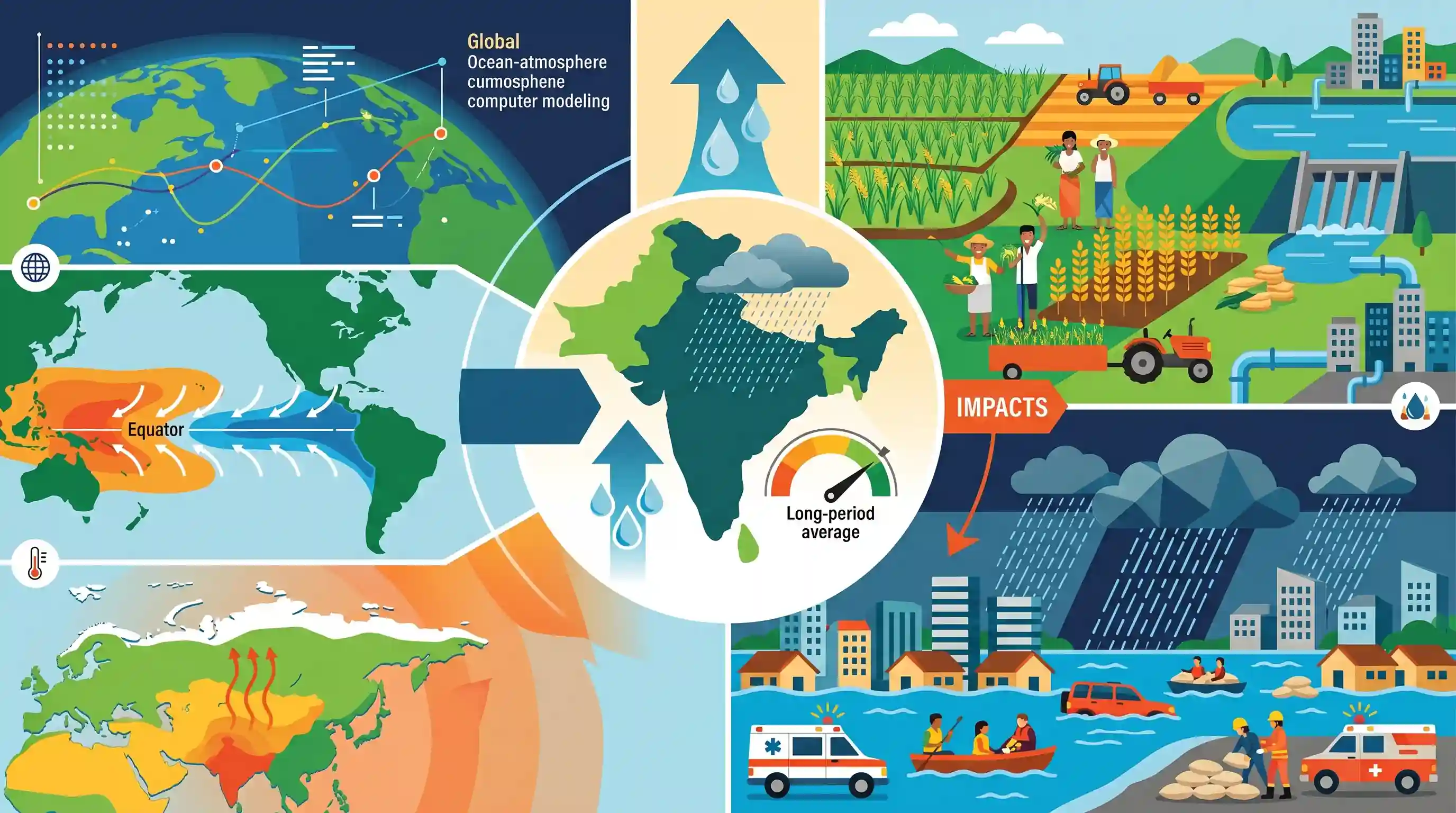
Why It Matters
Understanding the mechanics of the Indian monsoon and global climatic phenomena like ENSO and IOD is a core component of the UPSC Geography syllabus. It also bridges into GS3 (Agriculture and Disaster Management) because monsoon variability dictates crop yields, inflation dynamics, and the incidence of floods.
Summary
The India Meteorological Department (IMD) has forecast an 'above normal' southwest monsoon for 2025, anticipating rainfall at 105% of the Long Period Average (LPA). The prediction relies on a dynamic ocean-atmosphere model that points to favorable global climate parameters. The absence of El Nino conditions, combined with below-normal Eurasian snow cover, sets the stage for robust rainfall. While this bodes well for India's Kharif agricultural season and water reservoirs, authorities warn of potential hazards like intense localized downpours and flooding.
Key Points
- The IMD forecasts 'above normal' cumulative monsoon rainfall for 2025, pegged at 105% of the historical Long Period Average (LPA) of 87 cm.
- A monsoon-suppressing El Nino is unlikely this year, as neutral El Nino-Southern Oscillation (ENSO) conditions currently prevail along with a La Nina-like atmospheric circulation.
- 'Below normal' snow cover over the Eurasian region in early 2025 presents an inverse relationship with the summer monsoon, further favoring strong rainfall.
- Neutral Indian Ocean Dipole (IOD) conditions are present; a positive IOD typically aids the monsoon but is currently neutral.
- While abundant rainfall will benefit Kharif crop sowing and reservoir storage, it heightens the risk of extreme weather events such as intense downpours, floods, and landslides.
Important Terms
India Meteorological Department (IMD)

India's principal government agency for meteorology, seismology, and weather forecasting, operating under the Ministry of Earth Sciences since 1875.
UPSC context
GS Papers I and III. Tests understanding of institutional frameworks for weather monitoring, disaster management, and agricultural advisories.
Long Period Average (LPA)
The 50-year rainfall average used as a benchmark for monsoon performance; currently 868.8 mm (87 cm) based on 1971–2020 data.
UPSC context
GS Paper I (Climatology). Essential for interpreting seasonal forecasts and agricultural output predictions in both Prelims and Mains.
El Niño
A climate pattern involving unusual warming of surface waters in the eastern tropical Pacific, which typically disrupts and weakens the Indian monsoon.
UPSC context
GS Paper I (Physical Geography). A core concept for atmospheric circulation and its global socio-economic impacts on Indian agriculture.
La Niña
The cooling phase of the ENSO cycle in the central/eastern Pacific, which often strengthens the Indian monsoon and boosts agricultural productivity.
UPSC context
GS Paper I (Geography). Tests knowledge of global climate drivers that favor higher yields but increase flood risks.
Indian Ocean Dipole (IOD)
An atmospheric-ocean phenomenon involving sea surface temperature differences between the western (Arabian Sea) and eastern (near Indonesia) Indian Ocean.
UPSC context
GS Paper I (Geophysical Phenomena). Important for understanding regional monsoon variability and its ability to mitigate El Niño effects.
Kharif Season
The summer cropping season (June–October) where moisture-dependent crops like paddy and maize are sown with the onset of the southwest monsoon.
UPSC context
GS Paper III (Agriculture). Crucial for questions on cropping patterns, food security, and the economy's reliance on rainfall.
Prelims Trap
"Above-normal snow cover over the Eurasian region strongly favors an above-normal Indian summer monsoon."
This is a classic trap. The relationship is inverse. Extensive Eurasian snow cover cools the landmass, weakening the summer thermal contrast between land and the Indian Ocean, thereby suppressing the monsoon.
Static Concepts Connected
How do El Niño and a Positive IOD impact the Indian Monsoon differently?
- El Niño: Warms the central/eastern equatorial Pacific, shifting the Walker Circulation and generally suppressing rain-bearing winds over the Indian subcontinent.
- Positive IOD: Warms the western Indian Ocean relative to the east, boosting convection and pushing moisture-laden winds toward India, enhancing rainfall.
- Combined Interaction: A strong Positive IOD can act as a buffer, occasionally neutralizing the drought-inducing effects of a concurrent El Niño year.
What is the Long Period Average (LPA) for the Indian Monsoon?
- Definition: The average rainfall recorded over a 50-year period, used by the IMD as a historical benchmark for seasonal forecasting.
- Current Baseline: Currently based on 1971–2020 data, the all-India Southwest Monsoon LPA is pegged at 87 cm.
- Categorization: Rainfall is "Normal" at 96-104% of LPA, "Above Normal" at 104-110%, "Excess" >110%, and "Deficient" <90%.
Cross-Topic Patterns
Kharif sowing and macroeconomic inflation
Above-normal monsoon boosts Kharif output (rice, pulses, oilseeds), which can cool rural distress and food inflation—a critical factor dictating the RBI's interest rate and monetary policy stance.
Monsoon distribution and urban flooding
While cumulative rainfall is 105%, concentrated spurts cause urban flooding. Mains often links climate change-induced uneven monsoon distribution to urban stormwater drainage failures and disaster management.

Expect a multi-statement Prelims 2026 question linking Eurasian snow cover anomalies, IOD phases, and the dynamic MMCFS forecasting model.
Linked PYQs · 4
Linked PYQs · 4
- 2011PrelimsGS1
La Nina is suspected to have caused recent floods in Australia. How is La Nina different from El Nino? 1. La Nina is characterised by unusually cold ocean temperature in equatorial Indian Ocean whereas El Nino is characterised by unusually warm ocean temperature in the equatorial Pacific Ocean. 2. El Nino has adverse effect on south-west monsoon of India, but La Nina has no effect on monsoon climate. Which of the statements given above is/are correct?
- 2017PrelimsGS1
With reference to 'Indian Ocean Dipole (IOD)' sometimes mentioned in the news while forecasting Indian monsoon, which of the following statements is/are correct? 1. IOD phenomenon is characterised by a difference in sea surface temperature between tropical Western Indian Ocean and tropical Eastern Pacific Ocean. 2. An IOD phenomenon can influence an El Nino's impact on the monsoon. Select the correct answer using the code given below:
- 2002PrelimsGS1
For short-term climate prediction, which one of the following events, detected in the last decade, is associated with occasional weak monsoon rains in the India subcontinent?
- 2020MainsGS1
Account for the huge flooding of million cities in India including the smart ones like Hyderabad and Pune. Suggest lasting remedial measures.
