India Seeks Zero Tariff Garment Access Under US Trade Pact
Source:The Hindu ↗
Why It Matters
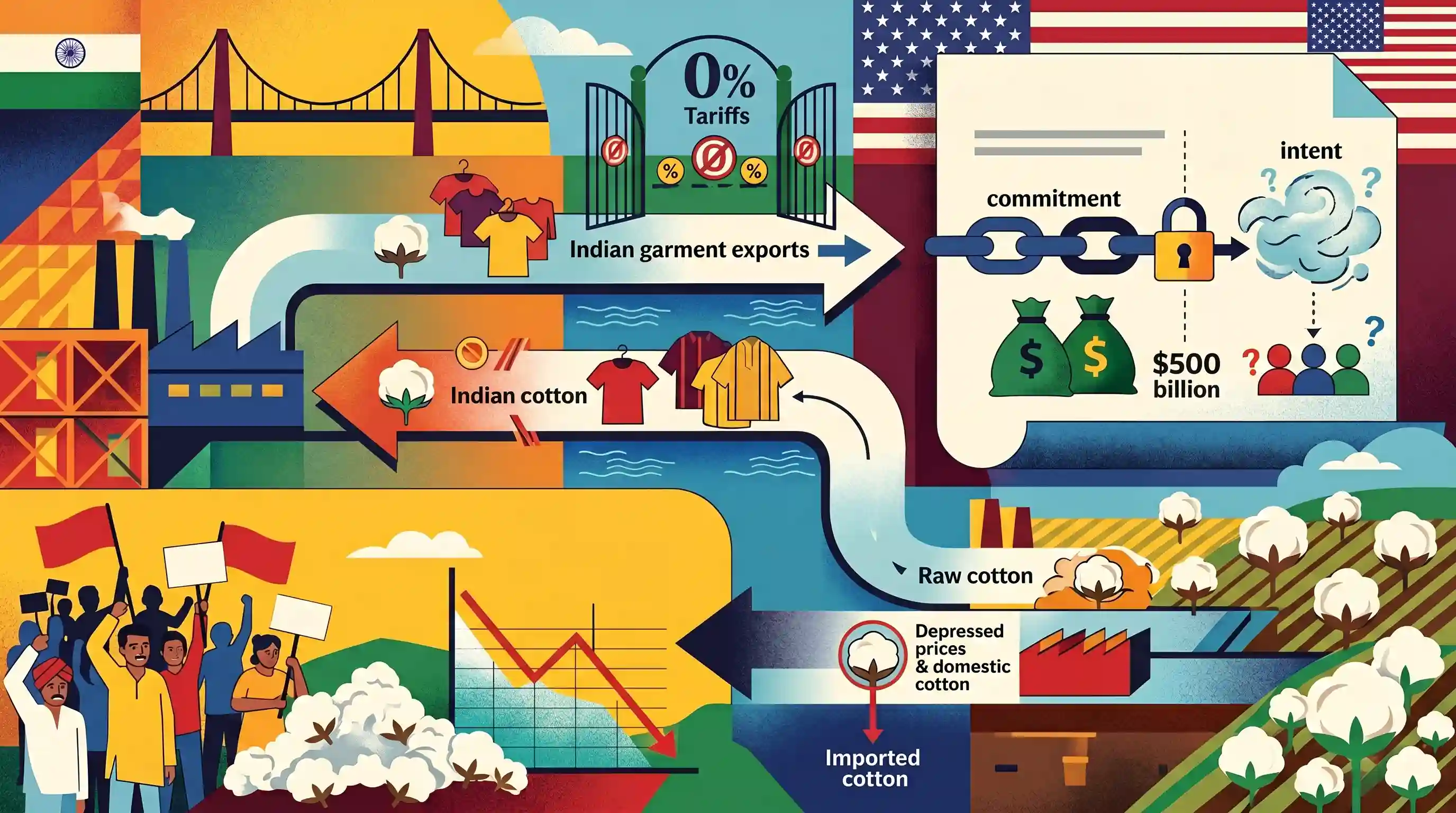
It illustrates the classic trade-policy dilemma where securing market access and tariff reductions for manufacturing exports (textiles) requires concessions in raw material imports (cotton), directly risking domestic agricultural livelihoods.
Summary
Commerce Minister Piyush Goyal announced that under a proposed interim trade agreement with the United States, India's garment exports will receive the same zero-tariff benefits recently granted to Bangladesh, provided the raw cotton is sourced from America. This statement counters Opposition claims that Indian textiles would face uncompetitive 18% tariffs. The US has also tempered its initial claims, revising a fact sheet to reflect an "intent" rather than a firm "commitment" by India to purchase $500 billion in American goods over the coming years. However, linking textile export competitiveness to the import of US cotton has sparked domestic concerns; organizations like the Samyukt Kisan Morcha argue this arrangement could severely depress prices for domestic cotton farmers, who already lack adequate Minimum Support Price (MSP) coverage.
Key Points
- India is negotiating an interim trade pact with the US to secure zero-tariff access for its garment exports, matching the recent benefits given to Bangladesh.
- To avail the zero reciprocal tariff, Indian textile manufacturers will have to source their raw material (cotton) from the United States.
- The US revised its initial trade fact sheet, changing India\'s stance from \"committed\" to \"intends\" to buy $500 billion in American goods, and dropped references to agricultural products and digital service tax.
- Farmers\' groups like the Samyukt Kisan Morcha warn that importing US cotton to facilitate garment exports will hurt domestic cotton farmers who already struggle with MSP issues.
Important Terms
Minimum Support Price (MSP)

The minimum price set by the Government of India for specific crops, ensuring a guaranteed return to farmers regardless of market fluctuations.
UPSC context
GS Paper 3: Agriculture and Food Security. Tests understanding of price stabilization mechanisms and farmer welfare policies.
Interim Trade Agreement
A preliminary or limited-scope trade pact signed before a final, comprehensive Free Trade Agreement (FTA) or CEPA to provide immediate mutual benefits.
UPSC context
GS Paper 2: International Relations; GS Paper 3: Economy. Tests knowledge of bilateral trade diplomacy and export strategies.
Samyukt Kisan Morcha (SKM)
An umbrella coalition of farmers' unions in India, formed to lead nationwide protests and advocate for agrarian reforms, including legal MSP guarantees.
UPSC context
GS Paper 2: Civil Society and Pressure Groups. Relevant for understanding organized farmer movements and stakeholder influence.
Reciprocal Tariff / Zero-Tariff Benefits
A trade policy where partner countries reduce or eliminate import duties on each other's goods, ensuring balanced market access.
UPSC context
GS Paper 3: External Sector. Tests knowledge of tariff structures, competitiveness, and global trade dynamics.
Yarn Forward Rule
A trade rule requiring garments to be made from yarn/fiber produced within the member countries to qualify for duty-free status.
UPSC context
GS Paper 3: Industrial Growth/Textiles. Tests understanding of 'Rules of Origin' and value-chain requirements in international trade.
Prelims Trap
The India-US interim trade pact grants unconditional zero-tariff access to Indian garment exports.
The zero-tariff benefit is not unconditional; it is strictly tied to a "Rules of Origin" clause requiring Indian manufacturers to source raw cotton specifically from the United States.
Static Concepts Connected
What are "Rules of Origin" (RoO) in international trade agreements?
- Definition: They are the criteria needed to determine the national source of a product.
- Core Purpose: They prevent third countries from bypassing tariffs by routing their goods through a nation that has an FTA with the target market.
- Textile Application: In textiles, a "yarn-forward" rule often dictates that yarn spinning and all subsequent manufacturing steps must occur within partner countries to claim duty-free status.
What are the core cultivation requirements and MSP status of Cotton in India?
- Cultivation Conditions: It is a Kharif crop requiring 210 frost-free days, bright sunshine, light rainfall, and well-drained black soil (Regur).
- MSP Status: Cotton is one of the mandated crops for which the Cabinet Committee on Economic Affairs (CCEA) announces MSP based on CACP recommendations.
- Top Producers: Gujarat, Maharashtra, and Telangana are typically the top producing states in India.
Cross-Topic Patterns
Export Promotion vs Domestic Agriculture
Trade pacts linking export market access (textiles) to raw material imports (US cotton) directly conflict with domestic farmer protections (MSP), highlighting the classic trade-vs-agriculture policy dilemma.
LDC Preference Schemes & Textile Competitiveness
India's structural tariff disadvantage against Bangladesh stems from LDC preference schemes. As Bangladesh graduates from LDC status, India's push for FTAs and interim pacts becomes critical for global textile parity.

Expect a 2026 Prelims question merging "Rules of Origin" in FTAs with India's textile export constraints and cotton MSP coverage.
Linked PYQs · 4
Linked PYQs · 4
- 2025MainsGS3
What are the challenges before the Indian economy when the world is moving away from free trade and multilateralism to protectionism and bilateralism? How can these challenges be met?
- 2018MainsGS3
What do you mean by Minimum Support Price (MSP)? How will MSP rescue the farmers from the low income trap?
- 2017MainsGS3
How do subsidies affect the cropping pattern, crop diversity and economy of farmers? What is the significance of crop insurance, minimum support price and food processing for small and marginal farmers?
- 2018PrelimsGS1
Consider the following: 1. Areca nut 2. Barley 3. Coffee 4. Finger millet 5. Groundnut 6. Sesamum 7. Turmeric The Cabinet Committee on Economic Affairs has announced the Minimum Support Price for which of the above?
