Bhopal Hosts BRICS Culture Meeting with Focus on Artifact Return
Source:newindianexpress ↗
Why It Matters
The article is highly relevant for MPPSC Prelims as it involves a major international summit (BRICS Culture Working Group) being hosted in Bhopal. Furthermore, the push to repatriate the Vagdevi idol directly touches upon the history of the Paramara dynasty and the cultural heritage of Dhar, Madhya Pradesh, which is a frequent area of focus in state exams.
Summary
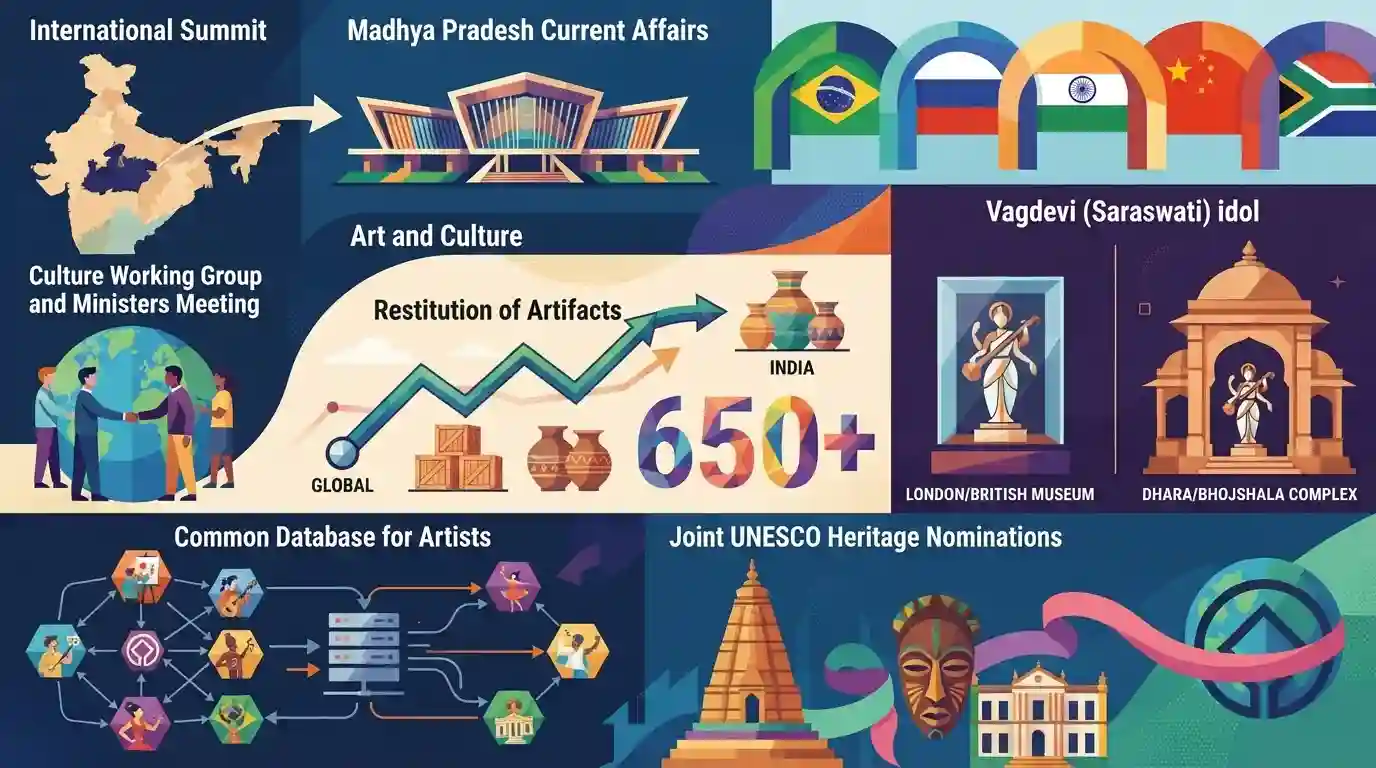
India is set to host the BRICS Culture Working Group and Ministers Meeting in Bhopal, Madhya Pradesh, with a major focus on the restitution of stolen and smuggled cultural artifacts. The Ministry of Culture emphasized that protecting cultural property is a top priority, showcasing the successful repatriation of 650 antiquities since 2014 from countries like the USA and Australia. A key focal point for Madhya Pradesh is the effort to repatriate the Vagdevi (Saraswati) idol, originally from the historical Dhar Bhojshala complex, currently located in the British Museum in London. Additionally, the summit will discuss a common database for artists and joint UNESCO heritage nominations.
Key Points
- The BRICS Culture Working Group and Ministers Meeting is scheduled to be held in Bhopal, Madhya Pradesh.
- A primary agenda for India is the restitution and repatriation of stolen and smuggled cultural antiquities.
- India intends to bring back the historically significant Vagdevi (Saraswati) idol of Dhar Bhojshala, which is currently housed in the British Museum, London.
- Since 2014, significant progress has been made with the repatriation of 650 antiquities, including returns from the USA and Australia.
- Other discussion points include creating a common database of BRICS artists and preparing multinational nominations for UNESCO.
Prelims Trap
All cultural artifacts must be at least 100 years old to be legally classified as an 'antiquity' in India.
Under the Antiquities and Art Treasures Act, 1972, manuscripts and documents only need to be 75 years old, whereas sculptures/coins require 100 years.
Static Concepts Connected
How does Indian law define and protect 'antiquities'?
- Age Criteria: Under the 1972 Act, coins, sculptures, or paintings must be >100 years old. However, manuscripts or historical documents only need to be >75 years old.
- Export Monoploy: Only the Central Government or its specifically authorized agencies are permitted to legally export antiquities outside India's borders.
- UNESCO Convention: India's framework aligns with the 1970 UNESCO Convention, which is the primary international legal framework for the restitution of smuggled artifacts.
What is the cultural significance of Raja Bhoj and the Parmar dynasty?
- Dhar Bhojshala: Established by Raja Bhoj in Dhar, Madhya Pradesh, it served as an elite center for Sanskrit learning and a temple dedicated to Goddess Saraswati (Vagdevi).
- Scholarly King: Raja Bhoj (11th century) was a renowned polymath who authored significant Sanskrit treatises on architecture (Samarangana Sutradhara), poetry, and yoga.
Cross-Topic Patterns
Soft Power and Cultural Repatriation
Repatriation of antiquities has become a key diplomatic tool in bilateral and multilateral (BRICS, G20) forums to assert post-colonial sovereignty and project soft power.
ASI and Contested Heritage Monuments
The Dhar Bhojshala complex features overlapping religious claims, linking medieval history to modern legal battles and archaeological surveys governed by the ASI and the Ancient Monuments Act.

Expect a multi-statement question combining the legal definition of an 'antiquity' under the 1972 Act with facts about Raja Bhoj's reign.
Linked PYQs · 2
Linked PYQs · 2
- 2019MPPSC_PRELIMSGS1
Which among the following source throw light on the history of Parmar Dynasty ?
- 2022MPPSC_PRELIMSGS1
Where was the Global Investors Summit - 2023 held in Madhya Pradesh?
