India Mandates Sustainable Aviation Fuel Blending for Flights
Source:The Hindu ↗
हे का महत्त्वाचे आहे
This mandate marks a significant regulatory step by India towards greening the transport sector, specifically civil aviation, which is notoriously hard to abate. It connects directly with India's net-zero targets, international climate commitments, and energy security policies.
सारांश
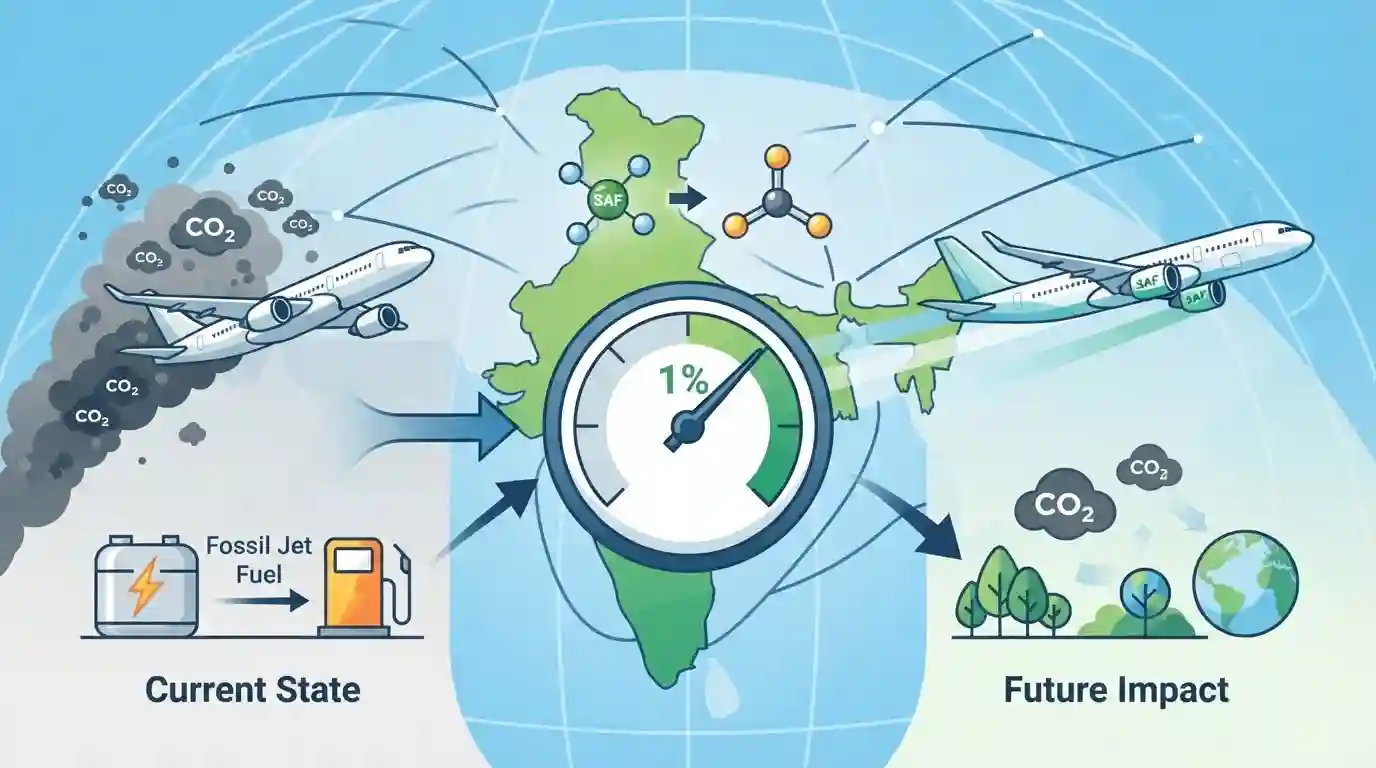
India is planning to mandate a 1% Sustainable Aviation Fuel (SAF) blending for international flights beginning in January. This policy aims to curb carbon emissions in the civil aviation sector, addressing environmental obligations and international commitments.
मुख्य मुद्दे
- India is set to mandate a 1% Sustainable Aviation Fuel (SAF) blending requirement for international flights starting in January.
- The move aims to curb carbon emissions from the fast-growing civil aviation sector and align with international climate targets.
- SAF can be produced from diverse biomass and waste streams, reducing life-cycle greenhouse gas emissions compared to conventional jet fuel.
- Implementation challenges include domestic production scaling, feedstock availability, and cost differentials with fossil fuels.
पूर्वपरीक्षा सापळा
India mandated 1% SAF blending across all commercial domestic and international flights simultaneously from January.
Aspirants often assume SAF blending applies uniformly to all domestic and international flights simultaneously; however, initial mandates frequently target international routes first under ICAO/CORSIA frameworks.
संबंधित स्थिर संकल्पना
What is ICAO's CORSIA framework and its primary mechanism for international aviation emissions?
- Phased Approach: Voluntary to Mandatory phases for offsetting international flight carbon emissions above a baseline.
- MRV Mechanism: Operates on Monitoring, Reporting, and Verification (MRV) systems for airline operators.
- Mitigation Tools: Promotes eligible carbon credits and Sustainable Aviation Fuel (SAF) usage to meet offsetting requirements.
What are the primary feedstocks and pathways for producing Sustainable Aviation Fuel (SAF)?
- Feedstock Diversity: Derived from non-fossil sources including used cooking oil (UCO), agricultural waste, and municipal solid waste.
- Emission Reduction: Achieves significant life-cycle greenhouse gas emission reductions compared to conventional fossil jet fuel.
- Production Pathways: Produced via pathways like HEFA (Hydroprocessed Esters and Fatty Acids) and Fischer-Tropsch synthesis.
आंतर-विषय नमुने
CORSIA and Paris Agreement Linkages
ICAO's CORSIA framework intersects with India's Nationally Determined Contributions (NDCs) under the Paris Agreement, linking civil aviation decarbonization to broader climate finance and carbon market debates.
Used Cooking Oil: Food Safety to Biofuels
Promoting UCO-based SAF production ties public health/food safety regulations (preventing reused cooking oil in food chains) directly with green energy infrastructure.

Expect a statement-based question linking ICAO's CORSIA framework with India's domestic SAF blending mandates and non-fossil feedstocks.
संबंधित PYQ · 2
संबंधित PYQ · 2
- 2024PrelimsGS1
Consider the following materials: 1. Agricultural residues 2. Corn grain 3. Wastewater treatment sludge 4. Wood mill waste Which of the above can be used as feedstock for producing Sustainable Aviation Fuel?
- 2025PrelimsGS1
With reference to 'Direct Air Capture', an emerging technology, which of the following statements is/are correct? I. It can be used as a way of carbon sequestration. II. It can be a valuable approach for plastic production and in food processing. III. In aviation, it can be a source of carbon for combining with hydrogen to create synthetic low-carbon fuel. Select the correct answer using the code given below.
