Navy Drone Leasing and Maritime Domain Awareness Acquisition
Source:The Hindu ↗
Why It Matters
This development showcases how India uses procedural reforms (like the leasing option in Defence Acquisition Procedure) to quickly secure state-of-the-art surveillance technologies in response to immediate regional maritime threats. It is highly relevant for GS3 Security (maritime security, defense modernization) and GS2 International Relations (India-US strategic partnership, Indo-Pacific geopolitics).
Summary
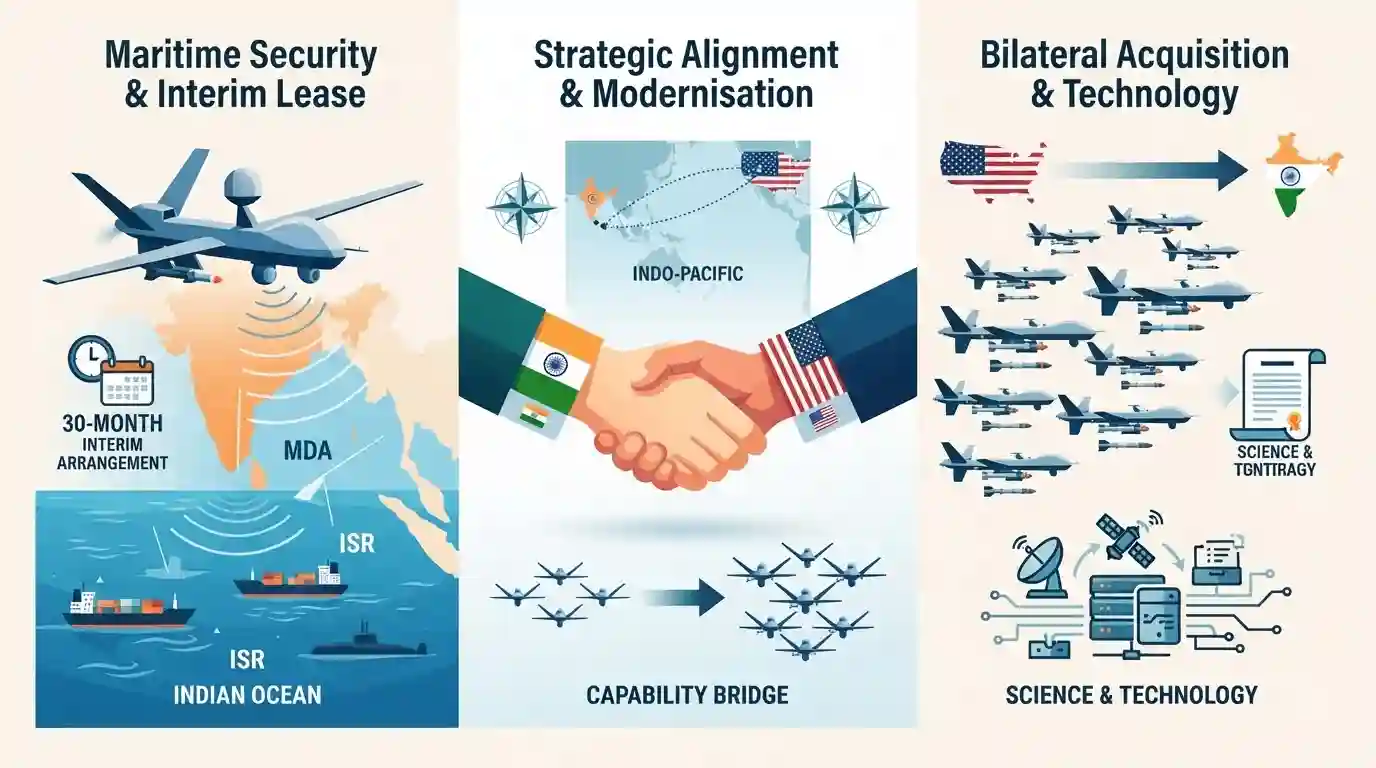
The Union Ministry of Defence has signed a ₹1,943-crore contract with General Atomics to lease two MQ-9B Sea Guardian High-Altitude Long-Endurance (HALE) drones for the Indian Navy for 30 months. This interim arrangement will quickly bolster India's Maritime Domain Awareness (MDA) and intelligence, surveillance, and reconnaissance (ISR) capabilities in the Indian Ocean Region. This lease acts as a capability bridge until the arrival of the 31 armed MQ-9B UAVs purchased under a $3.5 billion bilateral deal in October 2024, highlighting the shift toward agile defense procurement (leasing) and the growing strategic alignment between India and the United States in the Indo-Pacific.
Key Points
- The Ministry of Defence signed a ₹1,943-crore contract with U.S.-based General Atomics to lease two MQ-9B Sea Guardian High-Altitude Long-Endurance (HALE) remotely piloted aircraft systems for 30 months.
- The MQ-9B Sea Guardian systems will significantly enhance the Indian Navy's maritime domain awareness (MDA) and provide persistent intelligence, surveillance, and reconnaissance (ISR) coverage over the Indian Ocean Region (IOR).
- This 30-month lease acts as an interim capability bridge before the delivery of the 31 armed MQ-9B UAVs acquired under a separate $3.5 billion deal signed in October 2024, which are expected by 2030.
- The acquisition utilizes the 'Leasing' category introduced under the Defence Acquisition Procedure (DAP) to rapidly scale up operational capabilities without immediate massive capital expenditure.
- The deal underscores the deepening of India-U.S. defense cooperation and a shared strategic commitment to maintaining a free, open, and secure Indo-Pacific.
Important Terms
Defence Acquisition Procedure (DAP) 2020

India's regulatory manual for military procurement. Its 2020 iteration notably introduced a 'Leasing' category, allowing armed forces to quickly rent rather than purchase platforms to bridge immediate operational capability gaps.
UPSC context
GS-3 (Security). Highlights shifts toward agile defense acquisitions and efforts to maintain operational readiness pending final deliveries.
India-U.S. MQ-9B Armed UAVs Deal
A ~$3.5 billion bilateral agreement finalised in October 2024 to acquire 31 MQ-9B High-Altitude Long-Endurance (HALE) drones—15 SeaGuardians for the Navy and 16 SkyGuardians for the Army and Air Force.
UPSC context
GS-2 (IR) / GS-3 (Security). Essential for questions on Indo-U.S. defense interoperability, strategic technology transfers, and maritime surveillance.
General Atomics Aeronautical Systems Inc. (GA-ASI)
A major American aerospace and defense contractor that designs and manufactures unmanned aerial vehicles (UAVs) and radar solutions, most notably the Predator and MQ-9 series aircraft.
UPSC context
GS-3 (Science & Technology / Defence). Relevant for mapping foreign original equipment manufacturers (OEMs) critical to India's military modernization.
Indian Navy
The maritime branch of the Indian Armed Forces. In the context of the MQ-9B lease, it leads India's efforts to establish persistent Maritime Domain Awareness (MDA) across the vast Indian Ocean Region.
UPSC context
GS-3 (Security). Critical to maritime security topics, countering adversarial footprint in the IOR, and ensuring freedom of navigation.
Prelims Trap
Leasing of defence equipment is prohibited under India's defence procurement rules to promote indigenous manufacturing.
DAP 2020 explicitly introduced the 'Leasing' category to allow armed forces to quickly bridge capability gaps without incurring massive upfront capital expenditure.
Static Concepts Connected
What are the key features of the 'Leasing' category in DAP 2020?
- Cost Efficiency: Introduced in DAP 2020 to bypass long procurement cycles and reduce initial capital outgo for high-value military assets.
- Bifurcated Framework: Sub-divided into Lease (Indian) and Lease (Global) to permit sourcing from domestic entities or direct foreign manufacturers.
- Strategic Use-case: Ideal for bridging interim operational gaps, particularly for ISR assets, transport fleets, and training simulators, rather than combat-exclusive hardware.
What is the difference between HALE and MALE Unmanned Aerial Vehicles (UAVs)?
- HALE Drones: High-Altitude Long-Endurance (HALE) operates above 40,000 feet with 30-40+ hours endurance, used for strategic, wide-area reconnaissance (e.g., MQ-9B).
- MALE Drones: Medium-Altitude Long-Endurance (MALE) operates at 10,000-30,000 feet for tactical roles with roughly 24-hour endurance (e.g., Heron, Tapas).
- Payload Capabilities: Advanced HALE variants like the Sea Guardian can carry specialized maritime payloads, including Anti-Submarine Warfare (ASW) sonobuoy kits.
Cross-Topic Patterns
Foundational Pacts & ISR synergy
Real-time intelligence sharing from MQ-9Bs in the IOR is practically enabled by foundational US-India treaties like COMCASA and BECA, tightly linking hardware acquisitions to strategic diplomacy.
IOR Chokepoints and MDA
High-endurance drone deployment complements the Information Fusion Centre for Indian Ocean Region (IFC-IOR) by tracking PLA Navy submarine movements near critical chokepoints like the Malacca Strait.

Expect a mixed-statement question testing the MQ-9B's HALE classification alongside DAP 2020's innovative 'Leasing' provision.
Linked PYQs · 3
Linked PYQs · 3
- 2022MainsGS3
What are the maritime security challenges in India ? Discuss the organisational, technical and procedural initiatives taken to improve the maritime security.
- 2020MainsGS2
What is the significance of Indo-US defence deals over Indo-Russian defence deals? Discuss with reference to stability in the Indo-Pacific region.
- 2025MainsGS3
Why is maritime security vital to protect India's sea trade? Discuss maritime and coastal security challenges and the way forward.
