Introduction of Qdenga Vaccine and Vector Borne Disease Strategy
Source:The Hindu ↗
આ શા માટે મહત્વનું છે
The introduction of the first approved dengue vaccine in India represents a major breakthrough in managing vector-borne epidemics, reducing hospitalization costs, and strengthening national public health immunization frameworks.
સારાંશ
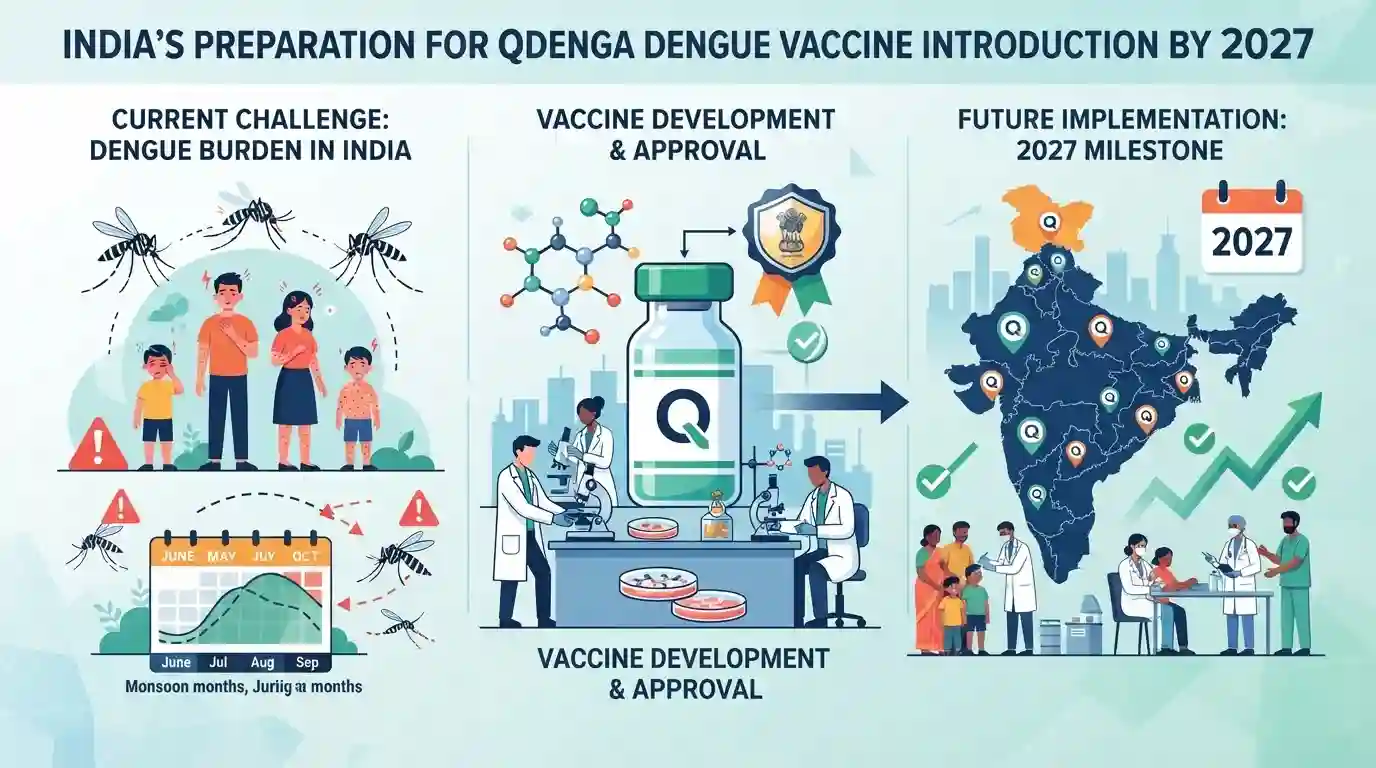
India is preparing to introduce its first approved dengue vaccine, Qdenga, developed by Takeda Pharmaceutical, by 2027. This marks a significant milestone in India's public health landscape, addressing the heavy seasonal burden of vector-borne viral infections and improving disease prevention.
મુખ્ય મુદ્દા
- India is set to launch its first approved dengue vaccine, Qdenga (developed by Takeda), in 2027.
- Dengue poses a major public health challenge in India due to high seasonal transmission driven by Aedes mosquitoes.
- The introduction of the vaccine will bolster India's vector-borne disease control strategy and preventive healthcare infrastructure.
મહત્વપૂર્ણ શબ્દો
Qdenga

A live-attenuated tetravalent dengue vaccine developed by Takeda Pharmaceutical that provides broad immune protection against all four dengue serotypes for individuals aged 4 to 60 years.
UPSC context
Important for GS Paper II (Health, Public Policy, Disease Control) and GS Paper III (Science & Technology - Biotechnology, Immunization).
Takeda Pharmaceutical
A major global research-driven pharmaceutical company headquartered in Japan, known for developing breakthrough immunization solutions such as the Qdenga dengue vaccine.
UPSC context
Relevant for GS Paper III (Science & Tech, Pharma sector, Public-Private Partnerships in healthcare and vaccine manufacturing).
પ્રિલિમ્સ ટ્રેપ
Qdenga is a transmission-blocking vaccine that completely prevents dengue virus transmission and replaces the need for vector-control measures.
Aspirants might assume a transmission-blocking vaccine stops infection entirely, whereas Qdenga is disease-modifying, reducing severity and hospitalisation while vector-control remains essential.
સંલગ્ન સ્થિર ખ્યાલો
What are the different types of vaccines and how do tetravalent vaccines work against multi-serotype viruses?
- Vaccine Types: Live-attenuated uses weakened pathogens to trigger a robust immune response, whereas inactivated uses killed pathogens.
- Tetravalent Design: Tetravalent vaccines target four distinct viral serotypes (like DENV-1 to DENV-4 in dengue) simultaneously to ensure comprehensive protection.
આંતર-વિષય પેટર્ન
Dengue Vaccines + Urban Vector Control
Vector-borne disease control merges public health immunisation strategies with urban sanitation frameworks under smart cities and municipal governance.
Public Health Immunisation + Health Economics
Introduction of novel private-market vaccines highlights the tension between universal public health provisioning and out-of-pocket expenditure in India's health economy.

UPSC frequently tests vaccine mechanisms (live-attenuated vs inactivated, tetravalent targets). Expect a statement on serotypes & vector control.
સંલગ્ન PYQ · 2
સંલગ્ન PYQ · 2
- 2021PrelimsGS1
With reference to recent developments regarding 'Recombinant Vector Vaccines', consider the following statements : 1. Genetic engineering is applied in the development of these vaccines. 2. Bacteria and viruses are used as vectors. Which of the statements given above is/are correct?
- 2017PrelimsGS1
Consider the following statements: 1. In tropical regions, Zika virus disease is transmitted by the same mosquito that transmits dengue. 2. Sexual transmission of Zika virus disease is possible. Which of the statements given above is/are correct?
