India hosts UN Troop Contributing Countries Chiefs Conclave
Source:The Hindu ↗
Why It Matters
India is historically one of the largest contributors to UN Peacekeeping forces. Understanding India's proactive role in shaping UN peacekeeping protocols, advocating for troop safety, and pushing for equitable decision-making is critical for GS-2 (International Relations) and assessing India's soft-power diplomacy.
Summary
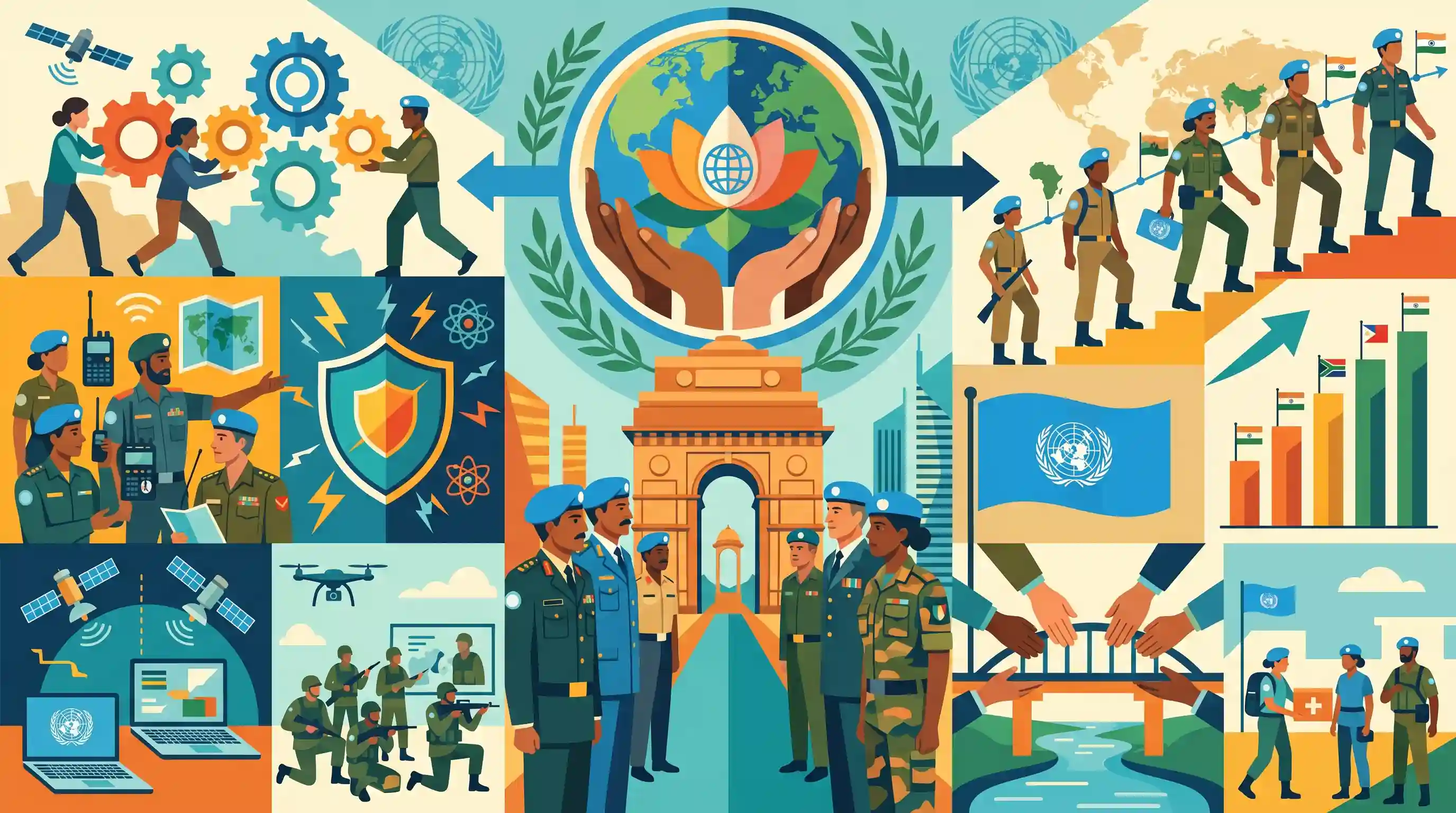
The Indian Army is set to host the United Nations Troop Contributing Countries' (UNTCC) Chiefs Conclave in New Delhi from October 14 to 16. Attended by delegates from 32 nations, the conclave aims to address operational challenges, interoperability, evolving threats, and the role of technology and training in UN Peacekeeping operations. It underscores India's prominent and long-standing contribution to UN missions and aligns with the nation's broader foreign policy ethos of "Vasudhaiva Kutumbakam."
Key Points
- The UNTCC Chiefs Conclave will be hosted by the Indian Army in New Delhi to discuss contemporary challenges in UN Peacekeeping.
- Key participants include delegates from 32 countries, Defence Minister Rajnath Singh, External Affairs Minister S. Jaishankar, and UN Under-Secretary-General for Peace Operations Jean Pierre Lacroix.
- The conclave will focus on improving interoperability, inclusivity in decision-making, and integrating technology and specialized training in peacekeeping missions.
- The event highlights India's position as one of the historically largest troop-contributing nations to UN Peacekeeping efforts.
- The initiative reflects India's broader global vision and diplomatic ethos centered around "Vasudhaiva Kutumbakam" (the world is one family).
Important Terms
UN Peacekeeping Operations (UNPKOs)

Missions deployed by the UN to help countries transition from conflict to peace through security, political, and peacebuilding support. Often referred to as "Blue Helmets."
UPSC context
GS II: Important International institutions. India is one of the largest historic troop contributors to these global missions.
Troop Contributing Countries (TCCs)
Member states of the United Nations that voluntarily provide military, police, and civilian personnel to serve in UN-mandated peacekeeping missions.
UPSC context
GS II: India's role in multilateral groupings. Highlights India's demand for greater participation in mission planning and decision-making.
Vasudhaiva Kutumbakam
An ancient Sanskrit phrase from the Maha Upanishad meaning "the world is one family," serving as a cornerstone of India's inclusive foreign policy ethos.
UPSC context
GS II: Foreign Policy and Ethics. Tests the application of traditional Indian values in contemporary global diplomacy and soft power.
UNTCC Chiefs Conclave
A high-level military meeting hosted by India (Oct 2024) for leaders of 32 nations to discuss operational challenges and technology in UN missions.
UPSC context
GS II: Bilateral and multilateral agreements involving India. Demonstrates India's leadership and strategic influence within the UN system.
Interoperability
The ability of different military units, equipment, and systems from diverse nations to operate effectively together during joint international missions.
UPSC context
GS III: Security/Defense. Essential for the tactical efficiency and safety of multinational forces in complex conflict zones.
Blue Helmets
The colloquial term for UN Peacekeepers, named after their iconic blue headgear, which symbolizes their neutral status and commitment to international peace.
UPSC context
GS II: International Relations. Often used in discussions regarding India's vast personnel contributions and high fatality rates in UN service.
Prelims Trap
UN Peacekeeping operations are authorized to use preemptive military force to enforce peace between warring factions.
UN Peacekeepers are not an offensive force. They strictly operate under three principles: consent of the parties, impartiality, and the non-use of force except in self-defense or defense of the mandate.
Static Concepts Connected
What are the three foundational principles of UN Peacekeeping?
- Consent of parties: Deployment requires the agreement of the main parties to the conflict, ensuring a cooperative environment.
- Impartiality: Peacekeepers must not favor or prejudice any party, maintaining a neutral stance to preserve trust and consent.
- Non-use of force: Force is strictly restricted to self-defense and defending the specific mandate authorized by the UNSC.
How are UN Peacekeeping operations authorized and financed?
- UNSC Authorization: Only the UN Security Council (UNSC) has the primary responsibility and authority to issue mandates establishing peacekeeping operations.
- Mandatory Funding: Financed through mandatory assessments on all UN Member States, with the five permanent UNSC members paying a significantly higher percentage.
Cross-Topic Patterns
TCC status as leverage for UNSC Reforms
India consistently leverages its status as a historically top troop-contributing country as a primary moral and practical justification for its inclusion as a permanent member of a reformed UNSC.
Women, Peace, and Security (WPS) agenda
India's 2007 deployment of an all-women Formed Police Unit to Liberia directly operationalized UNSC Resolution 1325, mirroring contemporary domestic debates about expanding roles for women in Indian armed forces.

Expect a 2026 multi-statement question testing the three foundational principles of UN Peacekeeping against Chapter VII peace enforcement.
Linked PYQs · 2
Linked PYQs · 2
- 2024MainsGS2
‘Terrorism has become a significant threat to global peace and security.’ Evaluate the effectiveness of the United Nations Security Council's Counter Terrorism Committee (CTC) and its associated bodies in addressing and mitigating this threat at the international level.
- 2022PrelimsGS1
With reference to the United Nations General Assembly, consider the following statements: 1. The UN General Assembly can grant observer status to the non-member States. 2. Inter-governmental organisations can seek observer status in the UN General Assembly. 3. Permanent Observers in the UN General Assembly can maintain missions at the UN headquarters. Which of the statements given above are correct?
