India Demographic Shift and Aging Population Trends
Source:The Hindu ↗
हे का महत्त्वाचे आहे
The shift in India's age structure towards an aging population has deep implications for economic growth, labor supply, healthcare, and social welfare policy design, making it a critical topic for GS1 and GS2.
सारांश
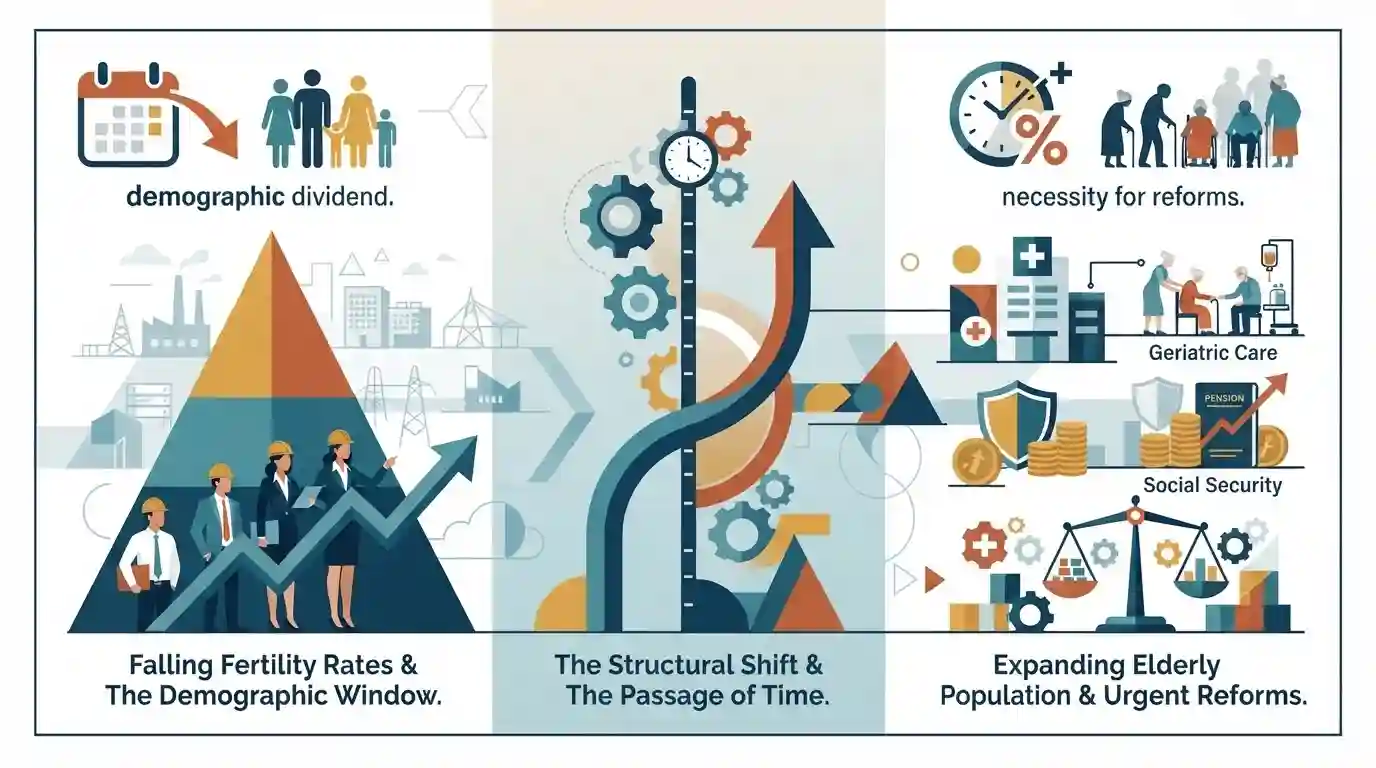
According to Moody’s, India's demographic profile is undergoing a structural shift characterized by falling fertility rates and an expanding elderly population share later this century, necessitating urgent reforms in geriatric care, social security, and economic planning.
मुख्य मुद्दे
- Moody’s report indicates that India will witness a significant rise in its elderly population later this century due to falling fertility rates and shifts in age structure.
- The transition underscores the gradual closing of India's demographic dividend window, requiring proactive policy interventions.
- Key challenges include healthcare infrastructure strain, geriatric care needs, and long-term social security sustainability.
महत्त्वाच्या संज्ञा
Demographic Dividend

A country's economic growth potential resulting from shifts in its age structure, wherein the working-age share of the population is larger than the non-working-age share.
UPSC context
UPSC GS Paper I (Population and Associated Issues) and GS Paper III (Economic Development); tests understanding of workforce dynamics and economic planning.
Replacement-Level Fertility
The average number of children that would be born to a woman over her lifetime, with 2.1 being the threshold required to maintain a stable population size without immigration.
UPSC context
UPSC GS Paper I (Demographic Trends and Population Policy); tests analysis of fertility decline and aging population structures.
Geriatric Care
Specialized healthcare focusing on the physical, mental, and social well-being of elderly individuals, addressing age-related chronic illnesses, rehabilitation, and long-term support systems.
UPSC context
UPSC GS Paper II (Social Justice/Health) and GS Paper I; tests policy preparedness for healthcare challenges in an aging society.
Moody’s
A credit rating agency that evaluates sovereign and corporate debt issuers, issuing macroeconomic and demographic assessments that influence global capital flows and investment ratings.
UPSC context
UPSC GS Paper III (Indian Economy and External Sector); tests awareness of international rating agencies' perspectives on domestic economic vulnerability.
पूर्वपरीक्षा सापळा
India's demographic dividend window has completely closed, requiring an immediate halt to youth skilling initiatives.
Aspirants often assume India's demographic dividend window is closing immediately or has already closed; reports like Moody's specify a gradual structural shift unfolding over the coming decades.
संबंधित स्थिर संकल्पना
What are the key determinants and phases of India's demographic transition?
- Initial Stage: Stage I involves high birth and death rates resulting in slow population growth.
- Mortality Decline: Stage II sees declining mortality with persistently high fertility, accelerating population growth.
- Fertility Drop: Stage III marks falling fertility rates, expanding working-age population, and the opening of the demographic dividend window.
- Aging Phase: Final Stage features low birth and death rates with a rapidly expanding elderly population and shrinking workforce.
आंतर-विषय नमुने
Demographics + Sovereign Credit Ratings
Shifting age structures directly impact fiscal deficits, pension liabilities, and sovereign credit ratings assessed by agencies like Moody's.
Aging Population + Fiscal Federalism & Pension Reform
A shrinking workforce relative to dependents strains EPF, NPS, and state pension schemes, demanding structural social security reforms.

Demographic dividend inversion and geriatric care provisioning will be tested via multi-statement statements linking NFHS data to fiscal stress.
संबंधित PYQ · 2
संबंधित PYQ · 2
- 2013MainsGS1
Critically examine the effect of globalization on the aged population in India.
- 2020MainsGS2
In order to enhance the prospects of social development, sound and adequate health care policies are needed particularly in the fields of geriatric and maternal health care. Discuss.
