Scheduled Delivery of Remaining S 400 Air Defense Systems from Russia
Source:The Hindu ↗
Why It Matters
This article touches upon India's strategic autonomy, balancing defense ties between Russia and the West (amidst potential CAATSA sanctions). It also highlights modern internal security challenges, specifically the need for anti-drone and advanced air defense technologies to secure borders.
Summary
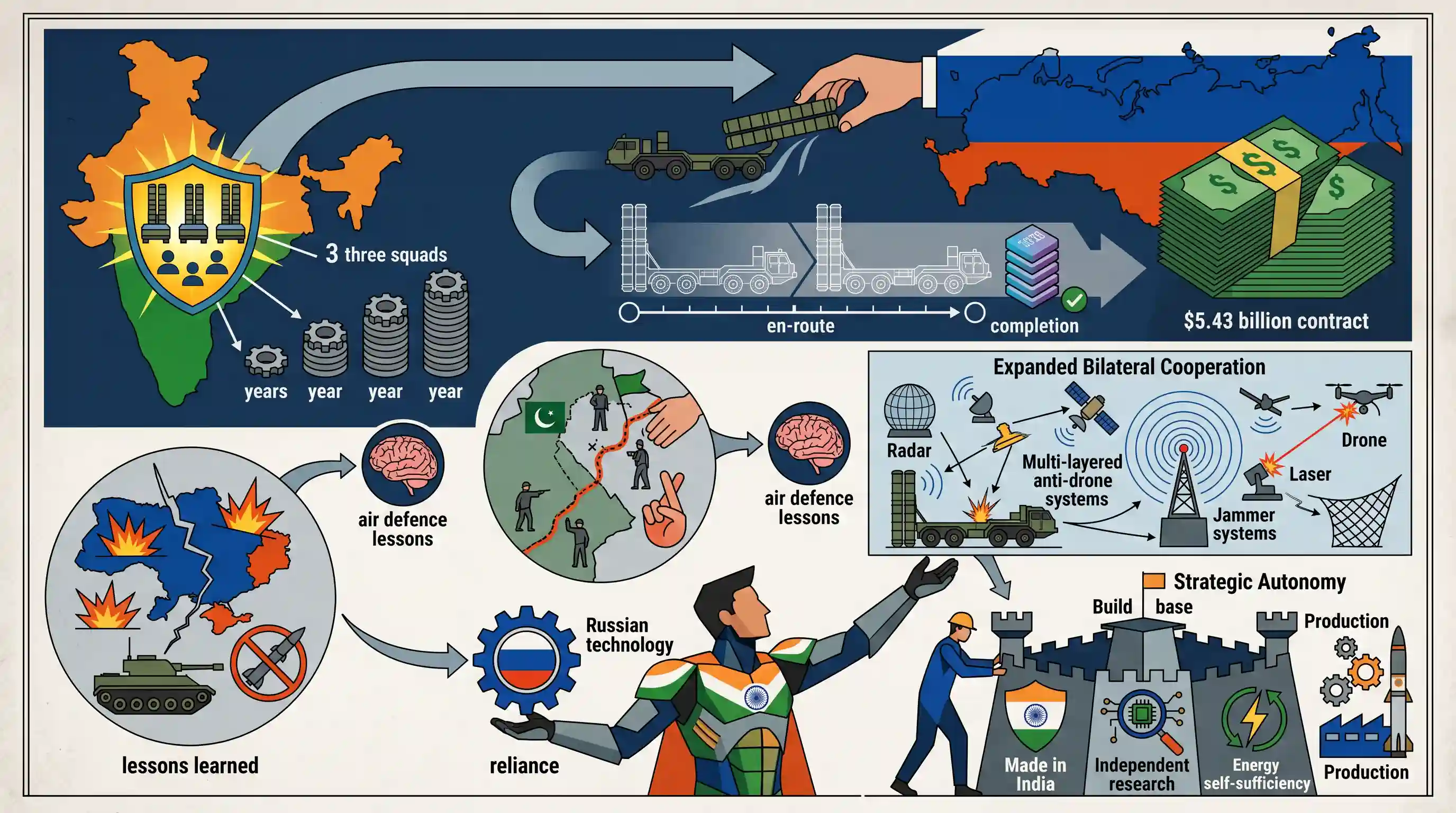
Russia expects to deliver the remaining two units of the S-400 Triumf air defence missile system to India by 2026, completing a $5.43 billion contract signed in 2018. While three squadrons have already been supplied, the remaining deliveries faced delays. Furthermore, reflecting on the lessons learned from recent conflicts—including the Russia-Ukraine war and India-Pakistan border skirmishes—the two nations are exploring expanded bilateral cooperation in air defence and anti-drone technologies. This development highlights India's ongoing reliance on Russian military hardware and its commitment to strategic autonomy in defense procurement.
Key Points
- Russia has committed to delivering the remaining two units of the S-400 Triumf air defence system to India by 2026, fulfilling the $5.43 billion deal signed in 2018.
- Three squadrons of the S-400 have already been delivered and operationalized by India.
- India and Russia are also discussing potential cooperation in anti-drone technology and broader air defence systems, driven by lessons from recent conflicts.
- The efficiency of the S-400 system was highlighted in the context of recent India-Pakistan border clashes and the ongoing Russia-Ukraine conflict.
Important Terms
S-400 Triumf missile system

A mobile, long-range Russian surface-to-air missile (SAM) system capable of intercepting aircraft, drones, and ballistic missiles at ranges up to 400 km and altitudes of 30 km.
UPSC context
Relevant for GS Paper 3 (Defense Technology). Tests knowledge of India's multi-layered air defense and its technical edge in regional security.
Rosoboronexport
Russia's sole state-owned intermediary agency for exporting and importing military and dual-use products. It handles over 85% of Russian arms exports globally.
UPSC context
Relevant for GS Paper 2. Vital for understanding the institutional framework of India-Russia military-technical cooperation and defense procurement processes.
CAATSA
A 2017 US federal law that imposes sanctions on countries engaging in 'significant transactions' with the Russian, Iranian, or North Korean defense or intelligence sectors.
UPSC context
Relevant for GS Paper 2. Examines the 'Effect of policies of developed countries' and the diplomatic balancing act between the US and Russia.
Strategic Autonomy
A nation’s ability to pursue its own national interests and adopt its preferred foreign policy without being constrained by other states or external pressures.
UPSC context
Relevant for GS Paper 2 (Foreign Policy). A core tenet of Indian diplomacy often tested by high-profile defense deals with Russia.
Indian Air Force (IAF)
The fourth branch of the Indian Armed Forces responsible for air defense and offensive operations. It manages the deployment and operationalization of the S-400 squadrons.
UPSC context
Relevant for GS Paper 3 (Internal Security). Tests understanding of the role of specific armed forces in maintaining national sovereignty.
Anti-drone Technology
Defensive systems designed to detect, track, and neutralize unmanned aerial vehicles (UAVs) using electronic jamming, kinetic strikes, or laser technologies.
UPSC context
Relevant for GS Paper 3. Addresses modern 'Security challenges in border areas' and the evolution of asymmetric warfare.
Prelims Trap
"CAATSA is a UN-mandated sanctions regime targeting countries that purchase Russian military hardware."
CAATSA is a US domestic law, not a UN mandate. Furthermore, it penalizes defense transactions with Russia, Iran, and North Korea, not just Russia.
Static Concepts Connected
How does the S-400 differ from the US THAAD system?
- Target versatility: S-400 is a multi-role system intercepting UAVs, cruise missiles, fighter jets, and ballistic missiles. THAAD is strictly an anti-ballistic missile system.
- Multi-layered interception: The S-400 can engage targets at various altitudes and ranges up to 400 km, creating a tiered defense shield from a single highly mobile platform.
What are the core provisions of CAATSA?
- US Domestic Law: A 2017 United States federal law designed to penalize adversaries through secondary sanctions.
- Targeted nations: Targets significant transactions with the defense and intelligence sectors of Russia, Iran, and North Korea.
- Presidential Waiver: Includes a provision allowing the US President to waive sanctions for certain countries based on US national security interests.
Cross-Topic Patterns
Strategic Autonomy vs. US CAATSA
Balancing S-400 procurement against CAATSA threats exemplifies India's multi-alignment, securing Russian legacy platforms while concurrently expanding high-tech US defense ties (like MQ-9B drones).
Evolution of anti-drone warfare
The shift towards bilateral anti-drone cooperation stems directly from asymmetric warfare lessons in the Russia-Ukraine conflict and cross-border narcotics smuggling via UAVs in Punjab.

Expect a Prelims match-the-following on global air defence systems (S-400, THAAD, Iron Dome) and their specific interception capabilities.
Linked PYQs · 4
Linked PYQs · 4
- 2020MainsGS2
What is the significance of Indo-US defence deals over Indo-Russian defence deals? Discuss with reference to stability in the Indo-Pacific region.
- 2023MainsGS3
The use of unmanned aerial vehicles (UAVs) by our adversaries across the borders to ferry arms/ammunitions, drugs, etc., is a serious threat to the internal security. Comment on the measures being taken to tackle this threat.
- 2018PrelimsGS1
What is "Terminal High Altitude Area Defense (THAAD)", sometimes seen in the news?
- 2023PrelimsGS1
Consider the following statements: 1. Ballistic missiles are jet-propelled at subsonic speeds throughout their flights, while cruise missiles are rocket-powered only in the initial phase of flight. 2. Agni-V is a medium-range supersonic cruise missile, while BrahMos is a solid-fuelled intercontinental ballistic missile. Which of the statements given above is/are correct?
