Himachal to Host New High Altitude Health Research Centre
Source:opengovasia ↗
Why It Matters
Important for HPAS aspirants tracking major institutional and healthcare infrastructure updates within Himachal Pradesh, particularly concerning high-altitude research.
Summary
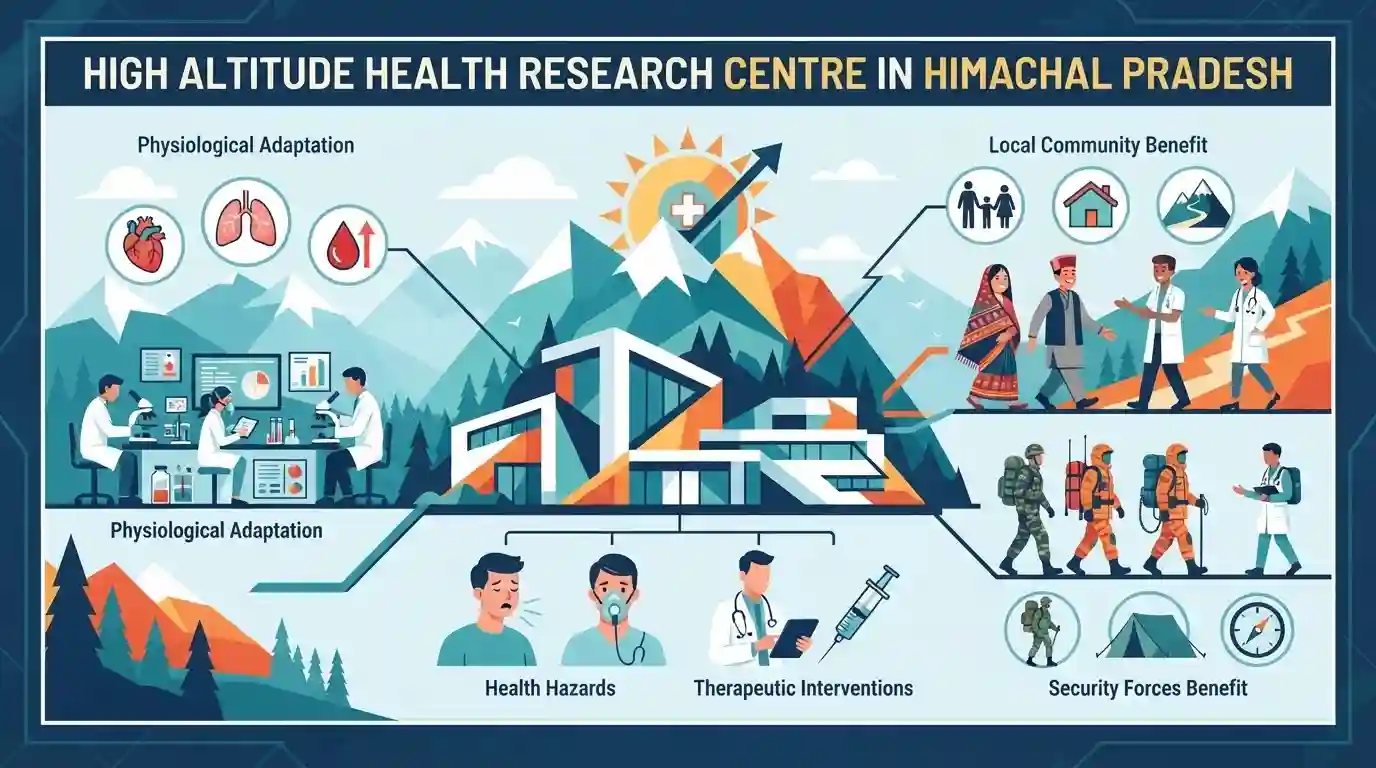
India is setting up a High Altitude Health Research Centre in Himachal Pradesh to conduct advanced scientific and medical studies on physiological adaptation, health hazards, and therapeutic interventions in high-altitude environments, benefiting both local hill communities and security forces.
Key Points
- India is establishing a High Altitude Health Research Centre in Himachal Pradesh to study health challenges, physiological changes, and diseases associated with high-altitude environments.
- The facility aims to boost medical research tailored to mountain regions, supporting the armed forces stationed at high altitudes as well as the local populace.
- The initiative highlights strategic health infrastructure development in Himalayan regions.
Important Terms
ICMR

Apex body in India for formulating, coordinating, and promoting biomedical research, functioning under the Department of Health Research, Ministry of Health and Family Welfare.
UPSC context
HPAS GS Paper II/III (Health and Science & Tech): Tests knowledge of national health research bodies and key institutional interventions in HP.
Prelims Trap
High Altitude Health Research Centre is established under the sole administrative control of the State Agriculture University.
Aspirants often confuse specialized national research institutes in Himachal with agricultural universities like CSK HPKV or Dr. YS Parmar UHF, missing specialized health/defence-linked centers like this.
Static Concepts Connected
What are the primary physiological challenges faced by humans at high altitudes?
- Hypoxia & Pressure: Lower atmospheric pressure results in reduced oxygen availability, leading to hypoxia, hyperventilation, and increased heart rate.
- Environmental Stressors: Extreme cold, high UV radiation, and low humidity trigger altitude sickness, frostbite, and dehydration.
- Chronic Illnesses: Prolonged exposure can lead to chronic mountain sickness (CMS), pulmonary edema, and cognitive impairment.
Cross-Topic Patterns
High-Altitude Health + Defence Preparedness
High-altitude health research directly supports India's border infrastructure and operational readiness of forces deployed in challenging terrain like Ladakh and Himachal.
Himalayan Ecosystems + Sustainable Infrastructure
Medical research centers in fragile Himalayan ecosystems must balance developmental infrastructure with eco-sensitive zone (ESZ) regulations and sustainable tourism policies.

High-altitude health research center in HP will feature in state-specific prelims matching statements on institutional mandates.
Linked PYQs · 2
Linked PYQs · 2
- 2025HPAS_PRELIMSGS1
Consider the following statements : (1) Kibbar is the largest wildlife sanctuary in Himachal Pradesh. (2) Kheerganga National Park was established in 1994 in Himachal Pradesh. (3) Tarla wildlife sanctuary of Himachal Pradesh has an area of 46.4 km². (4) Chail wildlife sanctuary of Himachal Pradesh was established in 1962. Choose the correct answer from the options given below :
- 2024HPAS_PRELIMSGS1
Arrange the following Institutes of India from North to South : (1) National Bureau of Animal Genetic Resources (2) National Bureau of Plant Genetic Resources (3) National Bureau of Fish Genetic Resources (4) National Bureau of Agricultural Insect Resources Choose the correct answer from the options given below :
