National Mission Targets for Sickle Cell Anaemia Eradication
Source:The Hindu ↗
Why It Matters
Sickle cell anaemia combines two core UPSC themes: genetic diseases (Science & Technology/Health) and tribal welfare (Social Justice). The specific 2047 elimination target and the launch of a dedicated national mission make this highly relevant for both Prelims (factual specifics of the disease and mission) and Mains (evaluating healthcare reach to marginalized groups).
Summary
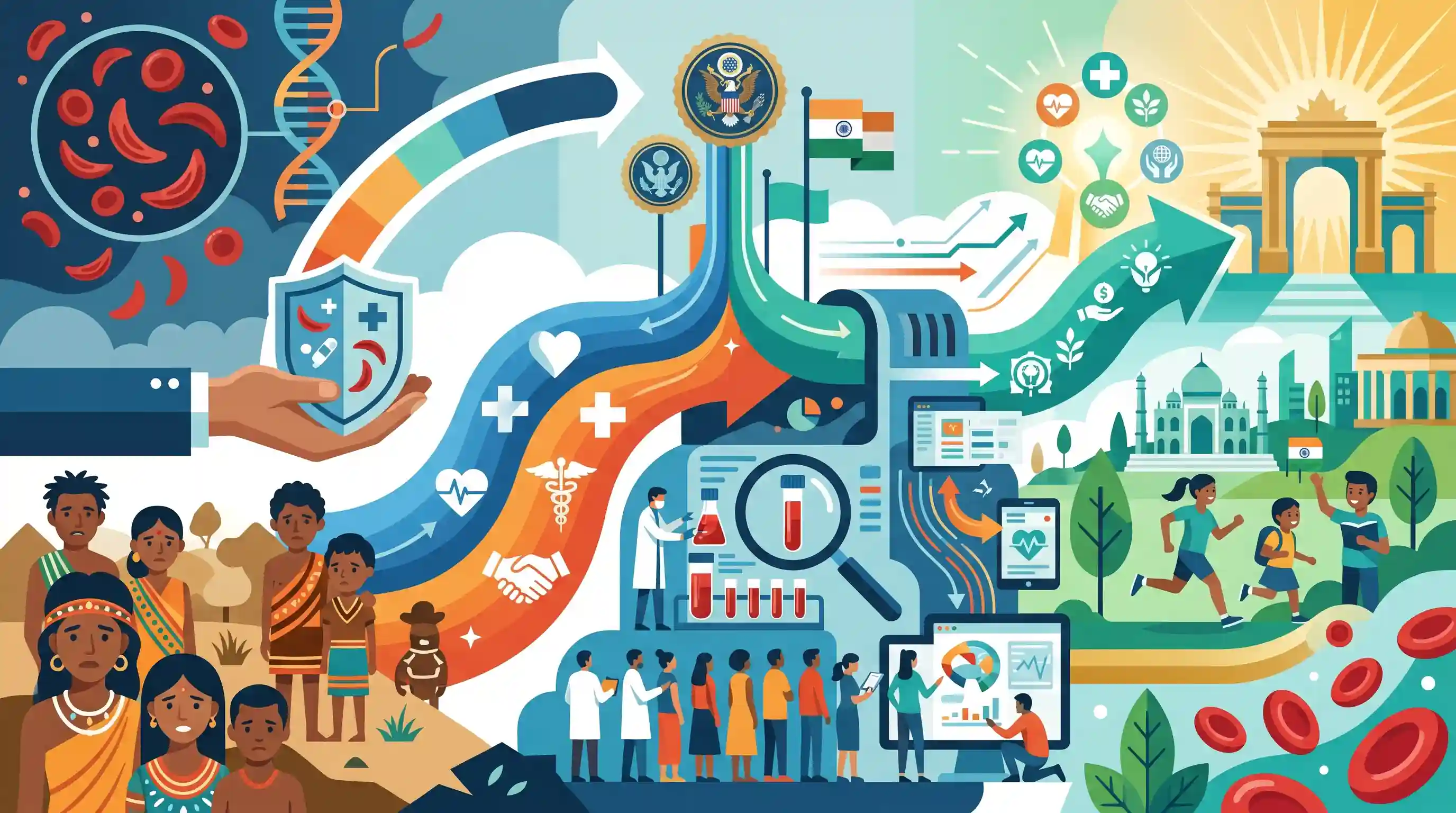
President Droupadi Murmu has underscored India's ambitious national target to eradicate sickle cell anaemia by 2047. Driven by the National Sickle Cell Anaemia Elimination Mission, the government is focusing on a massive screening campaign targeting younger demographics, primarily within tribal populations where the genetic disorder is endemic. The initiative highlights a collaborative effort between the Health and Tribal Affairs ministries, blending advanced health tracking with targeted welfare for vulnerable communities.
Key Points
- India has set a target to completely eradicate sickle cell anaemia by 2047, a goal reiterated by President Droupadi Murmu.
- Sickle cell anaemia is a genetic blood disorder that disproportionately affects India's tribal populations, making it both a public health and a social justice issue.
- The National Sickle Cell Anaemia Elimination Mission employs a whole-of-government approach, heavily relying on the coordination between the Ministry of Health and Family Welfare and the Ministry of Tribal Affairs.
- A massive screening drive targeting crores of individuals (specifically 0-40 years of age) is a cornerstone of the mission to identify carriers, provide genetic counselling, and prevent disease transmission.
Important Terms
National Sickle Cell Anaemia Elimination Mission

A central initiative launched in 2023 aiming to eliminate sickle cell disease as a public health problem by 2047 through mass screening of 7 crore people and counseling in 17 high-burden states.
UPSC context
GS Paper II (Social Justice/Health); tests knowledge of government strategies for eradicating genetic diseases and tribal health outcomes.
Sickle Cell Anaemia
An inherited genetic blood disorder where red blood cells become rigid and crescent-shaped, blocking blood flow and causing severe pain, anemia, and organ damage; highly prevalent in India’s tribal belts.
UPSC context
GS Paper III (Science & Technology - Health); essential for understanding genetic mutations and public health challenges in endemic regions.
Particularly Vulnerable Tribal Groups (PVTGs)
A highly vulnerable sub-classification of Scheduled Tribes characterized by stagnant populations and low literacy; they are the primary target for sickle cell screening due to extreme genetic susceptibility.
UPSC context
GS Paper I (Indian Society) and GS Paper II (Social Justice); critical for welfare schemes and targeted health interventions.
Genetic Counseling
A preventive healthcare process that advises individuals on the risks of inheriting or passing on genetic disorders, a core component of the mission using "Genetic Status Cards."
UPSC context
GS Paper III (Science & Technology); highlights the role of preventive medicine and genetic literacy in national health missions.
Ministry of Health and Family Welfare (MoHFW)
The lead ministry responsible for the sickle cell mission’s clinical implementation, providing the screening framework, health infrastructure, and digital monitoring through the National Health Mission.
UPSC context
GS Paper II (Governance); represents administrative leadership and institutional frameworks for national disease control.
Ministry of Tribal Affairs (MoTA)
The nodal ministry collaborating with Health officials to provide community outreach, funding, and dedicated portals like the "Sickle Cell Disease Support Corner" for tribal communities.
UPSC context
GS Paper II (Social Justice); illustrates inter-ministerial coordination for the welfare and development of marginalized sections.
Prelims Trap
Sickle cell anaemia is an autosomal dominant disorder that spreads rapidly in endemic tribal areas.
Sickle cell anaemia is an autosomal RECESSIVE genetic disorder. A child must inherit the mutated gene from BOTH parents to manifest the actual disease.
Static Concepts Connected
What is the biological mechanism underlying Sickle Cell Anaemia?
- Genetic Mutation: It is caused by an autosomal recessive mutation in the beta-globin (HBB) gene located on chromosome 11.
- Cellular Deformation: The mutation produces abnormal haemoglobin S (HbS), causing flexible red blood cells to distort into rigid, crescent (sickle) shapes that block blood flow.
- Inheritance Pattern: A child only develops the full disease if they inherit the defective recessive gene from both parents (both are carriers).
What are the modern and conventional interventions for Sickle Cell Disease?
- Gene Editing: CRISPR-Cas9 therapies (like Casgevy) can edit a patient's stem cells to produce fetal haemoglobin, offering a cure, but are currently prohibitively expensive.
- Conventional Management: Routine management in India heavily relies on affordable drugs like Hydroxyurea (which boosts fetal haemoglobin) and regular blood transfusions.
- Bone Marrow Transplant: A curative but complex procedure that requires a closely matched donor, making it difficult for mass deployment.
Cross-Topic Patterns
Endogamy and Genetic Bottlenecks
Tribal endogamy practices increase the prevalence of autosomal recessive disorders, directly linking sociological kinship and marriage patterns (GS1) with biological public health outcomes (GS2).
Inter-ministerial convergence models
The mission's joint execution by MoHFW and Tribal Affairs mirrors POSHAN Abhiyaan, highlighting the 'whole-of-government' governance model increasingly favored in UPSC Mains analysis.

Expect a 2026 prelims question merging CRISPR-Cas9 gene editing applications, the 2047 elimination target, and recessive inheritance.
Linked PYQs · 4
Linked PYQs · 4
- 2023PrelimsGS1
Consider the following statements in the context of interventions being undertaken under Anaemia Mukt Bharat Strategy: 1. It provides prophylactic calcium supplementation for pre-school children, adolescents and pregnant women. 2. It runs a campaign for delayed cord clamping at the time of child-birth. 3. It provides for periodic deworming to children and adolescents. 4. It addresses non-nutritional causes of anaemia in endemic pockets with special focus on malaria, hemoglobinopathies and fluorosis. How many of the statements given above are correct?
- 2023MainsGS2
“Development and welfare schemes for the vulnerable, by its nature, are discriminatory in approach.” Do you agree? Give reasons for your answer.
- 2024MainsGS2
In a crucial domain like the public healthcare system the Indian State should play a vital role to contain the adverse impact of marketisation of the system. Suggest some measures through which the State can enhance the reach of public healthcare at the grassroots level.
- 2021MainsGS2
“Besides being a moral imperative of a Welfare State, primary health structure is a necessary precondition for sustainable development.” Analyze.
