Accelerating India thorium nuclear energy program for security
Source:Indian Express ↗
Why It Matters
India's three-stage nuclear program and the transition to thorium are recurring themes in UPSC Prelims (advantages of thorium, reactor types) and Mains GS3 (energy security, clean energy tech, science policy). The introduction of HALEU and Molten Salt Reactors provides critical contemporary updates for answers on nuclear technology.
Summary
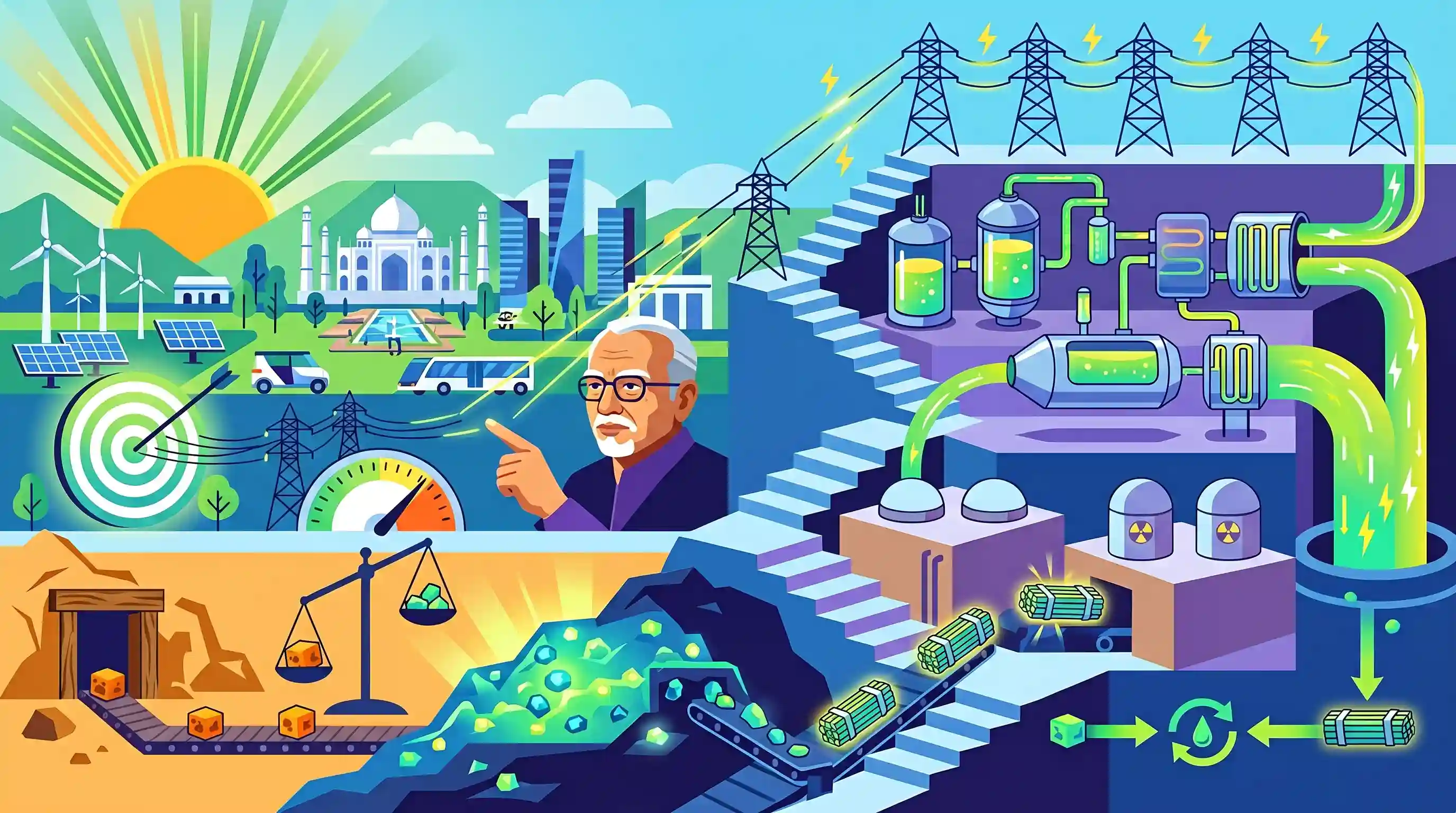
To achieve a net-zero compliant economy and energy security by 2047, India aims to expand its nuclear power capacity to 100 GWe. Given limited domestic uranium, experts like Dr. Anil Kakodkar emphasize accelerating the transition to India's abundant thorium reserves. Strategies include deploying Thorium-HALEU fuel in existing Pressurised Heavy Water Reactors (PHWRs) and developing Thorium Molten Salt Reactors (TMSRs) as part of the advanced stages of India's three-stage nuclear programme.
Key Points
- India targets a massive scale-up of nuclear energy to 100 GWe by 2047 to meet the energy demands of a net-zero compliant Viksit Bharat.
- Due to limited domestic uranium, realizing this scale requires transitioning to India's vast thorium reserves, which forms the basis of India's three-stage nuclear power programme.
- The traditional three-stage program uses Pressurised Heavy Water Reactors (PHWRs) and Fast Breeder Reactors (FBRs) to eventually breed fissile Uranium-233 (U-233) from fertile Thorium-232.
- To accelerate the transition, experts propose using Thorium-HALEU (high-assay low-enriched uranium) fuel in existing PHWRs, bypassing some delays in the FBR deployment timeline.
- Thorium Molten Salt Reactors (TMSRs) are advocated for the third stage, offering enhanced safety, higher operating temperatures (suitable for green hydrogen production), and inherent proliferation resistance.
Important Terms
Three-stage nuclear power programme

A long-term strategy devised by Homi Bhabha to achieve energy independence by utilizing India's thorium, involving three phases: PHWRs, Fast Breeder Reactors, and Thorium-based reactors.
UPSC context
GS Paper 3: Science & Tech/Energy. Tests knowledge of India's indigenous roadmap for nuclear fuel self-sufficiency.
Viksit Bharat 2047
The government's vision to transform India into a developed nation by 2047, emphasizing economic growth, social progress, and a net-zero compliant energy infrastructure.
UPSC context
GS Paper 3: Economic Development. Relevant for understanding long-term national planning and sustainable development goals.
Thorium-HALEU fuel
An advanced nuclear fuel mixing Thorium with High-Assay Low-Enriched Uranium. It is proposed to accelerate Thorium utilization in current reactors while reducing reliance on imported natural uranium.
UPSC context
GS Paper 3: Science & Tech. Important for questions on nuclear fuel cycle innovations and energy security.
Thorium Molten Salt Reactor (TMSR)
A next-generation reactor design using liquid salts as both fuel and coolant, optimized for the efficient use of Thorium and enhanced safety.
UPSC context
GS Paper 3: Science & Tech. Relevant for advanced nuclear technologies and stage-three reactor development.
Atomic Energy Commission (AEC)
The governing body for atomic energy policy in India, directly under the Prime Minister. It oversees the Department of Atomic Energy (DAE).
UPSC context
GS Paper 2: Statutory/Regulatory Bodies. Tests understanding of the institutional framework for strategic energy sectors.
Bhabha Atomic Research Centre (BARC)
India’s premier nuclear research facility. It conducts extensive R&D on reactor design, fuel cycles, and societal applications of nuclear energy.
UPSC context
GS Paper 3: Science & Tech. Tests knowledge of premier institutions driving indigenous scientific research.
Prelims Trap
"Thorium-232 is a fissile material that can independently sustain a nuclear chain reaction in Stage III reactors."
Thorium-232 is fertile, not fissile. It cannot sustain a chain reaction independently and requires a fissile driver (like U-235) to transmute into fissile U-233.
Static Concepts Connected
How is India's 3-Stage Nuclear Programme structured?
- Stage I (PHWRs): Uses natural uranium to produce electricity, yielding Plutonium-239 as a vital byproduct for the next stage.
- Stage II (FBRs): Uses Plutonium-239 and depleted Uranium to breed more fuel, while converting a fertile Thorium blanket into fissile Uranium-233.
- Stage III (Thorium Reactors): Operates primarily on Uranium-233 and Thorium-232, achieving a self-sustaining thorium cycle that capitalizes on India's vast reserves.
Where are Thorium reserves (Monazite sands) geographically concentrated in India?
- Coastal Placer Deposits: Found abundantly as placer deposits along the eastern and western coasts, primarily in Kerala (Chavara), Tamil Nadu, and Odisha (Chhatrapur).
- Inland Deposits: Significant inland placer deposits also exist in the states of Jharkhand, West Bengal, and Bihar.
- Global Significance: India holds roughly 25% of the world's thorium reserves, making monazite a prescribed substance under the Atomic Energy Act.
Cross-Topic Patterns
Nuclear-powered Green Hydrogen production
Thorium Molten Salt Reactors (TMSRs) operate at high temperatures, making them ideal for high-temperature steam electrolysis to produce green hydrogen, bridging nuclear S&T with India's National Green Hydrogen Mission.
HALEU dependency and NSG geopolitics
Using HALEU (enriched up to 20%) requires global enrichment capabilities. This links India's domestic thorium acceleration directly to the geopolitics of the Nuclear Suppliers Group (NSG) and global uranium supply chains.

Expect a 2026 prelims multi-statement question contrasting fertile Thorium-232 with fissile materials, alongside HALEU's role in PHWRs.
Linked PYQs · 3
Linked PYQs · 3
- 2012PrelimsGS1
To meet its rapidly growing energy demand, some opine that India should pursue research and development on thorium as the future fuel of nuclear energy. In this context, what advantage does thorium hold over uranium? 1. Thorium is far more abundant in nature than uranium. 2. On the basis of per unit mass of mined mineral, thorium can generate more energy compared to natural uranium. 3. Thorium produces less harmful waste compared to uranium. Which of the statements given above is/are correct?
- 2020PrelimsGS1
In India, why are some nuclear reactors kept under "IAEA Safeguards" while others are not?
- 2025MainsGS3
How can India achieve energy independence through clean technology by 2047? How can biotechnology can play a crucial role in this endeavour?
