Economic Growth Versus Public Infrastructure Quality Paradox
Source:Indian Express ↗
Why It Matters
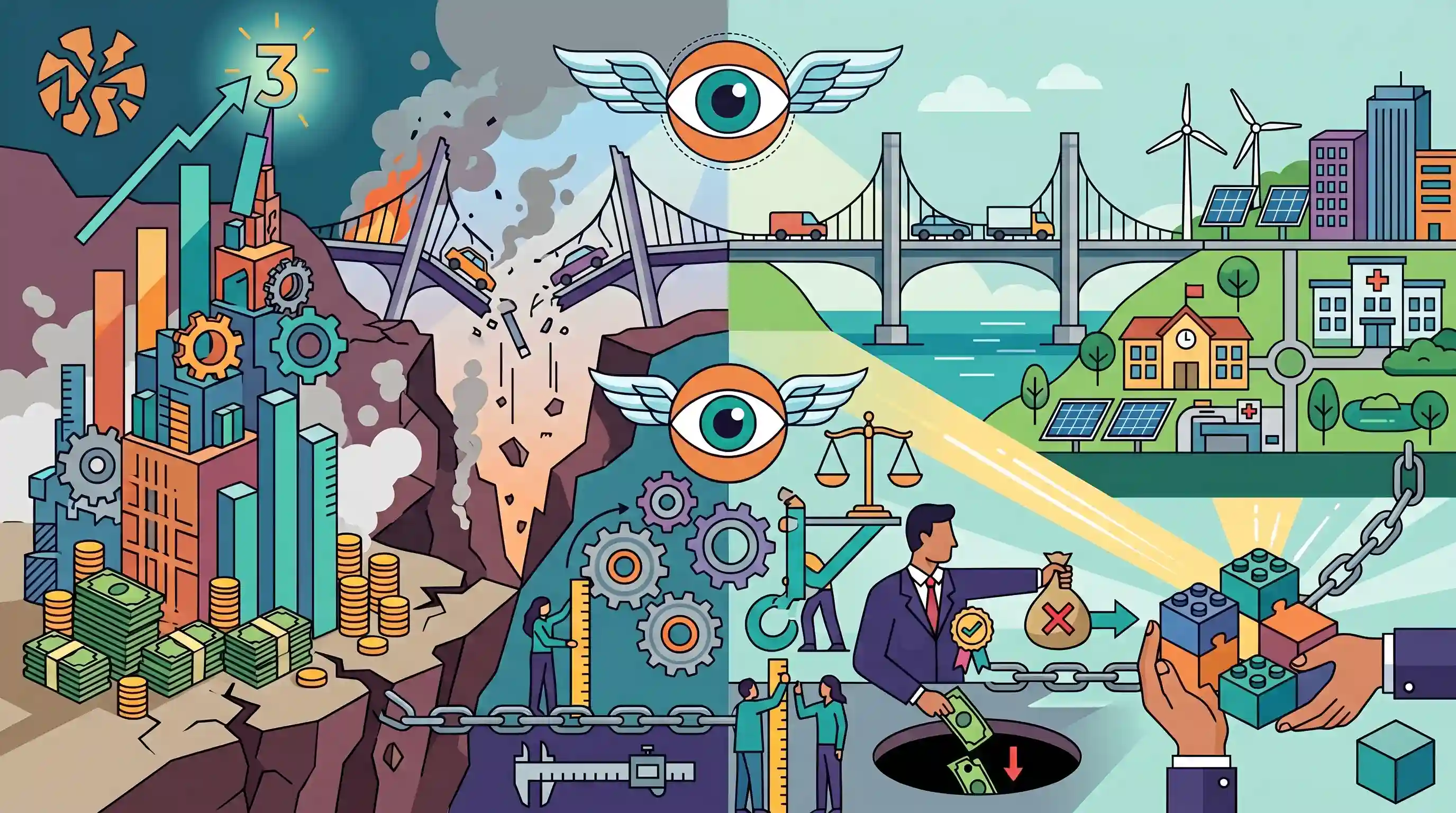
This illustrates the paradox of India's growth story, directly relevant to UPSC discussions on 'Growth vs Development', the necessity of quality infrastructure for inclusive economic growth, and the role of institutional accountability in ensuring public safety.
Summary
Maharashtra Deputy Chief Minister Ajit Pawar highlighted the stark contrast between India's macroeconomic ambition of becoming the world's third-largest economy and the ground reality of poor public infrastructure, pointing to recent instances of collapsing bridges. The statement draws attention to the disparity between aggregate GDP growth and real qualitative development, emphasizing that true economic progress requires durable infrastructure, institutional accountability, and zero tolerance for corruption in public works.
Key Points
- India's macroeconomic trajectory points toward it becoming the world's third-largest economy, but this aggregates success obscures critical local development failures.
- Recent incidents of collapsing bridges and public infrastructure highlight poor project execution, inadequate maintenance, and possible corruption.
- There is a stark contrast between quantitative economic growth (GDP) and qualitative development metrics like reliable public infrastructure.
- The statement emphasizes the need for accountability, institutional quality, and ethical governance in public works to ensure holistic and inclusive growth.
Prelims Trap
An increase in real GDP over time is the primary and definitive indicator of a country's Economic Development.
Aspirants confuse the terms. GDP increase is merely 'Economic Growth' (quantitative). 'Economic Development' (qualitative) mandates structural improvements in infrastructure, health, and living standards.
Static Concepts Connected
What is the fundamental difference between Economic Growth and Economic Development?
- Economic Growth: Refers to a quantitative increase in a country's real GDP, per capita income, or output over a specific period.
- Economic Development: A qualitative process where growth is accompanied by progressive changes in socio-economic structures, human capital, and robust public infrastructure.
- Measurement Indicators: Growth uses GDP/GNP; Development utilizes multidimensional metrics like the Human Development Index (HDI) and physical quality of life indices.
How does the 2nd ARC view systemic failures like collapsing infrastructure?
- Non-performance as Corruption: The Second Administrative Reforms Commission (ARC) views deliberate negligence and non-performance of public duties as a distinct form of corruption.
- Collusive Nexus: Substandard infrastructure often results from collusive corruption—a nexus between public officials and private contractors that undermines the Doctrine of Democratic Accountability.
Cross-Topic Patterns
Climate resilience + Infrastructure failure
Bridge collapses are often treated as purely administrative failures, but they frequently link to Climate Change (GS3), where extreme weather events exceed legacy structural design parameters, acting as a threat multiplier.
GS3 Infrastructure + GS4 Probity nexus
GS4 case studies frequently use the "bridge collapse" scenario to test probity. It merges GS3 infrastructure execution with GS4 topics of collusive corruption and contractor-bureaucrat nexus.

Mains 2026: Expect an essay or GS3 question critically contrasting India's 'third-largest economy' GDP metric against urban infra decay.
Linked PYQs · 3
Linked PYQs · 3
- 2021MainsGS3
“Investment in infrastructure is essential for more rapid and inclusive economic growth.” Discuss in the light of India's experience.
- 2020MainsGS2
Institutional quality is a crucial driver of economic performance". In this context suggest reforms in Civil Service for strengthening democracy.
- 2019MainsGS4
"Non-performance of duty by a public servant is a form of corruption". Do you agree with this view? Justify your answer.
