Urban infrastructure focus needed on functional public goods delivery
Source:The Hindu ↗
Why It Matters
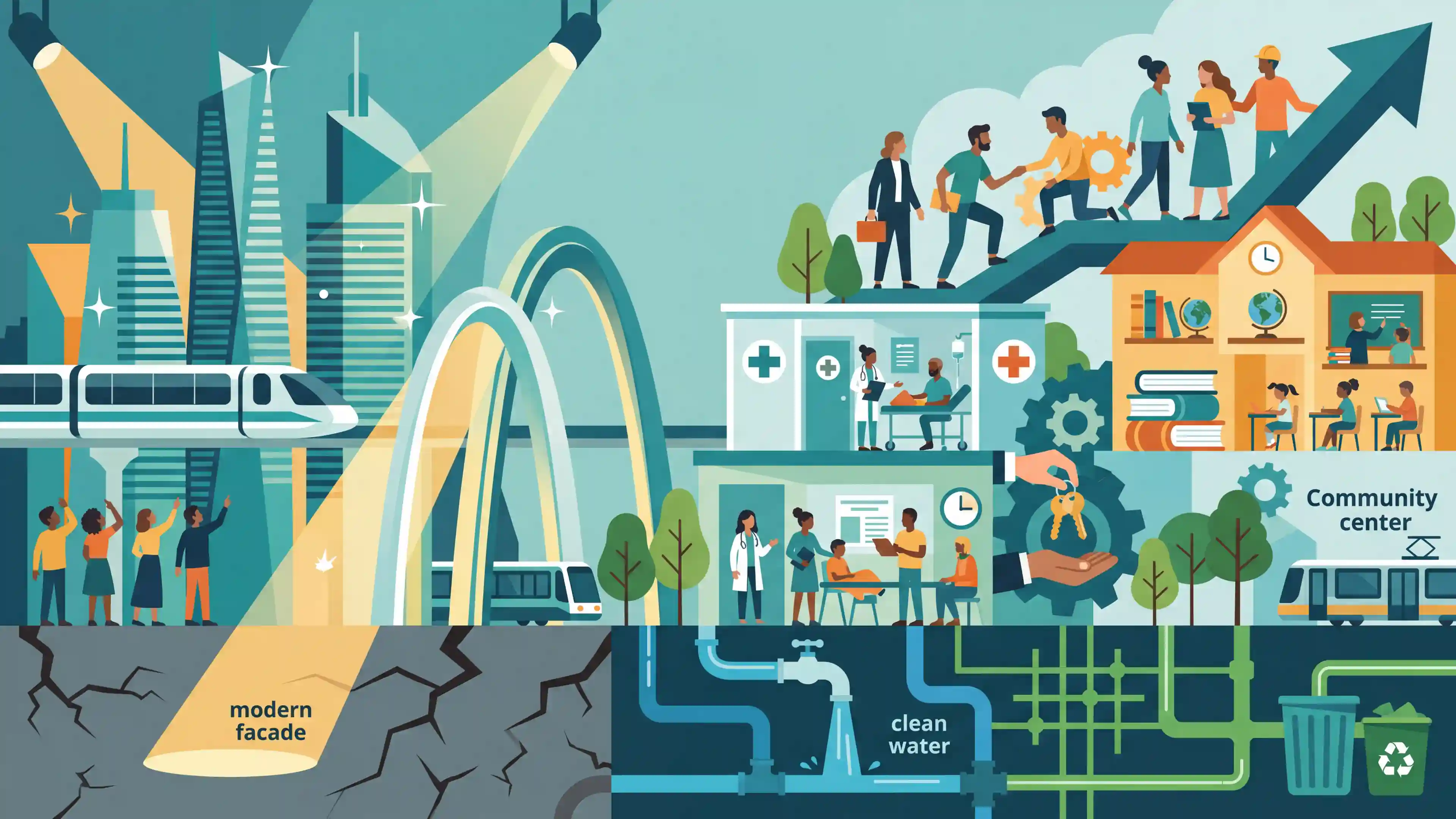
This article provides a critical perspective for UPSC aspirants on the 'development versus beautification' debate, highlighting the necessity of functional public goods and inclusive infrastructure for sustainable economic growth and effective governance.
Summary
The article highlights a critical debate in India's development trajectory, arguing for a shift in focus from superficial beautification and mega-projects to establishing basic, functional infrastructure. It emphasizes that true, inclusive growth cannot be achieved merely by projecting an image of modernity; rather, it requires robust investments in everyday public services like clean water, healthcare, education, and dependable civic amenities. By addressing systemic governance and urban planning challenges, India can ensure that its development benefits the masses and builds lasting human capital.
Key Points
- There is an emerging contrast between aesthetic development (beautification and vanity mega-projects) and the pressing need for functional infrastructure in India.
- Prioritizing fundamental public goods—such as reliable electricity, clean water, solid waste management, and public health—is a prerequisite for substantive human development.
- Over-focusing on image projection diverts critical resources away from solving systemic issues like urban flooding, poverty, and inadequate civic amenities.
- Sustainable and inclusive economic growth requires basic infrastructural functionality that works for the masses, ensuring that development is felt on the ground rather than just seen in enclaves.
Important Terms
Inclusive Growth

Economic growth that is broad-based, shared, and pro-poor, ensuring fair distribution of opportunities and benefits across all sections of society, including the marginalized.
UPSC context
GS Paper 3: Indian Economy. Essential for answers on poverty reduction, inequality, and the 'Sabka Saath, Sabka Vikas' development philosophy.
Smart Cities Mission
A centrally sponsored scheme launched in 2015 to develop 100 cities with core infrastructure, sustainable environments, and 'smart solutions' like ICT for better governance.
UPSC context
GS Paper 1 (Urbanization) and GS Paper 3 (Infrastructure). Tests knowledge of urban planning and technology-driven civic service delivery.
Human Capital
The stock of knowledge, skills, health, and experience embodied in a population, which determines their productivity and potential for economic contribution.
UPSC context
GS Paper 2: Social Justice (Education and Health). Focuses on human resource development and reaping the demographic dividend.
Infrastructure Development
The fundamental physical systems of a nation—including transport, power, and water—essential for economic functioning and improving the quality of life.
UPSC context
GS Paper 3: Economy and Infrastructure. Tests understanding of the backbone for industry, tourism, and last-mile connectivity.
Urbanization
The socio-economic process of population shift from rural to urban areas, creating challenges in planning, housing, and delivery of basic civic amenities.
UPSC context
GS Paper 1: Social Issues/Geography. Critically examines urban sprawl, slum growth, and the sustainability of Indian cities.
Prelims Trap
"The Smart Cities Mission focuses primarily on uniform infrastructure upgrades across the entire city."
Aspirants often confuse SCM's "Area Based Development" (ABD) model, which focuses on specific enclaves, with pan-city upgrades. ABD is criticized for exclusionary beautification.
Static Concepts Connected
What are the core strategic components of the Smart Cities Mission?
- Area-Based Development: Transforming a specific enclave (retrofitting, redevelopment, or greenfield) to create a replicable model. This often faces criticism for elitist beautification.
- Pan-City Initiative: Application of technological Smart Solutions to existing city-wide infrastructure, such as intelligent traffic or centralized waste management systems.
Why do Urban Local Bodies (ULBs) struggle to provide basic civic amenities?
- Incomplete Devolution: States often hesitate to transfer all 18 functional domains listed in the 12th Schedule (e.g., urban planning, public health) to local bodies.
- Financial Dependence: Severe over-reliance on state/central grants and limited independent tax-raising capacity, especially due to inefficient property tax collection.
- Parastatal Agencies: Parallel state-appointed bodies (like water and sewerage boards) bypass democratically elected ULBs, fragmenting urban governance and eroding accountability.
Cross-Topic Patterns
Urban flooding & Disaster Management
The neglect of functional infrastructure like storm-water drains directly exacerbates climate-induced urban flooding, bridging GS1 urbanization with GS3 disaster management.
Capex vs Social Sector spending
Echoes the classic economic debate between high-visibility physical capital (mega-projects) and slow-gestation human capital (health, education) needed to realize India's demographic dividend.

Mains GS1/GS2 is likely to ask a critical evaluation of the Smart Cities Mission's 'Area-Based' approach vs 'Pan-City' basic amenities.
Linked PYQs · 4
Linked PYQs · 4
- 2021MainsGS3
“Investment in infrastructure is essential for more rapid and inclusive economic growth.” Discuss in the light of India's experience.
- 2024MainsGS3
Examine the pattern and trend of public expenditure on social services in the post-reforms period in India. To what extent this has been in consonance with achieving the objective of inclusive growth?
- 2025MainsGS1
How does smart city in India, address the issues of urban poverty and distributive justice?
- 2020MainsGS1
Account for the huge flooding of million cities in India including the smart ones like Hyderabad and Pune. Suggest lasting remedial measures.
