Bilateral Friction Tests India US Strategic Autonomy
Source:The Hindu ↗
Why It Matters
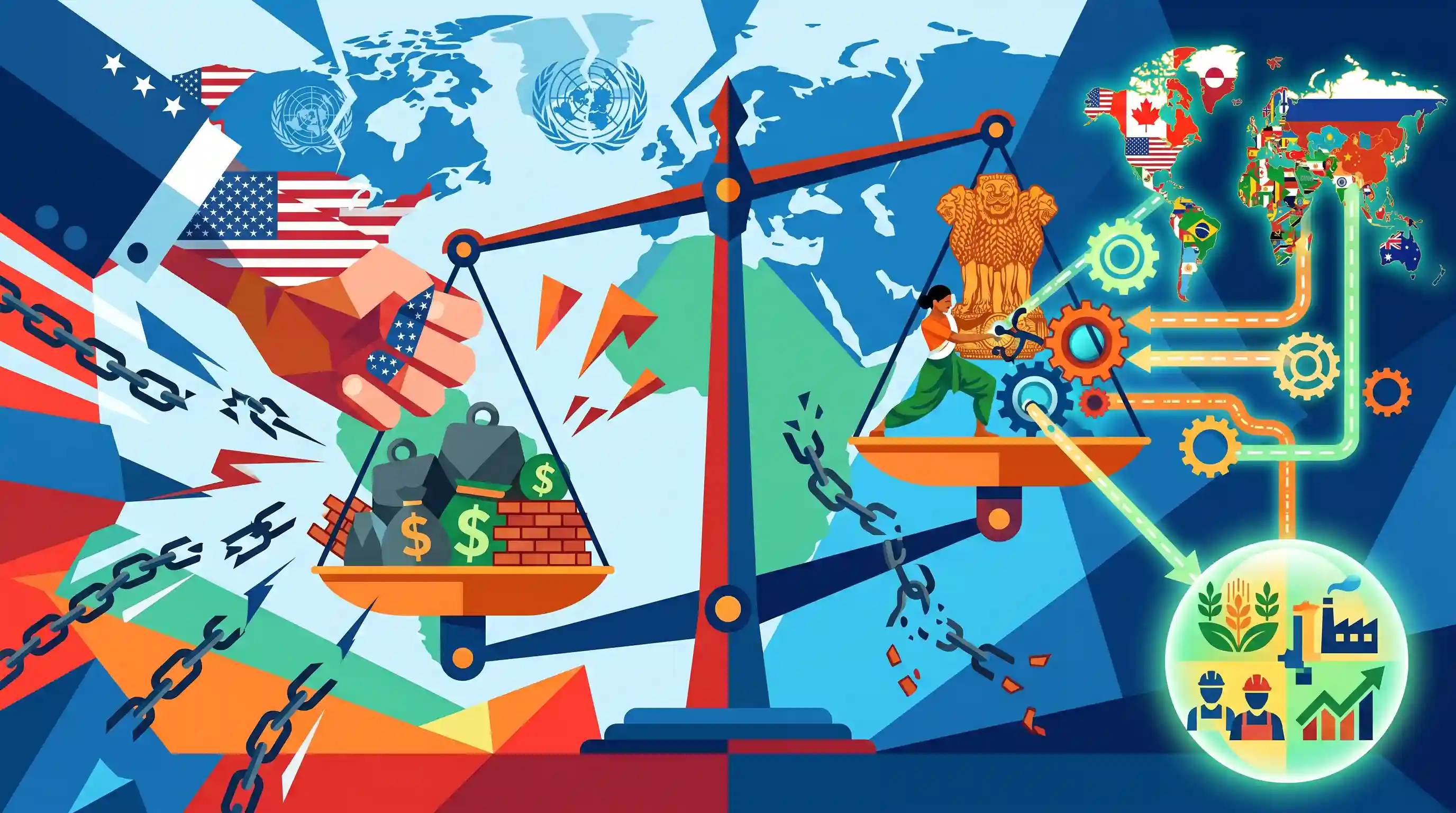
It highlights the contemporary friction points in the India-U.S. strategic partnership, emphasizing how protectionism, tariff disputes, and sanctions test India's strategic autonomy and economic resilience. Highly relevant for Mains GS2 (International Relations) and GS3 (Economy/Trade).
Summary
The article examines the multifaceted challenges testing India-U.S. bilateral relations, ranging from the threat of secondary sanctions to aggressive pushback on trade. As the U.S. leans heavily into protectionist policies and attempts to enforce one-sided trade deals, India finds its strategic autonomy and economic interests under pressure. The commentary highlights the need for India to deftly navigate these coercive diplomatic and economic strategies, balancing its growing global footprint with the protection of its domestic macroeconomic stability in an era of waning multilateralism.
Key Points
- India faces a complex diplomatic environment navigating pressure from the United States regarding sanctions on strategic partners and demands for unilateral trade concessions.
- The evolving bilateral friction stems from US demands for an unequal trade arrangement that contradicts principles of free and fair trade.
- Secondary sanctions and economic coercion test India's strategic autonomy and its ability to maintain a multi-aligned foreign policy.
- Protectionist trends and bilateral arm-twisting in global trade pose significant macroeconomic challenges to developing nations like India.
Important Terms
Strategic Autonomy

A nation's ability to pursue its own foreign policy and security interests independently, without being constrained by formal military alliances or external pressures from major powers.
UPSC context
GS Paper II (International Relations). Central tenet of Indian diplomacy; tested by US-Russia-China rivalries.
Secondary Sanctions
Economic penalties imposed by one country on third-party nations or companies to prevent them from trading with a primary sanctioned target (e.g., US penalizing Indian firms for buying Russian oil).
UPSC context
GS Paper II (Effect of policies of developed countries). Tests India’s energy security and strategic sovereignty.
CAATSA
A 2017 US law authorizing sanctions against countries that engage in significant transactions with Russian, Iranian, or North Korean defense or intelligence sectors.
UPSC context
GS Paper II (Bilateral relations). A recurring point of friction in India-US defense cooperation (e.g., S-400 deal).
Protectionism
Economic policies, such as high tariffs or import quotas, designed to restrict international trade and shield domestic industries from foreign competition.
UPSC context
GS Paper III (Economy/Trade). Challenges India's export-led growth and global supply chain integration.
Multi-alignment
A pragmatic foreign policy approach of engaging simultaneously with multiple major powers and regional blocs to maximize national interest without over-dependence on any single partner.
UPSC context
GS Paper II (IR). India's evolved strategy post-Non-Alignment for navigating a multipolar world.
Interim Trade Agreement (ITA)
A preliminary trade pact that offers limited tariff reductions or market access on specific goods to provide immediate relief while a comprehensive trade deal is negotiated.
UPSC context
GS Paper III (International Trade). Relevant for ongoing India-US and India-UK trade negotiations.
Prelims Trap
Secondary sanctions imposed by the United States are legally binding on India under United Nations conventions.
U.S. secondary sanctions (like CAATSA) are unilateral domestic laws with extraterritorial reach. They are not UN-mandated or legally binding under international law, though countries comply due to financial leverage.
Static Concepts Connected
What is the difference between primary and secondary sanctions?
- Primary Sanctions: Restrict a sanctioning country's own citizens and companies from engaging in trade, financial transactions, or business with the targeted nation.
- Secondary Sanctions: Target third-party foreign entities (e.g., Indian firms) trading with the sanctioned state, threatening their access to the sanctioning country's financial system (like the US dollar).
- Extraterritorial Legality: Secondary sanctions are often viewed as violating international law due to their extraterritorial application, unlike UN Security Council sanctions which are globally binding.
What is the Generalized System of Preferences (GSP) in global trade?
- UNCTAD Origin: Instituted in 1971 under the UN Conference on Trade and Development (UNCTAD) to promote industrialization and economic growth in developing nations.
- Tariff Mechanism: Developed countries grant preferential, duty-free market access to eligible products originating from beneficiary developing countries.
- Non-reciprocal Nature: It is a unilateral concession. Beneficiary developing countries receive these tariff cuts without having to lower their own tariffs in return for the developed nation.
Cross-Topic Patterns
Strategic Autonomy vs. Economic Coercion
India's "multi-alignment" doctrine is increasingly tested by U.S. weaponization of trade. Defense procurement (e.g., S-400) and energy imports often clash with U.S. secondary sanctions, testing India's diplomatic maneuvering.
Weaponized Trade & CAD Impact
Rising global protectionism and unilateral trade enforcement directly impact India's macroeconomic stability. They increase the import costs of intermediate goods, stymie export-oriented sectors, and threaten to widen the Current Account Deficit (CAD).

Expect a multi-statement Prelims question on the extraterritorial application of US domestic laws (CAATSA) vs UN sanctions.
Linked PYQs · 4
Linked PYQs · 4
- 2019MainsGS2
‘What introduces friction into the ties between India and the United States is that Washington is still unable to find for India a position in its global strategy, which would satisfy India's national self-esteem and ambitions.’ Explain with suitable examples.
- 2025MainsGS3
What are the challenges before the Indian economy when the world is moving away from free trade and multilateralism to protectionism and bilateralism? How can these challenges be met?
- 2018MainsGS3
How would the recent phenomena of protectionism and currency manipulations in world trade affect macroeconomic stability of India?
- 2012MainsGS2
How have the US sanctions against Iran affected India's bilateral relations with Iran?
