Stricter Social Media Takedown Rules and Constitutional Compliance
Source:The Hindu ↗
Why It Matters
The article is highly relevant for GS3 (Internal Security and Science & Tech) as it highlights the evolving regulatory framework for social media and emerging technologies like AI. Balancing freedom of expression with national security, platform accountability, and combating deepfakes are critical areas of focus for UPSC.
Summary
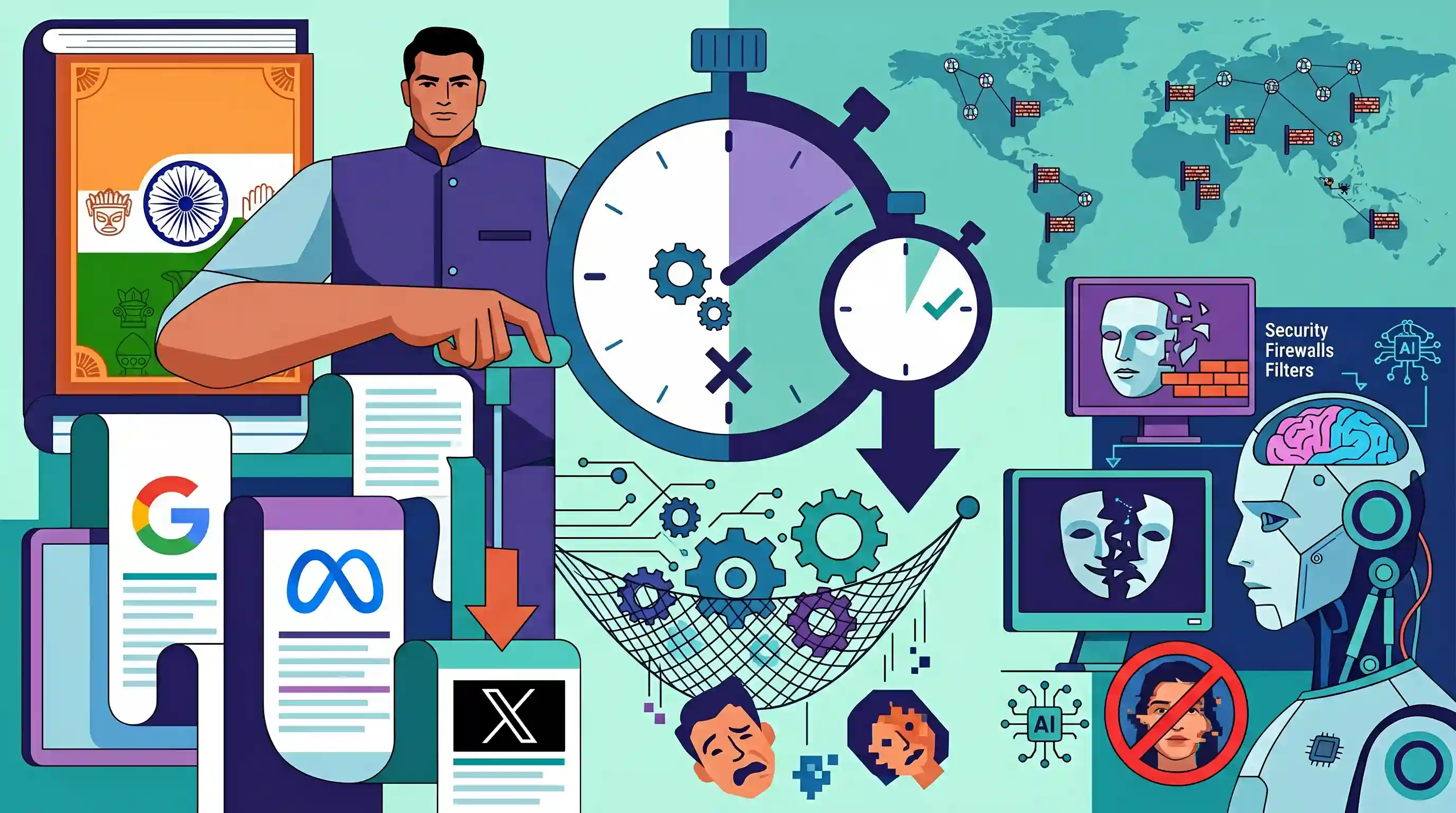
India's Information and Broadcasting Minister Ashwini Vaishnaw has warned global tech giants, including Google, Meta, and X, that they must operate within the framework of the Indian Constitution and respect the country's cultural context. This statement coincides with the government tightening IT rules, effectively reducing the mandated timeframe for platforms to take down unlawful content from 36 hours to just 3 hours. Speaking on the sidelines of an AI Impact Summit in Delhi, the Minister also stressed the need for robust regulations against deepfakes. These measures reflect a broader global movement demanding faster takedowns and greater accountability from Big Tech concerning harmful and AI-generated content.
Key Points
- The Indian government has tightened content-takedown rules, requiring social media platforms to remove unlawful content within 3 hours, down from the previous 36-hour window.
- Information Minister Ashwini Vaishnaw emphasized that global tech multinationals must operate within India's constitutional framework and respect its cultural context.
- The government highlighted the urgent need for stronger regulations to combat deepfakes and AI-generated harmful content.
- The regulatory push in India mirrors a global trend, with countries like Spain ordering probes into major platforms over AI-generated illegal material.
Important Terms
Information Technology (IT) Rules, 2021

Secondary legislation under the IT Act, 2000, regulating social media, OTT, and digital news. Amendments in 2026 reduced takedown windows for unlawful content from 36 hours to 3 hours.
UPSC context
GS Paper 2: Governance/Polity; GS Paper 3: Cyber Security. Tests understanding of digital rights, regulatory frameworks, and state-citizen-tech relations.
Significant Social Media Intermediary (SSMI)
A social media platform with over 50 lakh (5 million) registered users in India. They face stricter "additional due diligence," including appointing Indian-resident compliance officers and identifying "first originators" of messages.
UPSC context
GS Paper 2: Regulatory bodies. Tests knowledge of specialized legal classifications for big-tech firms like Meta, Google, and X under Indian law.
Deepfakes
AI-generated synthetic media (audio, video, or image) that convincingly replaces one person's likeness with another. Often used for misinformation, impersonation, or creating non-consensual intimate imagery.
UPSC context
GS Paper 3: Internal Security; Science & Technology. Tests awareness of emerging technological threats to national security, social harmony, and democratic processes.
Safe Harbour Protection
Legal immunity granted to intermediaries (under Section 79 of IT Act) from liability for third-party content. Platforms lose this protection if they fail to follow government-mandated "due diligence" or takedown orders.
UPSC context
GS Paper 3: Cyber Security/IT Law. Tests understanding of legal accountability and the "intermediary" status vs. "publisher" status of tech platforms.
Grievance Redressal Mechanism
A mandatory three-tier structure (Platform, Self-regulatory body, Government oversight) for resolving user complaints. Intermediaries must appoint a Resident Grievance Officer to acknowledge and resolve issues within specific timelines.
UPSC context
GS Paper 2: Citizen Charter/Governance. Tests knowledge of institutional safeguards for user rights and the mechanism for administrative accountability of tech giants.
Section 69A of Information Technology Act
Granting the Central Government the power to issue directions to block public access to any information via computer resources in the interest of sovereignty, security, or public order.
UPSC context
GS Paper 2: Fundamental Rights/Polity. Tests the legal basis for content takedowns and the balance between national security and the Right to Free Speech.
Prelims Trap
Under the new IT Rules, platforms must proactively identify and remove all unlawful content within 3 hours.
The 3-hour deadline triggers only *after* receiving a valid court or government order. Mandating proactive, algorithmic scanning for all unlawful content would conflict with established privacy norms.
Static Concepts Connected
What is the 'Safe Harbour' protection for internet intermediaries?
- Legal Basis: It is legally derived from Section 79 of the Information Technology (IT) Act, 2000.
- Core Protection: Grants conditional immunity to social media platforms and ISPs from legal liability for data or content posted by third-party users.
- Conditions for Loss: Protection is immediately lost if the platform fails to observe due diligence, such as ignoring a lawful government takedown notice within the mandated timeframe.
What are the Constitutional limits on digital free speech in India?
- Article 19(1)(a): Guarantees freedom of speech and expression, a fundamental right that extends fully to the digital and social media sphere.
- Article 19(2) Restrictions: Permits the State to impose reasonable restrictions based on sovereignty, public order, decency, morality, defamation, and security of the State.
- Applicability to Tech: Global platforms must subordinate their internal "community guidelines" to these specific Constitutional boundaries when operating in India.
Cross-Topic Patterns
Intermediary Liability + Digital Sovereignty
The drastic reduction in takedown timelines complements the Digital Personal Data Protection (DPDP) Act's compliance rules, showcasing India's broader, aggressive push for digital sovereignty against Big Tech monopolies.
Generative AI + Internal Security Threats
AI-generated misinformation is increasingly viewed as a non-traditional security threat. UPSC frequently links such advanced cyber capabilities to radicalization, election interference, and non-state actors in GS3.

Safe Harbour exceptions + deepfake regulation + Art 19(2) will likely merge into a complex GS2 or GS3 question on digital sovereignty.
Linked PYQs · 3
Linked PYQs · 3
- 2024MainsGS3
Social media and encrypting messaging services pose a serious security challenge. What measures have been adopted at various levels to address the security implications of social media? Also suggest any other remedies to address the problem.
- 2016MainsGS3
Use of Internet and social media by non-state actors for subversive activities is a major security concern. How have these been misused in the recent past? Suggest effective guidelines to curb the above threat.
- 2023MainsGS3
Introduce the concept of Artificial Intelligence (AI). How does Al help clinical diagnosis? Do you perceive any threat to privacy of the individual in the use of Al in healthcare?
