Government blocks Chinese battery apps following e-rickshaw shutdowns
Source:The Hindu ↗
Why It Matters
This case study is highly relevant to the UPSC syllabus as it links cyber-physical security, import dependence, and public safety. It illustrates how unsecured IoT devices in the EV supply chain can be weaponized to disrupt public transport, emphasizing the urgent need for cybersecurity standardization (like AIS-156) in smart infrastructure.
Summary
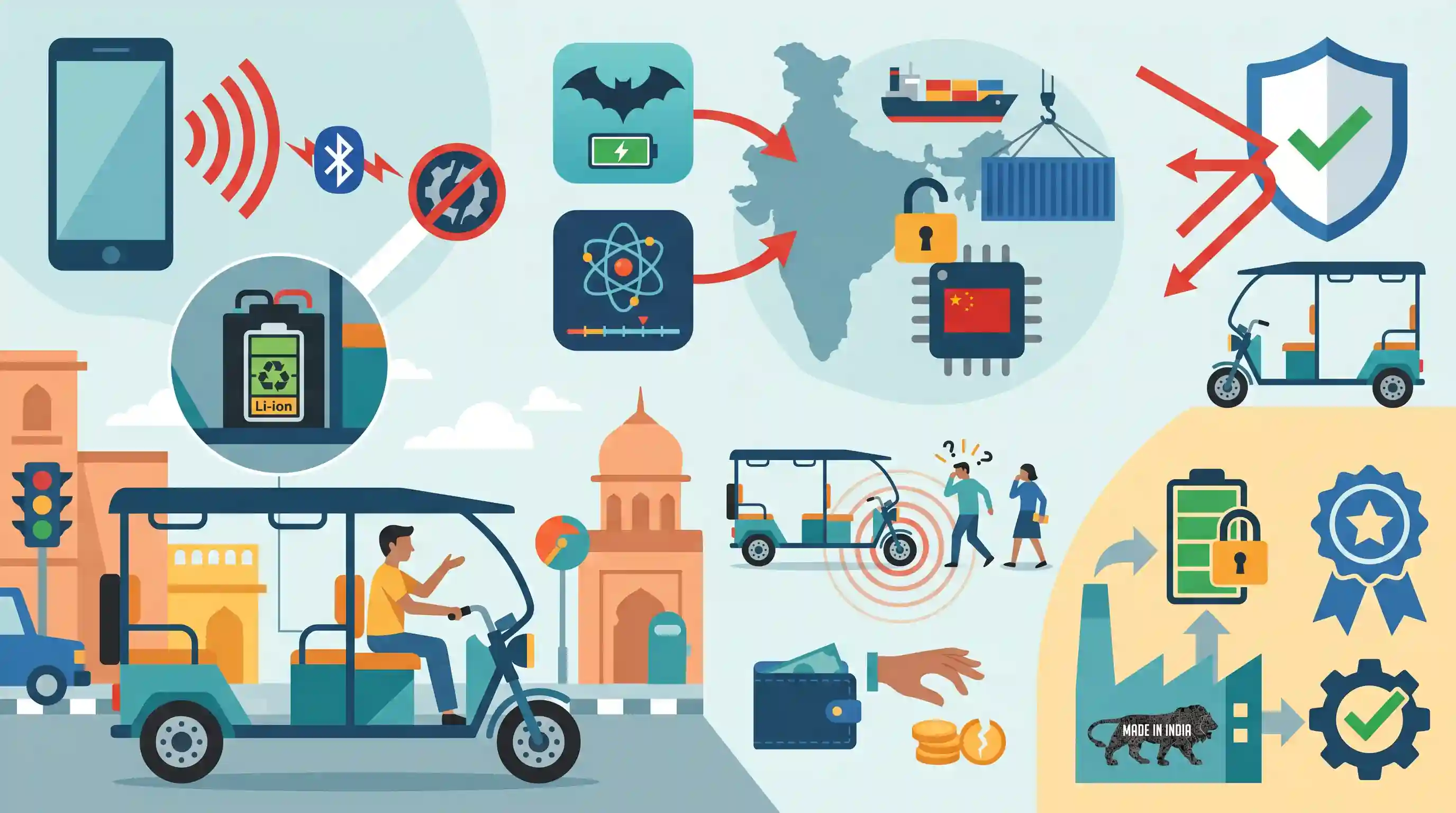
The Government of India has taken down two Chinese-developed smartphone apps, 'BAT-BMS' and 'Epoch Li-ion', after reports emerged that they were being used to remotely shut down budget e-rickshaws mid-ride. The exploit targeted unsecured, Bluetooth-enabled Lithium-ion Battery Management Systems (BMS) imported from China that lack basic security authentication. This caused sudden vehicle stalls, public safety hazards, and financial losses for drivers in Delhi. The incident highlights critical cyber-physical security vulnerabilities in India's micro-mobility sector and underscores the need for robust domestic manufacturing and safety standards for electric vehicle (EV) components.
Key Points
- The Indian Ministry of Electronics and Information Technology (MeitY) ordered the removal of two Chinese-developed apps, 'BAT-BMS' and 'Epoch Li-ion', from mobile app stores.
- The apps were being used to exploit Bluetooth vulnerabilities in budget e-rickshaws, allowing users to remotely turn off the vehicles' motors mid-ride.
- The root cause of the vulnerability is the use of cheap, imported Chinese Lithium-ion Battery Management Systems (BMS) that lack essential authentication and safety features.
- The remote power-cut issue selectively targeted Bluetooth-enabled lithium battery packs with unsecured BMS, leaving traditional lead-acid e-rickshaws unaffected.
- The disruption caused significant financial loss to drivers, safety hazards on busy urban roads, passenger disputes, and long backlogs at vehicle service centers.
- The Delhi Government's transport department has initiated a police investigation into the incident, reflecting the expanding overlap of cyber vulnerabilities and physical public safety.
Important Terms
Battery Management System (BMS)

An electronic control circuit in electric vehicle batteries that monitors voltage, temperature, and cell balancing to optimize performance and protect the vehicle from critical safety hazards.
UPSC context
GS Paper III (Science & Technology / EVs); tests understanding of critical clean energy technologies and transport security.
Ministry of Electronics and Information Technology (MeitY)
The executive ministry of the Government of India responsible for designing IT policies, promoting electronics manufacturing, and administering cybersecurity and digital governance laws.
UPSC context
GS Paper II (Executive Organs); tests awareness of nodal ministries governing digital public infrastructure and cyber-legislation enforcement.
Information Technology Act, 2000
India's primary legal framework governing cybercrime, digital signatures, and e-commerce, outlining offenses and penalties for unauthorized computer/network access and data breaches.
UPSC context
GS Paper III (Cybersecurity); tests understanding of India's legislative framework for regulating digital platforms and cyber-crimes.
Section 79 of IT Act
A statutory provision providing "safe harbour" immunity to internet intermediaries, protecting them from liability for third-party data or content if they maintain standard regulatory due diligence.
UPSC context
GS Paper III (Cybersecurity); tests knowledge of intermediary liability, platform governance, and safe harbour rules.
Section 69A of IT Act
A statutory clause enabling the Indian central government to block public access to websites or apps to protect national sovereignty, defense, security, or public order.
UPSC context
GS Paper II (Government Policies); tests knowledge of state powers to restrict online content under constitutional provisions.
Delhi Government Transport Department
The state authority responsible for vehicle licensing, registration, route regularization, and safety enforcement for public mobility systems and electric rickshaws in India's capital territory.
UPSC context
GS Paper II (State Administration); tests knowledge of regional regulatory mechanisms for urban transport and green mobility transition.
Prelims Trap
Section 69A of the IT Act is the primary provision used to prosecute individuals for unauthorized local hacking of smart devices.
Section 69A is exclusively for government blocking of public access to apps/sites. Prosecution of individuals for unauthorized access/hacking is done under Sections 43 and 66 of the IT Act.
Static Concepts Connected
What is a Battery Management System (BMS) and its core functions?
- Telemetry collection: Constantly monitors cell voltages, current, temperature, State of Charge (SoC), and overall health of the battery.
- Cell balancing: Redistributes charge among individual cells to ensure uniform performance and prevent premature degradation.
- Safety disconnect: Triggers isolation or circuit cut-offs during faults to prevent hazardous events like thermal runaway.
What are India's primary safety standards for EV batteries?
- AIS 156: Applies specifically to L-category vehicles (two-wheelers and three-wheelers, including e-rickshaws).
- AIS 038 Rev. 2: Applies to M-category (passenger cars) and N-category (goods carriage) electric vehicles.
- Mandatory compliance: Both standards mandate microprocessor-based BMS with active safety triggers for over-charge, over-discharge, and thermal anomalies.
Cross-Topic Patterns
Cyber-Physical Security & Critical Transit
Explores how unprotected IoT-enabled transport components create physical kinetic risks, shifting national security focus from mere data protection to real-time public infrastructure safety.
EV Supply Chains & Atmanirbharta
Highlights how reliance on cheap, unbranded imported components bypasses safety certifications like AIS-156, emphasizing the strategic need for domestic EV component manufacturing.

Cyber-physical attacks on critical IoT/EV infrastructure will likely bridge GS-3 cybersecurity and infrastructure questions in 2026.
Linked PYQs · 3
Linked PYQs · 3
- 2021MainsGS3
Keeping in view India's internal security, analyse the impact of cross-border cyber attacks. Also discuss defensive measures against these sophisticated attacks.
- 2022MainsGS3
What are the different elements of cyber security ? Keeping in view the challenges in cyber security, examine the extent to which India has successfully developed a comprehensive National Cyber Security Strategy.
- 2024MainsGS3
What is the technology being employed for electronic toll collection on highways? What are its advantages and limitations? What are the proposed changes that will make this process seamless? Would this transition carry any potential hazards?
