Economic Sanctions and Logistical Restrictions Against Pakistan
Source:The Hindu ↗
Why It Matters
Highlights India's strategy of deploying comprehensive, non-military pressure tactics (trade, visa, and transit sanctions) against state-sponsored terrorism. It underscores the fragility of regional stability, as diplomatic actions coincide with nuclear posturing and military escalations.
Summary
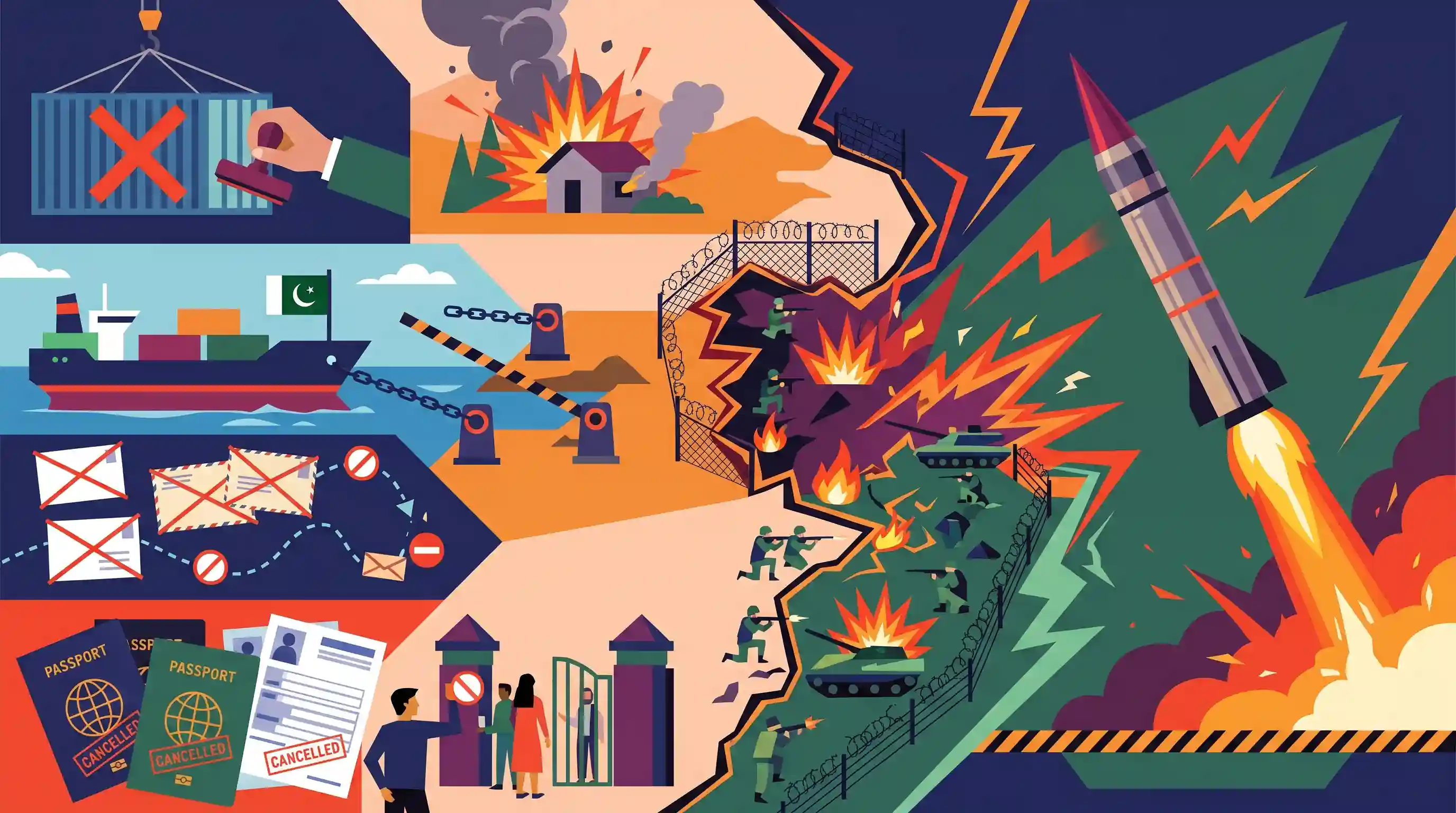
In response to the deadly Pahalgam terror attack, India has implemented sweeping diplomatic, economic, and logistical sanctions against Pakistan. The measures include a complete freeze on imports by the DGFT, a ban on Pakistani-flagged ships in Indian ports, the suspension of all postal links, and the revocation of 14 visa categories for Pakistani nationals, including the SAARC Visa Exemption Scheme. Concurrently, regional tensions have escalated as Pakistan test-fired its nuclear-capable Abdali ballistic missile, and hostilities intensified along the Line of Control.
Key Points
- India announced a complete freeze on direct or indirect imports from Pakistan and suspended all postal links via air and surface routes following the April 22 Pahalgam terror attack.
- The Ministry of Ports, Shipping and Waterways prohibited Pakistani-flagged ships from entering Indian ports and restricted Indian ships from visiting Pakistan.
- India drastically restricted its visa regime, revoking 14 categories of visas for Pakistani nationals, including the SAARC Visa Exemption Scheme.
- Pakistan test-fired 'Abdali', a 450 km range nuclear-capable ballistic missile, intensifying hostilities along the Line of Control, which India termed a 'grave provocation'.
Important Terms
SAARC Visa Exemption Scheme (SVES)

Launched in 1992, this mechanism allows 24 categories of individuals (including dignitaries, business leaders, and journalists) from member states to travel visa-free using a special sticker to facilitate regional people-to-people contact.
UPSC context
GS Paper 2 (International Relations); important for understanding diplomatic tools and regional integration challenges in South Asia.
Directorate General of Foreign Trade (DGFT)
An attached office of the Ministry of Commerce and Industry that formulates and implements India’s Foreign Trade Policy (EXIM). It possesses statutory authority to prohibit, restrict, or regulate imports and exports.
UPSC context
GS Paper 3 (Indian Economy); relevant for trade regulations and economic sanctions as a tool of foreign policy.
SAARC (South Asian Association for Regional Cooperation)
Established in 1985, this eight-member intergovernmental organization aims to promote economic and regional integration in South Asia. Its progress is often stalled by bilateral tensions between India and Pakistan.
UPSC context
GS Paper 2 (International Relations); a core regional grouping frequently tested regarding its relevance and challenges.
Abdali (Hatf-II) Missile
A Pakistani short-range (450 km), solid-fuel, nuclear-capable ballistic missile designed for tactical battlefield use. It forms part of Pakistan’s 'Full Spectrum Deterrence' posture against India's conventional military strength.
UPSC context
GS Paper 3 (Internal Security/Science & Technology); critical for understanding the nuclear arms race and deterrence dynamics in South Asia.
Line of Control (LoC)
The 740 km de facto military boundary dividing Indian-administered and Pakistan-administered Jammu & Kashmir. It was redesignated from the 1949 Ceasefire Line under the bilateral 1972 Simla Agreement.
UPSC context
GS Paper 2 (International Relations) & Paper 3 (Security); essential for discussing border management and the Kashmir dispute.
Prelims Trap
India revoked Pakistan's Most Favoured Nation (MFN) status following the 2025 Pahalgam attack.
India revoked Pakistan's MFN status back in 2019 after the Pulwama attack. The current sanctions involve a complete DGFT import freeze, not an MFN revocation.
Static Concepts Connected
What is the SAARC Visa Exemption Scheme (SVES)?
- Origin: Launched in 1992 following the 4th SAARC Summit to promote regional people-to-people contact.
- Eligibility: Applies only to 24 specific categories (e.g., judges, parliamentarians, journalists), not the general public.
- Mechanism: Grants eligible individuals a Special Travel Document allowing visa-free travel across all SAARC member states.
How does India legally enforce complete trade bans?
- Nodal Agency: The Directorate General of Foreign Trade (DGFT), under the Ministry of Commerce and Industry.
- Legal Backing: Uses powers derived from the Foreign Trade (Development and Regulation) Act, 1992, overriding standard import rules.
- WTO Exception: Enabled globally by WTO's Article XXI (Security Exception), which allows breaching GATT/MFN obligations during national security emergencies.
Cross-Topic Patterns
Security Exception in WTO
Sweeping trade bans test the limits of GATT Article XXI (Security Exception). India's use of DGFT to freeze imports parallels global trends of weaponizing trade for national security.
Abdali & Tactical Nuclear Deterrence
Pakistan’s test of the short-range Abdali missile highlights its reliance on tactical nuclear weapons (TNWs) to counter India’s conventional military superiority and perceived Cold Start doctrine.

Expect a 2026 Prelims question testing the scope of the SAARC Visa Exemption Scheme alongside GATT's Article XXI security exceptions.
Linked PYQs · 4
Linked PYQs · 4
- 2015MainsGS2
Terrorist activities and mutual distrust have clouded India-Pakistan relations. To what extent the use of soft power like sports and cultural exchanges could help generate goodwill between the two countries? Discuss with suitable examples.
- 2016MainsGS2
Increasing cross-border terrorist attacks in India and growing interference in the internal affairs of several member-states by Pakistan are not conducive for the future of SAARC (South Asian Association for Regional Cooperation)." Explain with suitable examples.
- 2024MainsGS3
India has a long and troubled border with China and Pakistan fraught with contentious issues. Examine the conflicting issues and security challenges along the border. Also give out the development being undertaken in these areas under the Border Area Development Programme (BADP) and Border Infrastructure and Management (BIM) Scheme.
- 2020MainsGS3
Analyze internal security threats and transborder crimes along Myanmar, Bangladesh and Pakistan borders including Line of Control (LoC). Also discuss the role played by various security forces in this regard.
